
Cambodia
If you’re planning a trip to Cambodia, one of the first practical questions is what money you’ll need when you arrive. Unlike many countries, Cambodia uses two currencies side by side: US dollars and Cambodian riel. For travellers, this can be confusing at first, but in reality it’s quite straightforward once you understand how it works.
Across Cambodia, from Phnom Penh to Siem Reap and smaller towns, US dollars are widely accepted and are the main currency used for most tourist-related expenses. Cambodian riel is still used in everyday transactions, especially for smaller amounts, and you’ll often receive it as change.
Understanding how these two currencies work together will help you avoid confusion, make payments easier, and ensure you’re prepared from the moment you land.
Cambodia operates a dual-currency system:
For example, if something costs $3.50, you might pay $4 in USD and receive the $0.50 in riel (2,000 riel)
For visitors, this means you don’t need to exchange money into a local currency before arriving. Bringing US dollars is the simplest option.
In most situations, you can rely on US dollars:
Cambodian riel (KHR) is mainly used for:
For example, if something costs $2.75, you’ll typically pay with US dollars and receive the $0.25 in riel.
Yes – cash is still very important in Cambodia.
For most travellers:
You don’t need to bring all your spending money with you, as ATMs are widely available across the country.
ATMs are easy to find in major destinations like Phnom Penh, Siem Reap, and Sihanoukville.
This means you can arrive with a small amount of cash and withdraw more as needed.
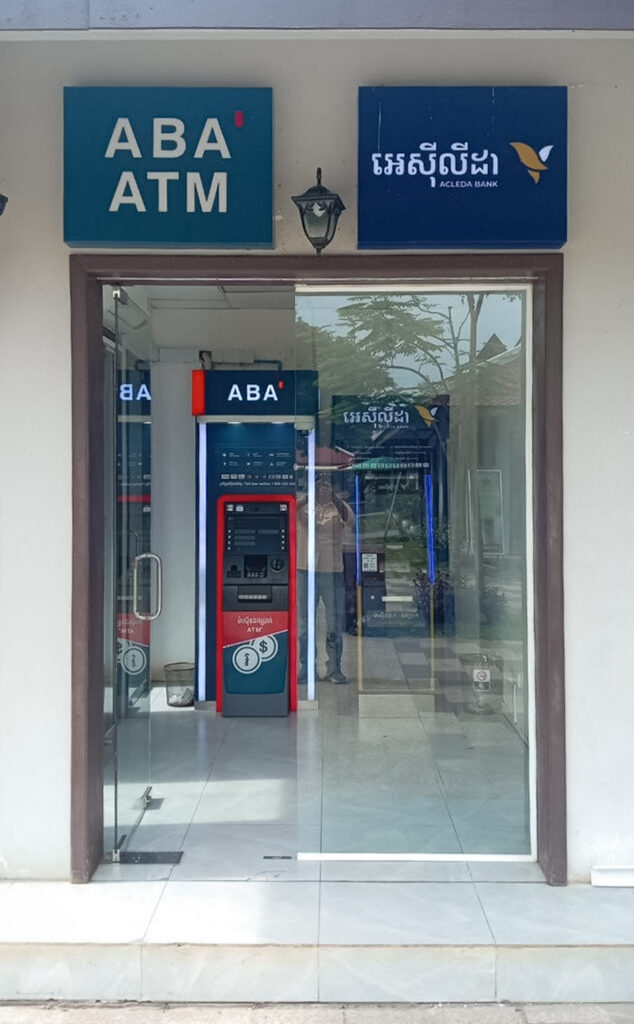
If you’re living in Cambodia or planning a longer stay, getting cash from a local bank account is easy. I use and recommend ABA Bank, which has ATMs across Cambodia and is widely used for local payments.
The bigger question for long-term visitors and expats is how to transfer money from an overseas bank account into Cambodia.
I’ve used several methods over the years, but Wise is currently the easiest option I’ve found personally. I use it to transfer money from my Australian bank account directly to my ABA Bank account in Cambodia. Transfers are usually very quick, often almost instant, and I’ve found the fees relatively low.
Once the money arrives in my ABA account, it’s available for cash withdrawals, card payments and KHQR payments, which are accepted almost everywhere in Cambodia.
If you need to regularly transfer money from overseas to Cambodia, a service such as Wise combined with a local Cambodian bank account is the method I find easiest and most convenient.
Card payments are becoming more common, especially in cities, but cash is still the standard in many places.
For day-to-day spending, it’s best to rely on cash and treat card payments as a backup.
Cambodia’s dual-currency system is easy once you see it in practice:
You don’t need to calculate exchange rates constantly — the system is widely understood and consistent across the country.
When you arrive at Phnom Penh International Airport:
Many travellers choose to withdraw a small amount on arrival and handle the rest later in the city.
If you prefer to avoid dealing with ATMs immediately after a long flight, it’s common to arrange your transport in advance and pay in cash once you arrive at your hotel.
If you prefer to avoid dealing with ATMs immediately after a long flight, many travellers choose to arrange their transport in advance. You can book a Phnom Penh airport transfer with a fixed price and pay in cash once you arrive, making the process much simpler after landing.
For more options, including private cars and transfers across Cambodia, you can also explore services through Connect Cambodia’s Phnom Penh airport transfer service.
At Siem Reap Angkor International Airport, accessing cash is generally straightforward, but it’s still helpful to know what to expect after landing.
Many travellers withdraw a small amount on arrival for immediate expenses such as transport, food, or tips, and then organise the rest once they’re settled in the city.
If you’d prefer to avoid using ATMs straight away after a long journey, it’s common to arrange your transport in advance. Booking a Siem Reap airport transfer with a fixed price allows you to go directly to your hotel and pay in cash on arrival, making the process much smoother after landing.
For most travellers, US dollars are the simplest and most practical currency to use in Cambodia. Cambodian riel plays a supporting role for smaller transactions, but you don’t need to plan heavily around it.
As long as you arrive with some usable USD or access to an ATM, you’ll be able to manage easily throughout your trip.