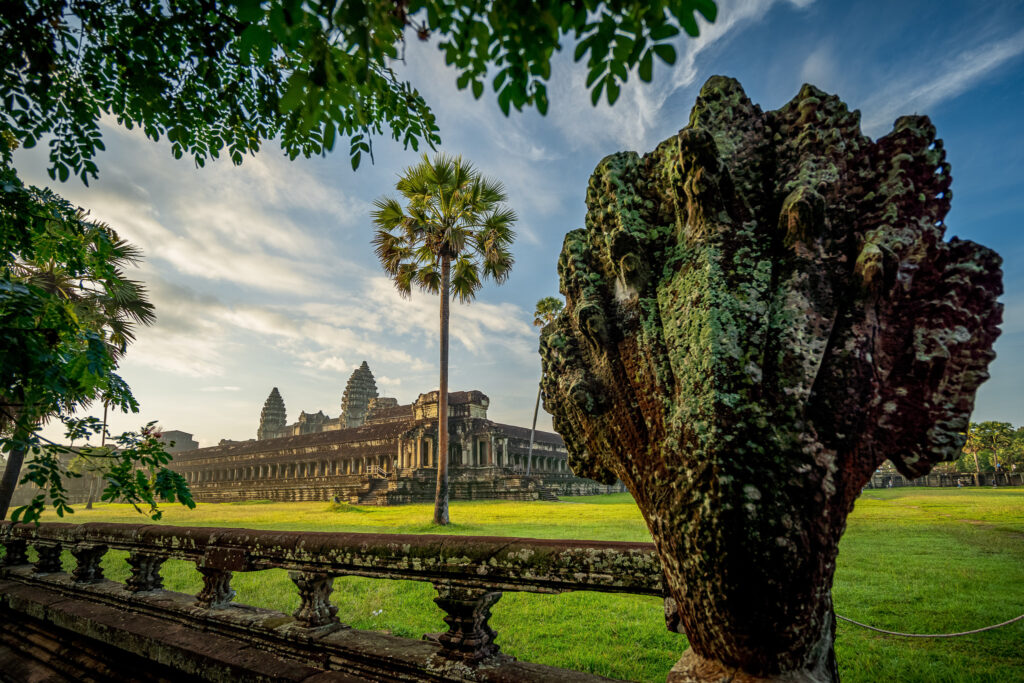
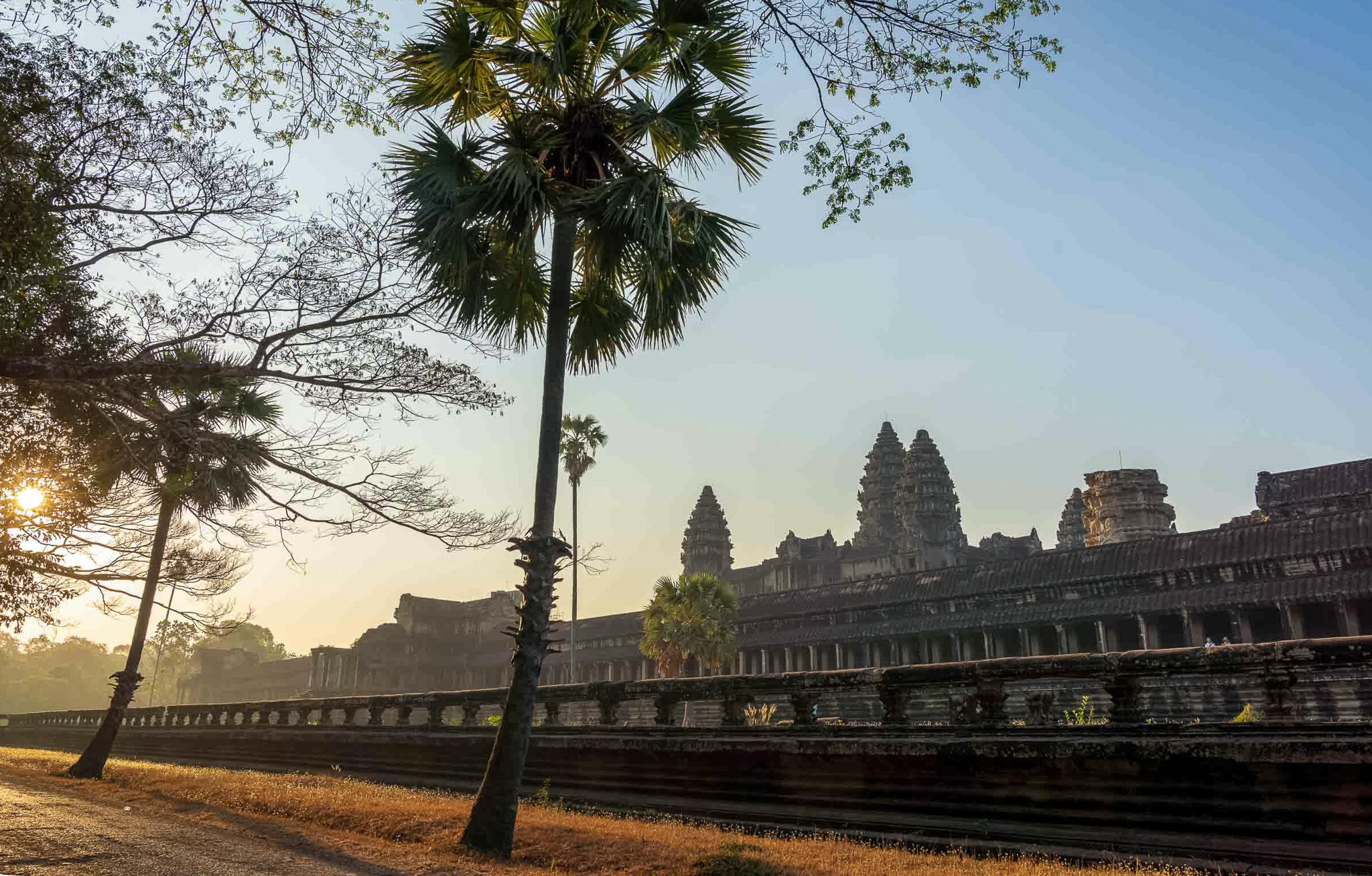
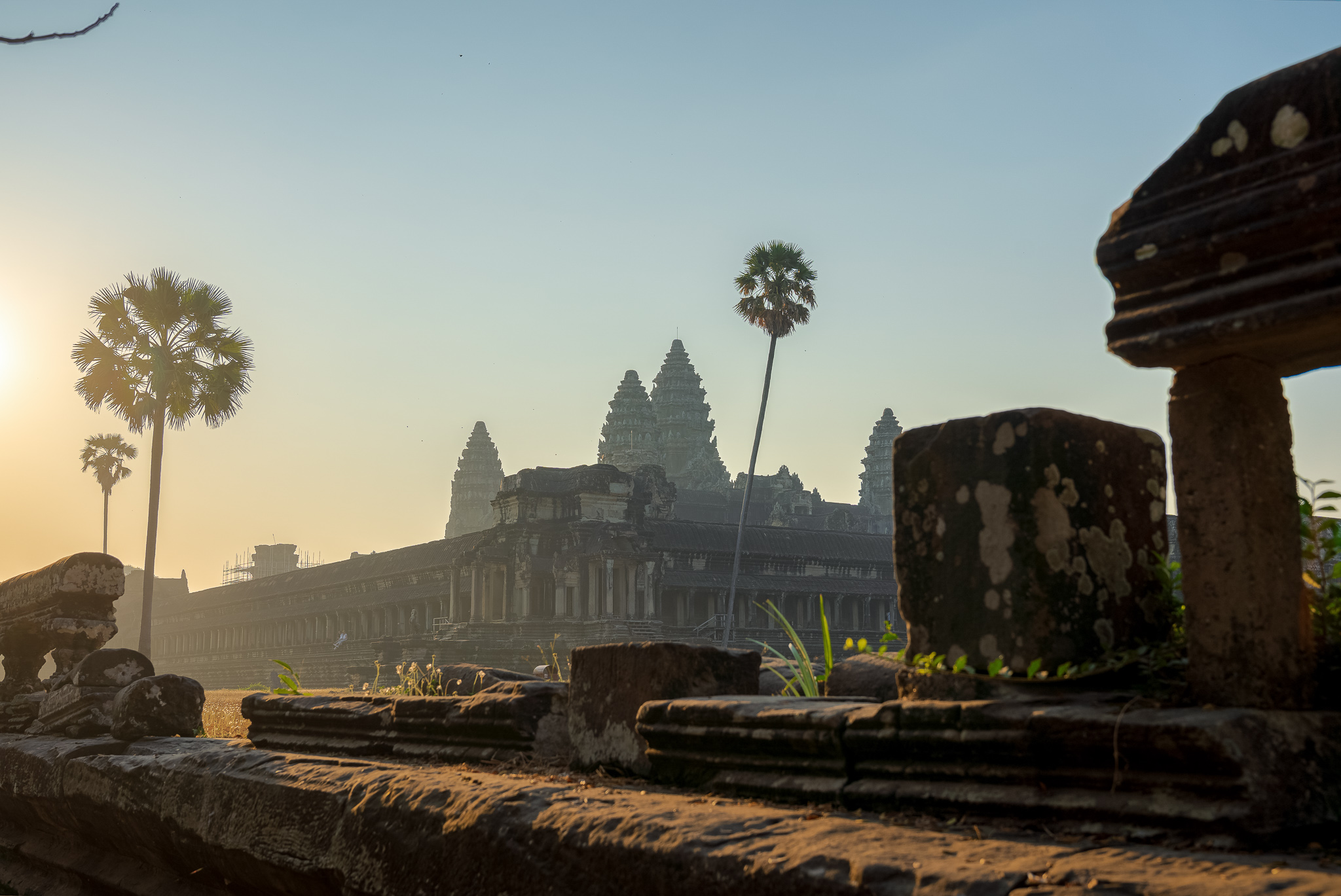
Angkor Wat Guide: Everything You Need to Plan Your Visit
Visiting Angkor Wat for the first time can leave you with a lot of questions. Much of the information you come across is out of date, inaccurate, or contradicts what you’ve read somewhere else.
This guide is built from first-hand, on-the-ground knowledge of Angkor Archaeological Park, Siem Reap, and everything you need to plan your visit. We continually update it with information from local certified tour guides, residents and photographers. Our aim is to make it the most comprehensive and useful guide to Angkor Wat and the wider Angkor Archaeological Park you’ll find.
Table of Contents
Angkor Wat: the largest religious monument in the world
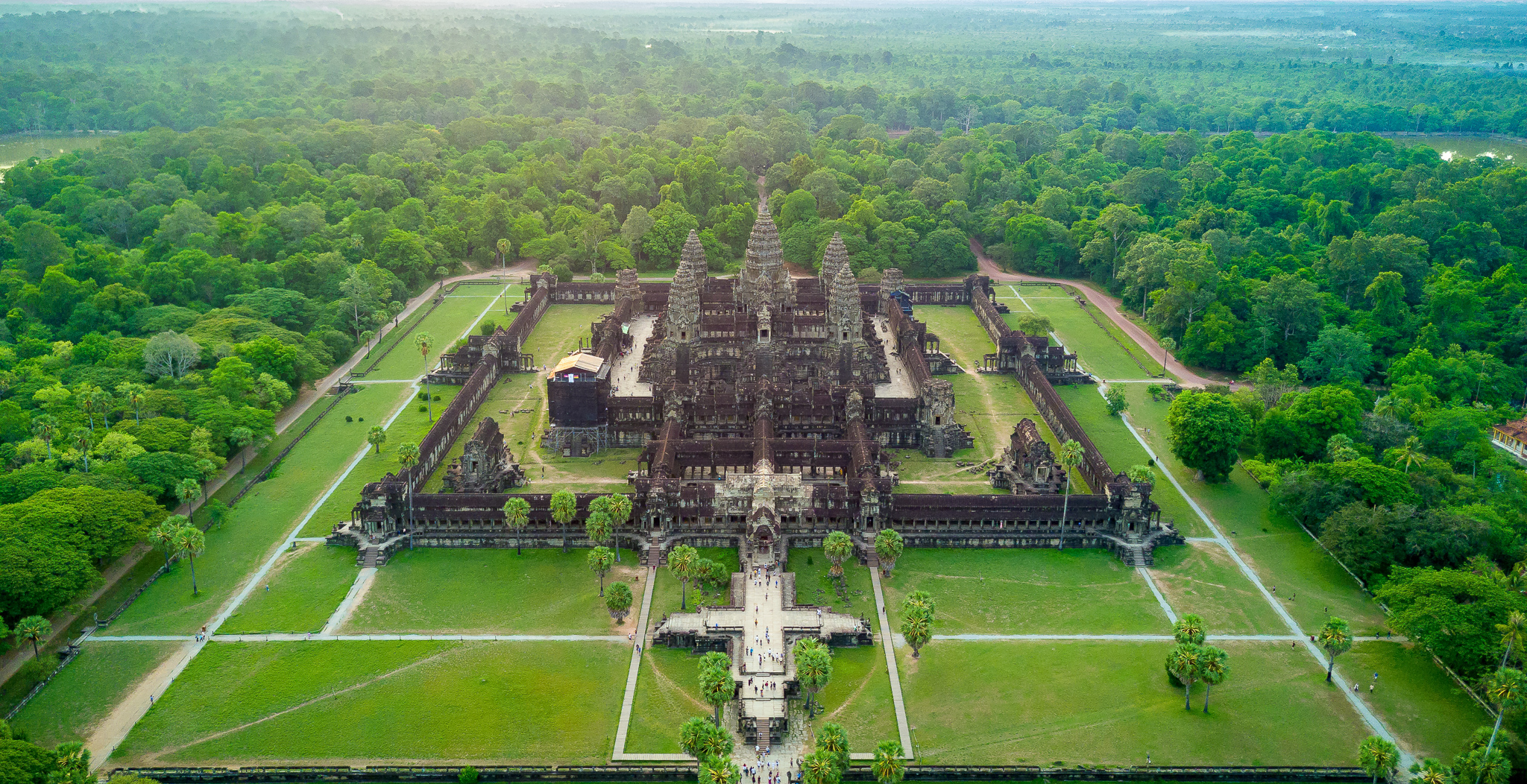
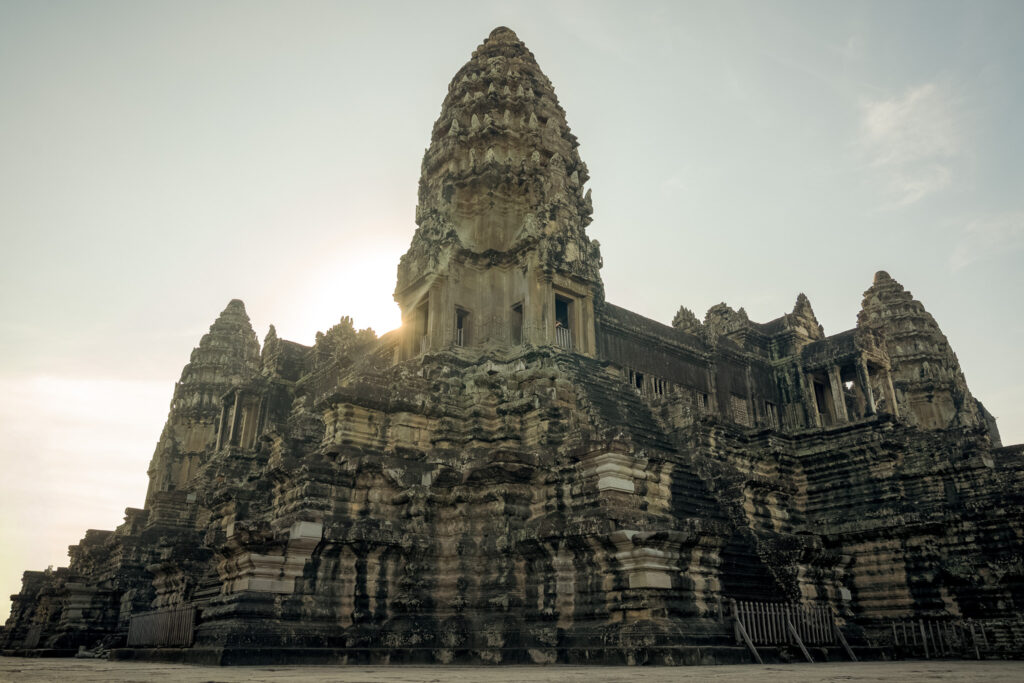
Angkor Wat is not just Cambodia’s most famous temple. It is the largest religious monument in the world, covering around 162 hectares (400 acres), and one of the greatest surviving achievements of the Khmer Empire.
Angkor Wat itself is just one part of a much larger historic area known as Angkor Archaeological Park. The park covers around 400 square kilometres and contains the remains of the ancient Khmer capital and dozens of temples and archaeological sites, including Angkor Wat, Angkor Thom, Bayon and Ta Prohm. When people talk about visiting “Angkor”, they are referring to this much wider area, not just Angkor Wat.
Built in the early 12th century during the reign of King Suryavarman II, Angkor Wat was originally a Hindu temple dedicated to Vishnu. It later became a Buddhist temple and remains an active place of worship today.
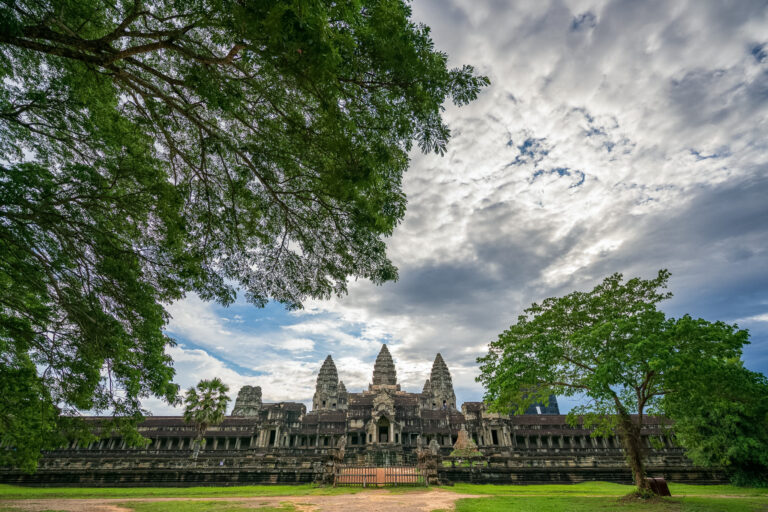
The scale of Angkor Wat is difficult to understand from photographs. A huge moat surrounds the complex, followed by long causeways, galleries covered with intricate bas-reliefs, courtyards and the famous five towers at its centre. The towers represent Mount Meru, the sacred mountain at the centre of the universe in Hindu cosmology, while the surrounding architecture forms part of a much larger symbolic landscape.
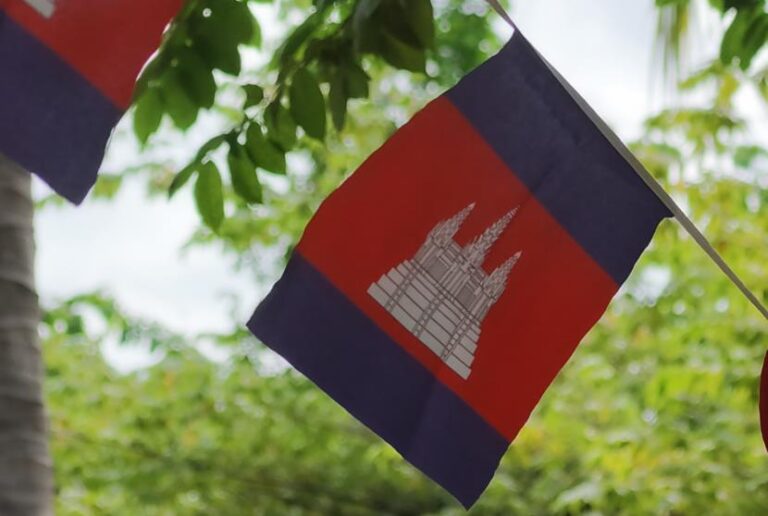
The Cambodian flag features Angkor Wat at its center.
Angkor Wat has also become a powerful symbol of Cambodia itself. Its distinctive towers appear on the Cambodian national flag, and the temple has survived centuries of political, religious and social change to become the country’s best-known cultural landmark.
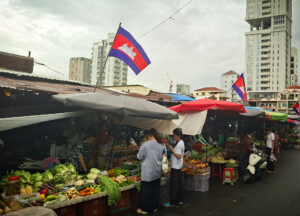
Angkor Wat on flag at a market in Phnom Penh
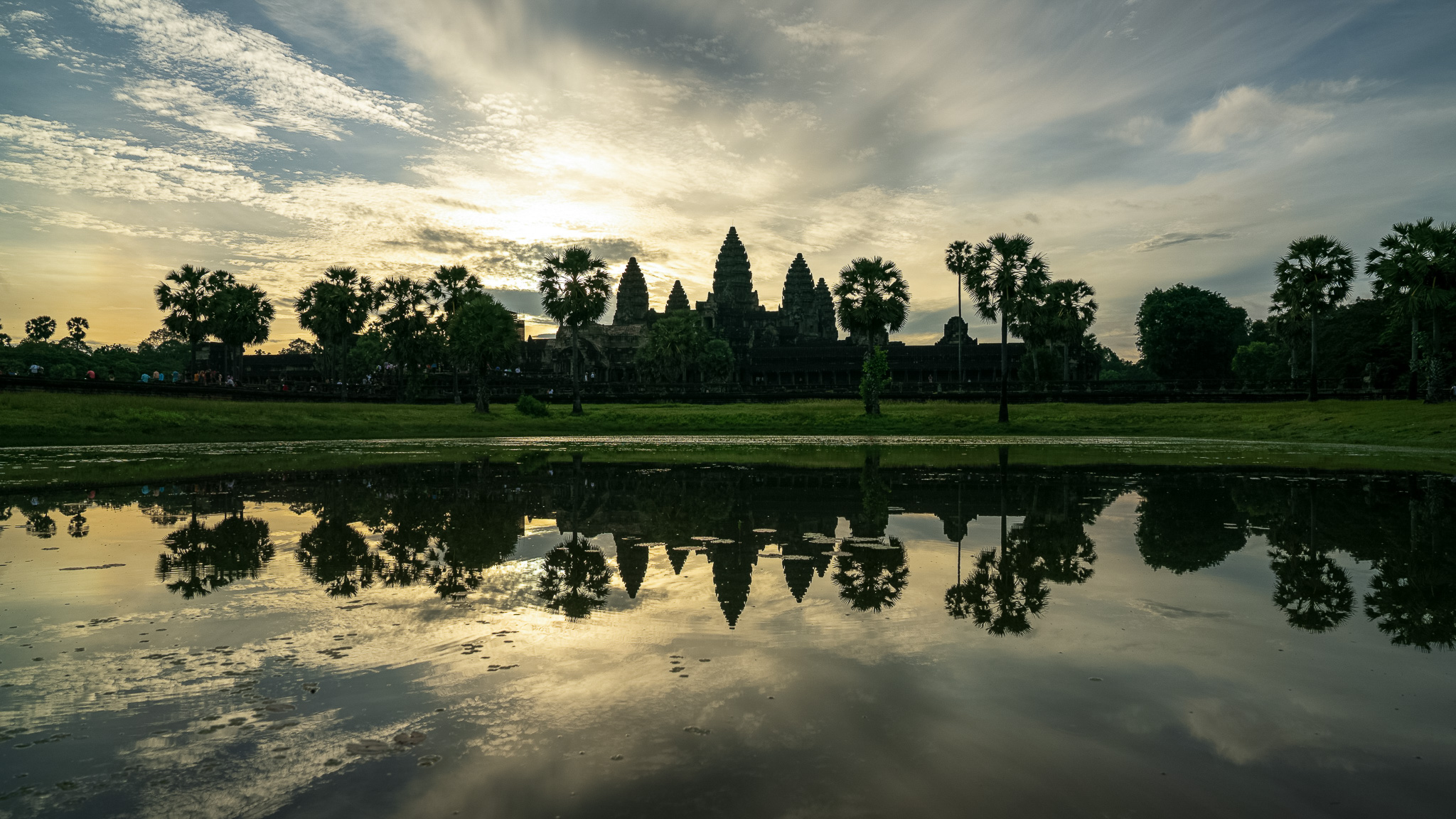
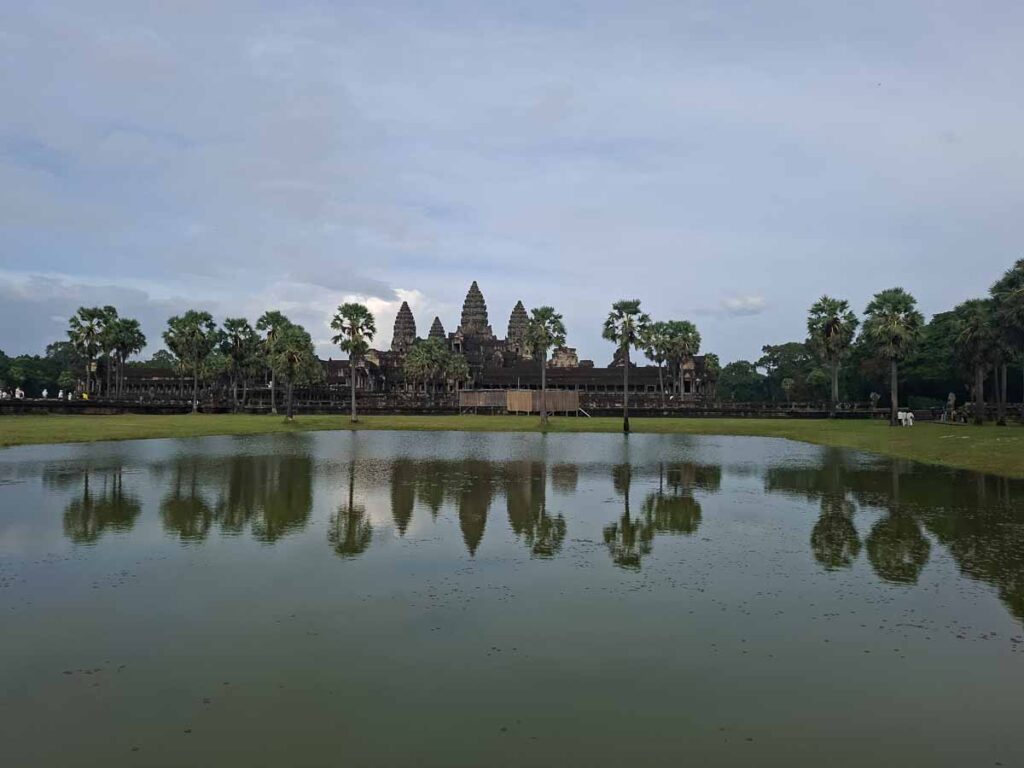
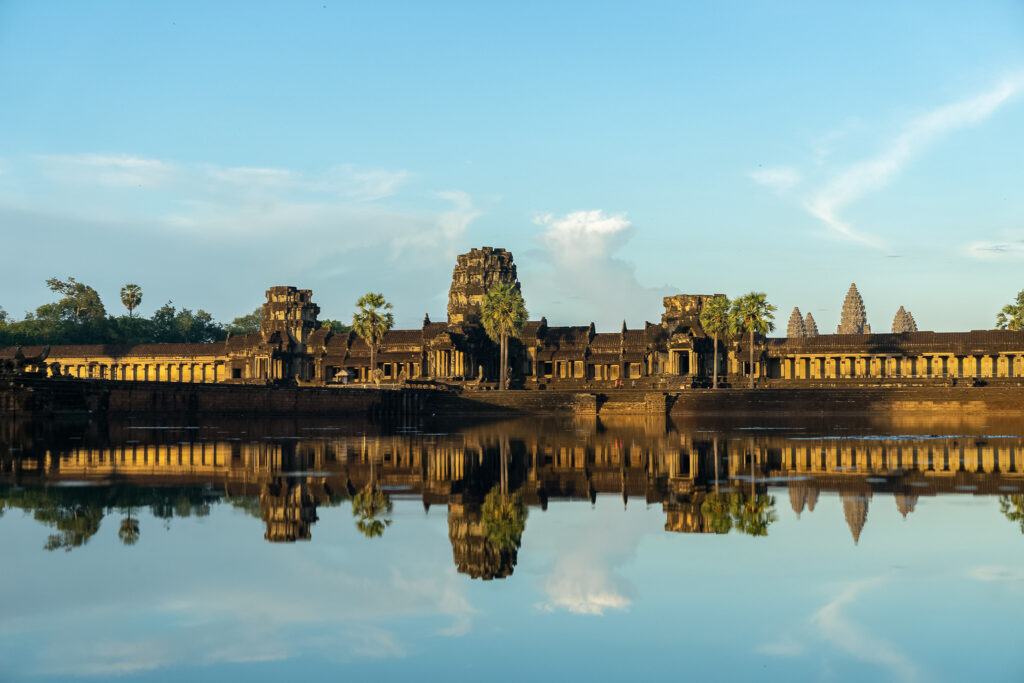
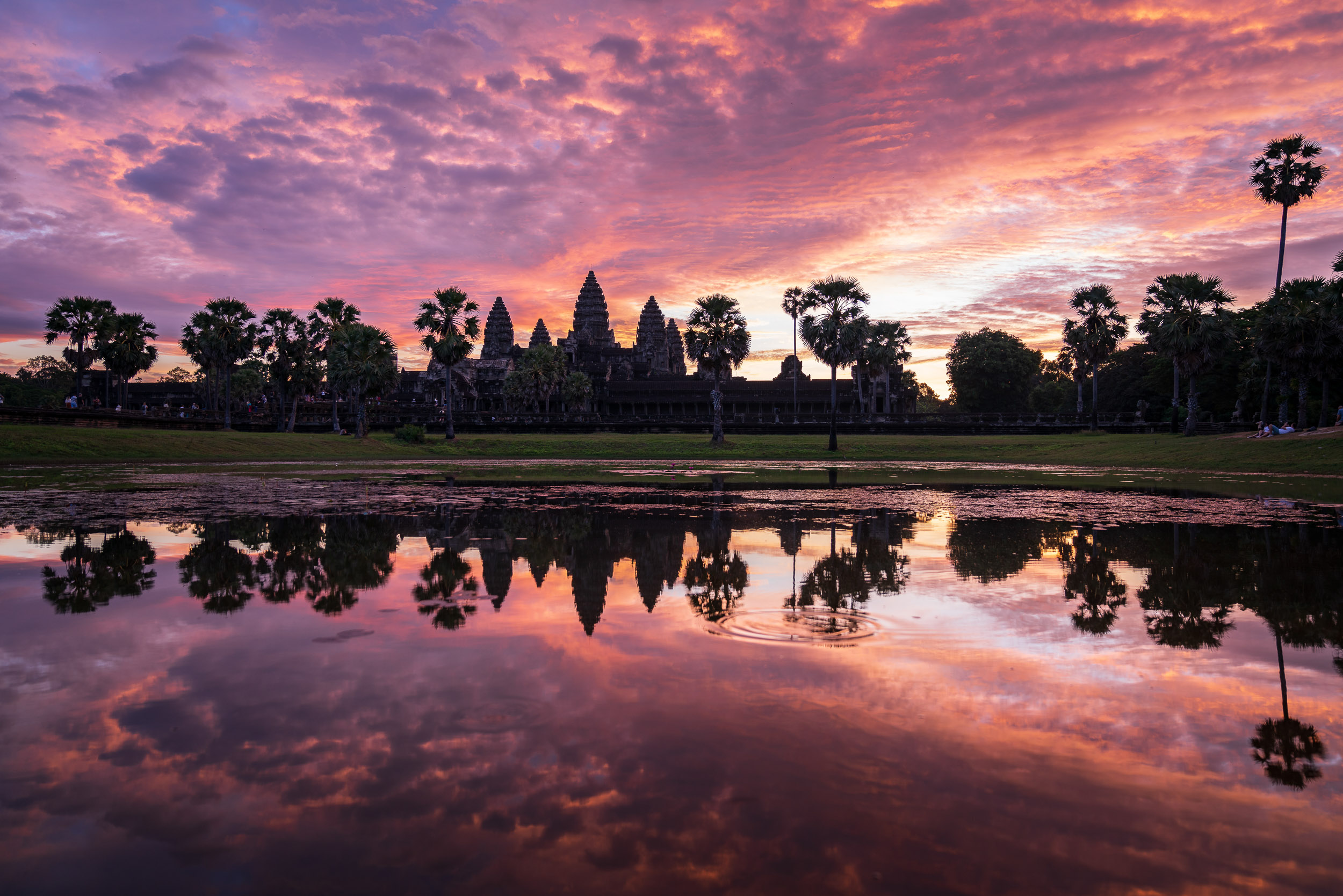
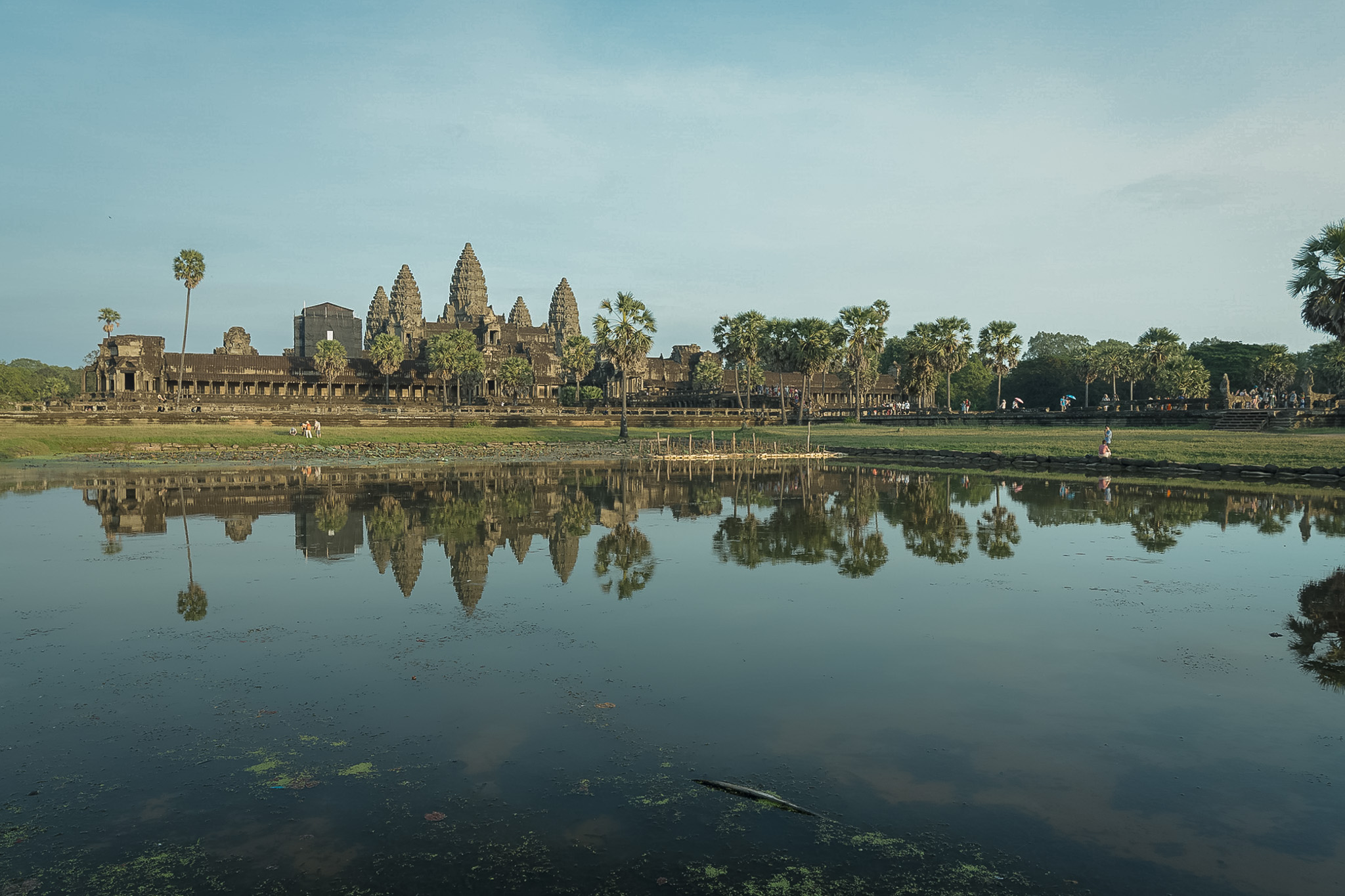
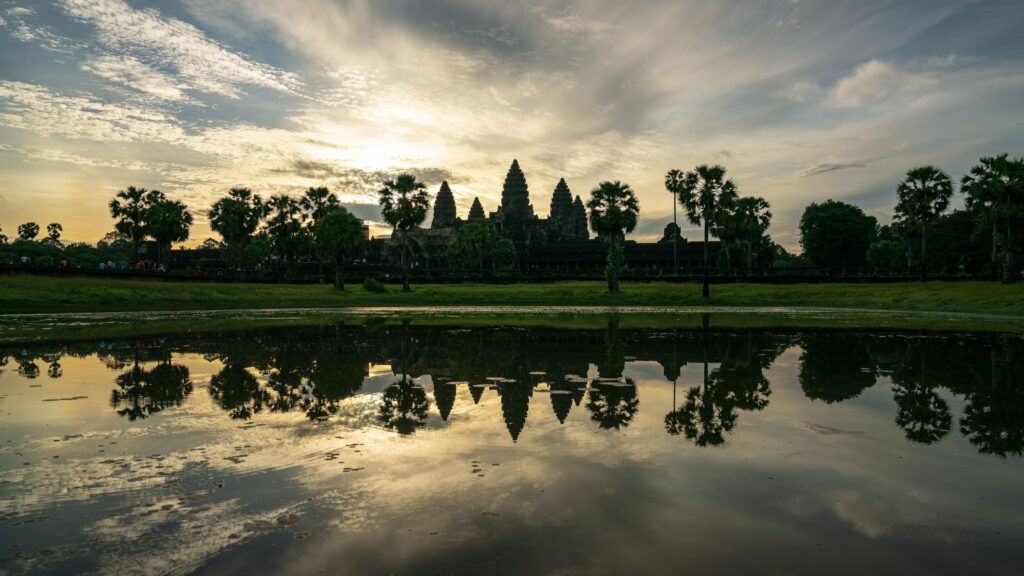
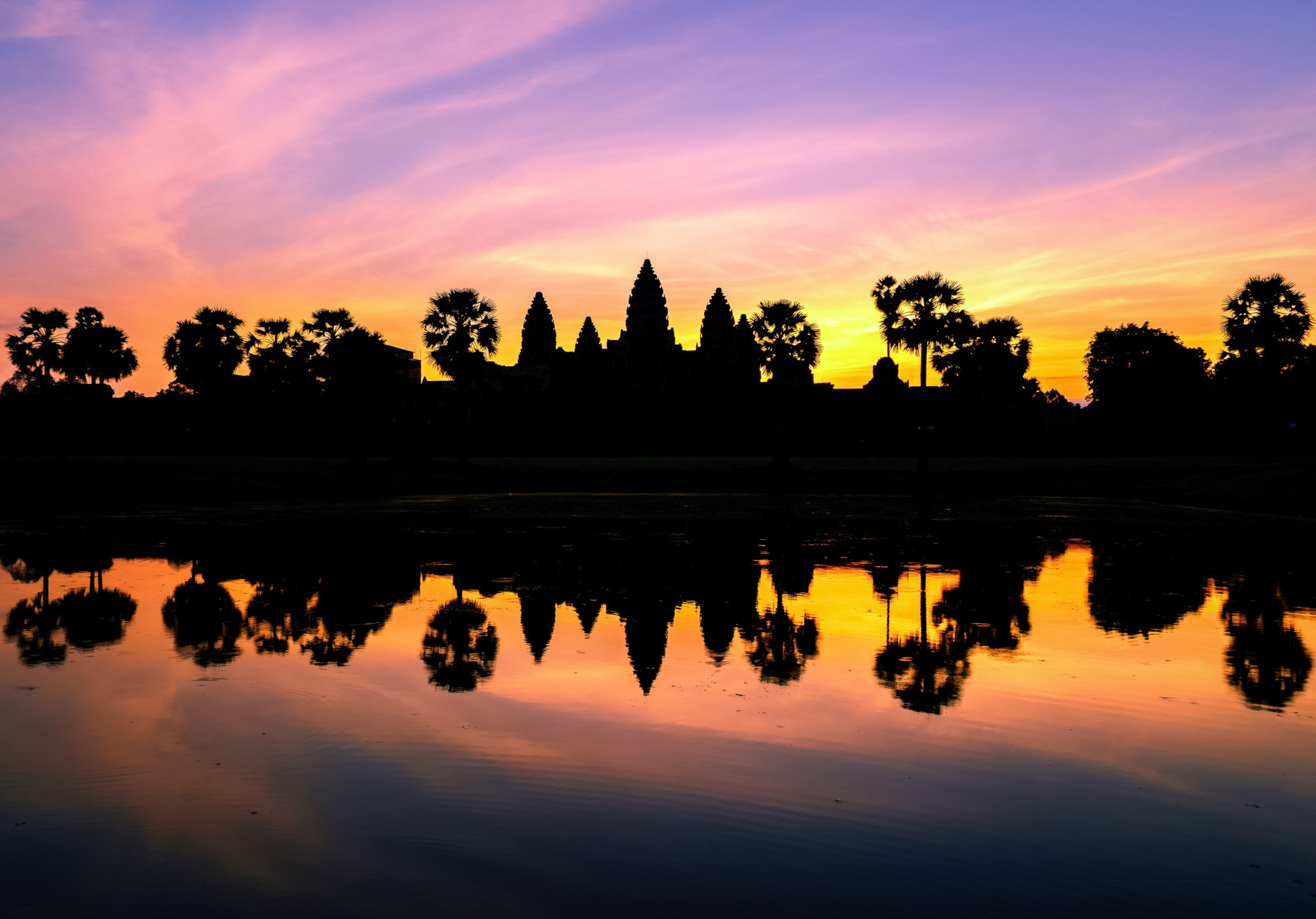
For most visitors, the classic view across the reflecting ponds at sunrise is their first impression of Angkor Wat. But that view is only a small part of the experience. Once you enter the temple itself, there is far more to explore than you might expect from seeing Angkor Wat from the outside.
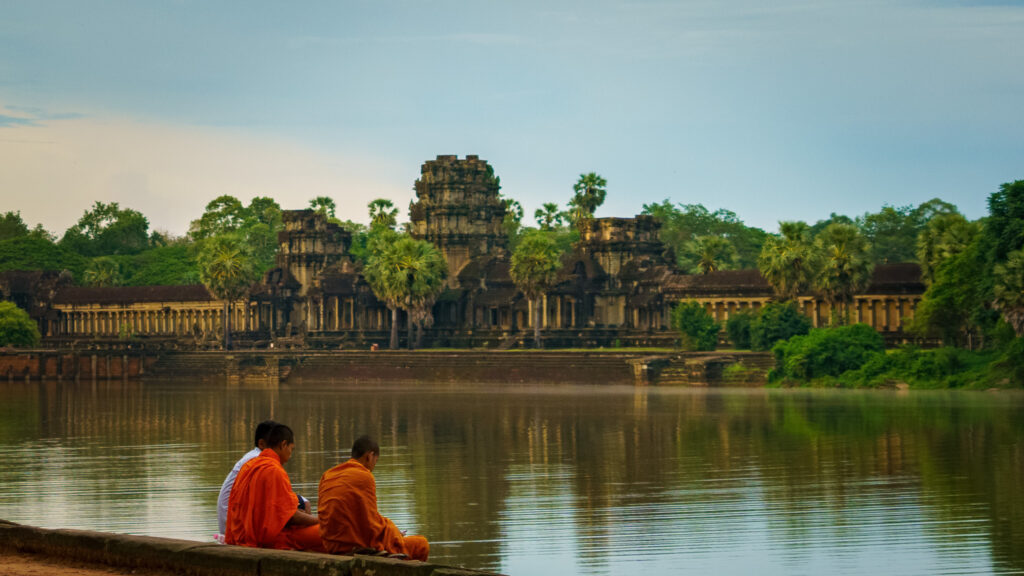
Angkor Wat Sunrise with reflection
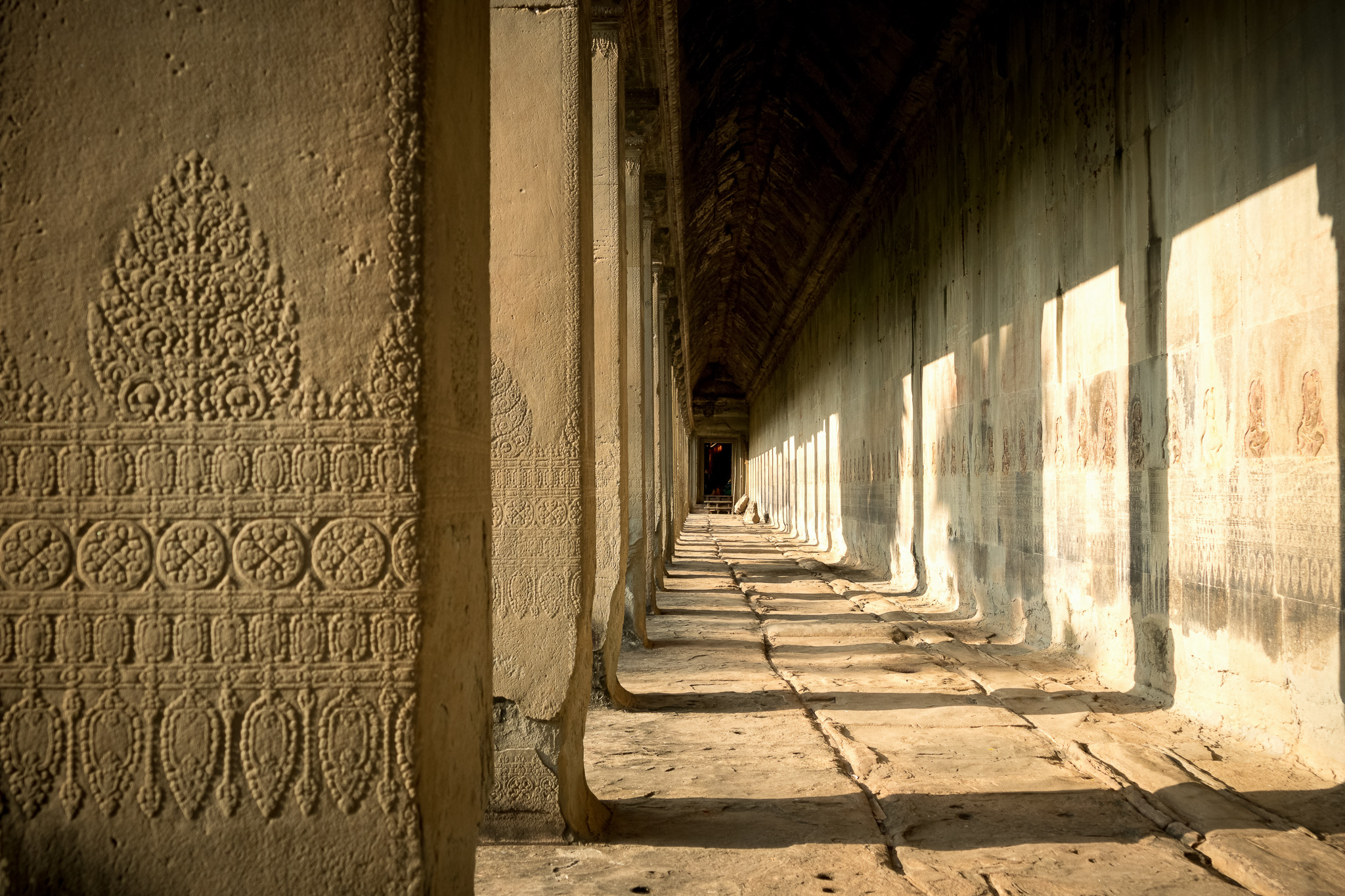
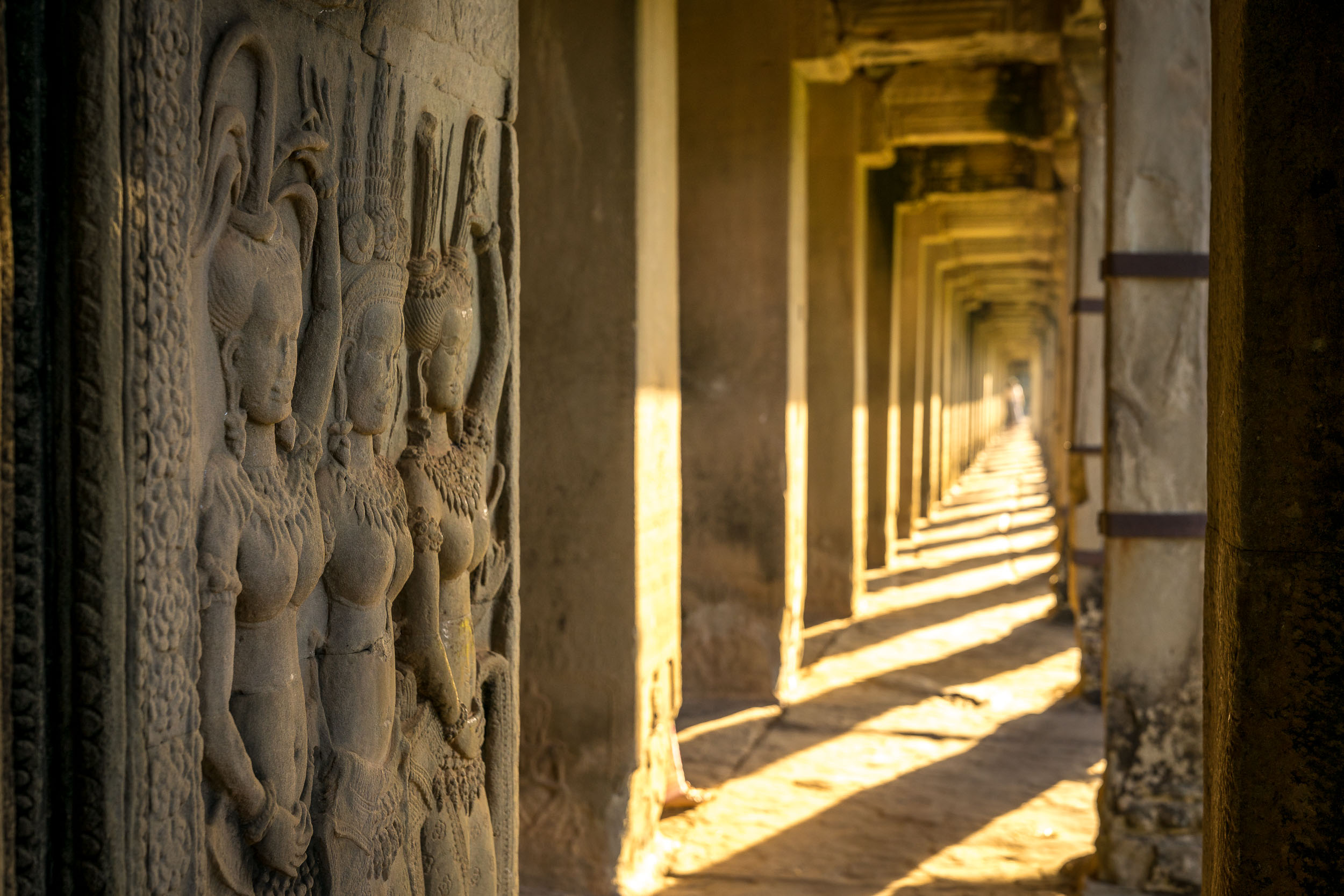
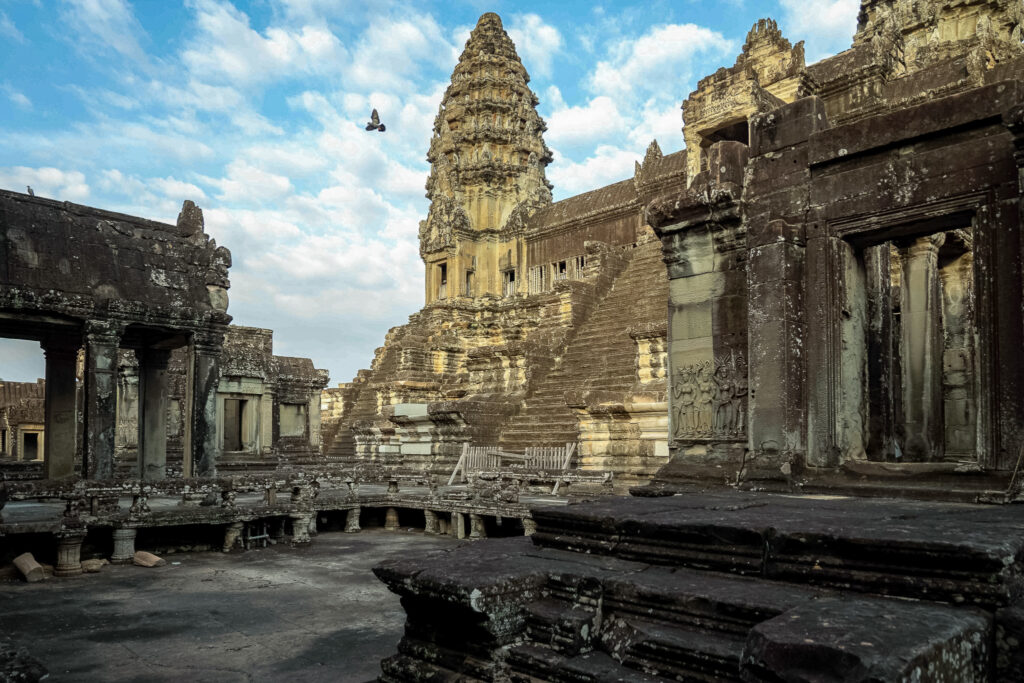
Walking through the galleries and seeing the stonework up close is just as important as seeing the famous exterior views. The long corridors, columns and covered galleries are full of details that are easy to walk past if you’re in a hurry. Even after countless visits, we still find new details and parts of Angkor Wat we had previously missed.
Detailed carvings on each column in a corridor in Angkor Wat
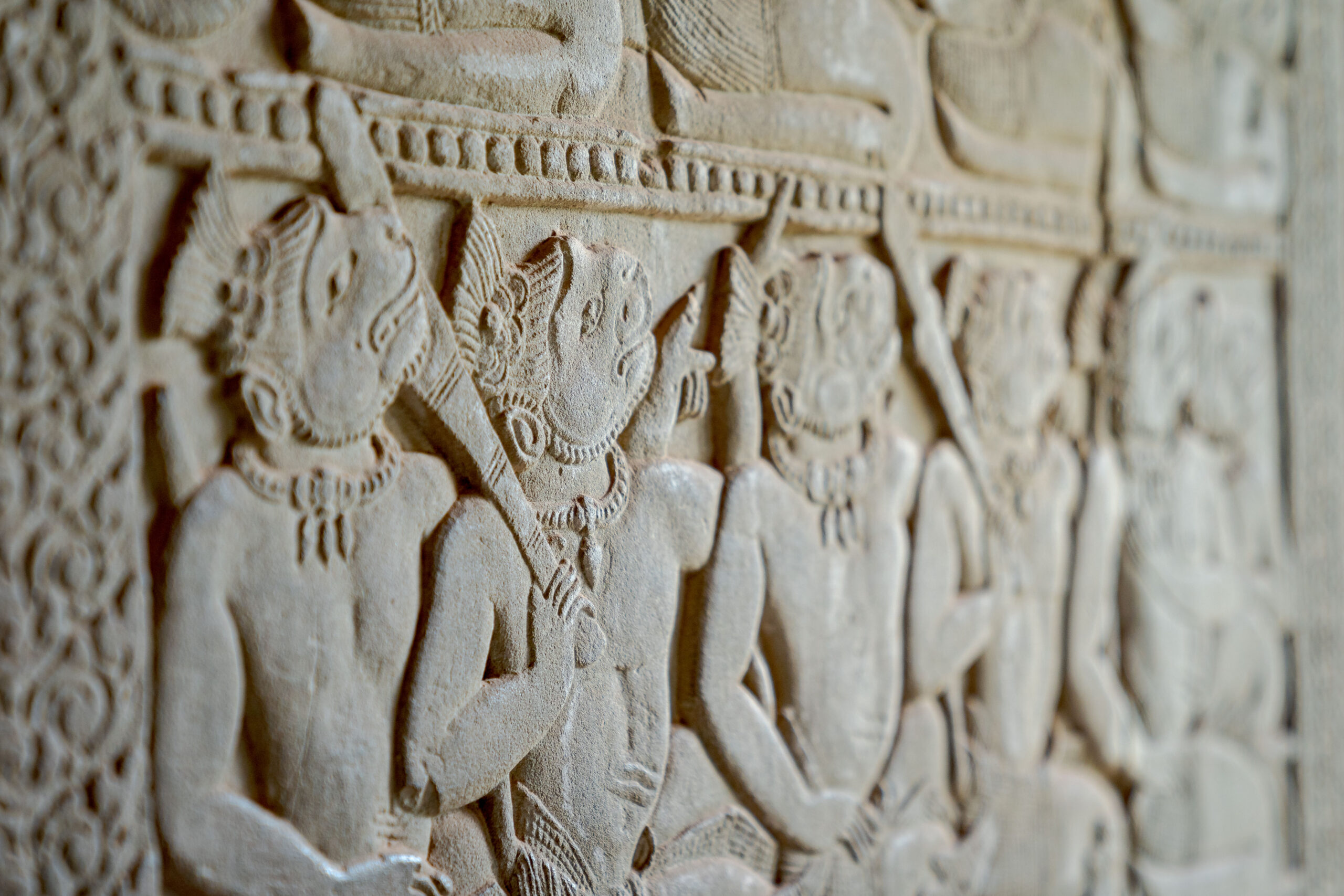
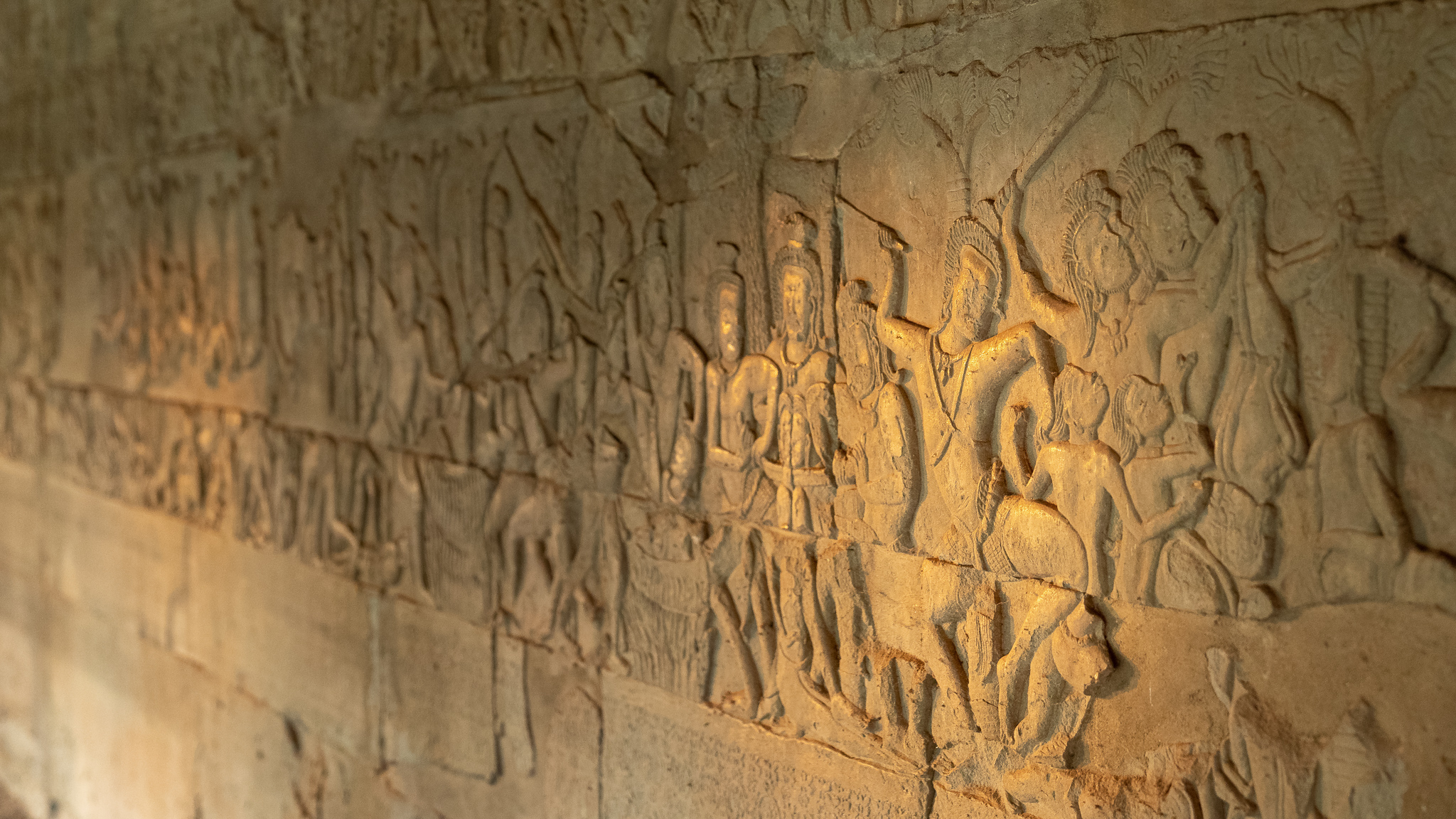
Some of the most interesting parts of Angkor Wat are found in the carvings and smaller architectural details throughout the temple. The walls tell stories through huge bas-reliefs, while doorways, columns and individual sections contain much smaller details. Taking your time to look around reveals far more of Angkor Wat, with something new to notice as you move through each part of the temple.
Sandstone bas-relief carving of figures at Angkor Wat, Cambodia
The more we learn about Angkor Wat, the more interesting it becomes. Look beyond the sandstone and you begin to notice the laterite beneath it. Learn how the temple was built, and that raises even bigger questions. How did they achieve this more than 800 years ago? What happened to the civilisation that built it?
The more you understand before you visit, the more there is to see when you get there.
Getting to Angkor Wat from Abroad
For international visitors, Siem Reap is the gateway to Angkor Wat. The temples are only a short distance from the city, so most travellers arrive in Siem Reap, stay in the city, and travel out to Angkor each day.
Most international flights arrive at Siem Reap Angkor International Airport (SAI), which replaced the old airport close to the city in 2023. One important thing to know when planning your arrival is that SAI is around 45–50 km from central Siem Reap, so the journey into town typically takes about an hour.
There are direct international flights to Siem Reap from several cities in Asia, while many travellers connect through regional hubs such as Bangkok, Singapore, Kuala Lumpur or Ho Chi Minh City. Another common option is to fly into Phnom Penh and continue to Siem Reap by domestic flight, private car or bus, though this is not our recommendation as flying into Siem Reap is more straightforward.
Once you reach Siem Reap, things become much easier. Angkor Wat is approximately 6 km north of central Siem Reap, and most hotels, restaurants and tourist services are based in the city rather than around the Angkor temples themselves.
You do not need to stay beside Angkor Wat. For almost everyone, the practical choice is to stay in Siem Reap and visit the Angkor temples from there.
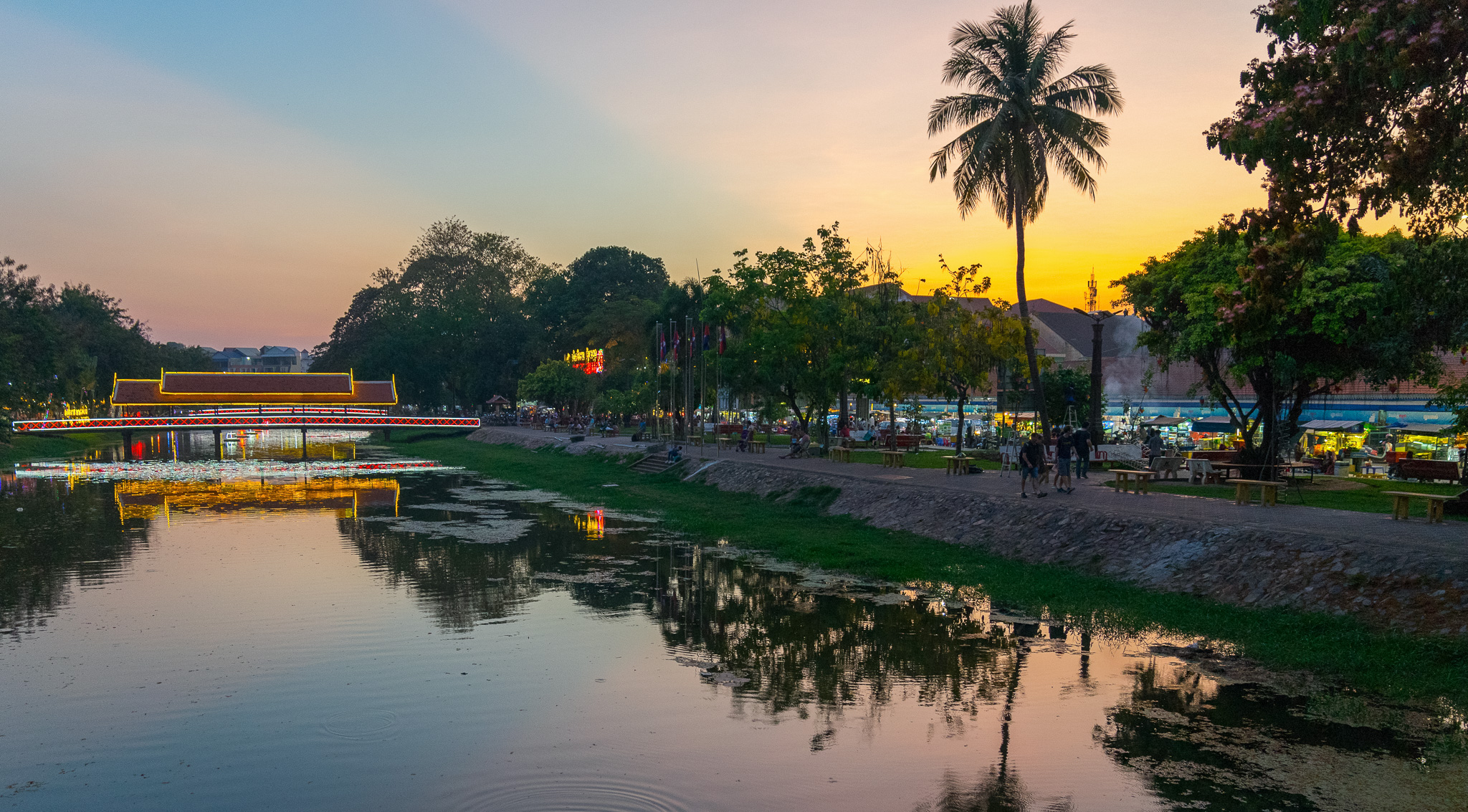
Siem Reap is a beautiful town with a character of its own. People come here because of Angkor Wat, but the city has developed an identity beyond the temples, with boutique shops, local artisans and an excellent range of restaurants and cafés. There is some genuinely great food here, from inexpensive Khmer restaurants and street food to some of Cambodia’s best restaurants.
Is Siem Reap Safe?
Absolutely. People generally feel very safe in Cambodia, and Siem Reap in particular is a welcoming and friendly place for visitors. As anywhere, normal common-sense precautions apply, but safety should not be a major concern when planning a visit to Siem Reap or Angkor Wat.
Angkor Wat visitor information
Location
Angkor Wat is approximately 5–6 km / 3–4 miles north of central Siem Reap, inside the Angkor Archaeological Park.
Travel time
Allow around 20–40 minutes from most hotels in Siem Reap, depending on your location, traffic and mode of transport. Journey times can be slightly longer around sunrise when large numbers of visitors are travelling towards Angkor Wat at the same time.
Tuk tuks and private cars are widely available, while an organised tour normally includes transport between Angkor Wat and the other temples on your itinerary.
Opening hours
Angkor Wat is open 5:00 AM–6:30 PM, allowing visitors to enter before sunrise. Some individual areas within the temple have different access times, so arriving at 5:00 AM does not mean that every part of Angkor Wat is immediately accessible.
If you’re visiting for sunrise, arrive early enough to walk from the entrance to your chosen sunrise position before first light.
Early morning offers cooler temperatures, although sunrise is one of Angkor Wat’s busiest periods. The crowds often begin to thin after the main sunrise rush, so staying to explore the temple afterwards can work well.
Late afternoon is another good option, particularly if you’ve already experienced sunrise on another day. The middle of the day is generally hotter, but can sometimes be useful if avoiding peak visitor periods is more important to you.
Time needed to visit
Allow around 2–3 hours to explore Angkor Wat itself. If you’re visiting Angkor Wat as part of the Small Circuit, allow at least half a day, with a full day giving you considerably more time at the other temples.
Combine Angkor Wat tour with
Angkor Wat is commonly visited with Angkor Thom, Bayon and Ta Prohm on the Small Circuit, one of the most popular routes through the Angkor Archaeological Park.
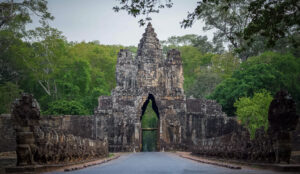
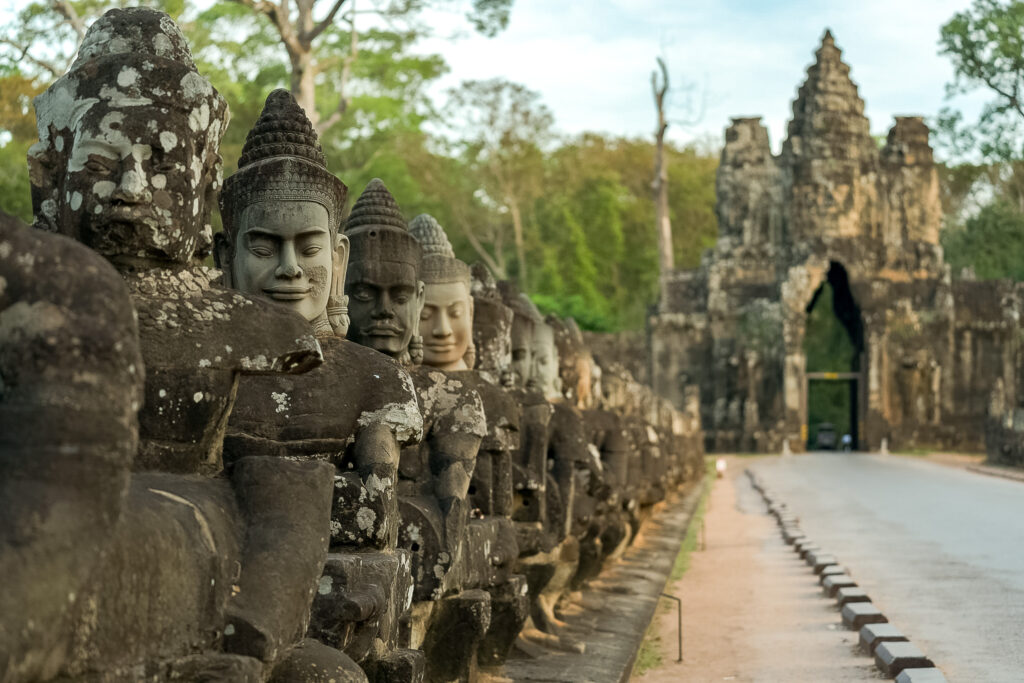
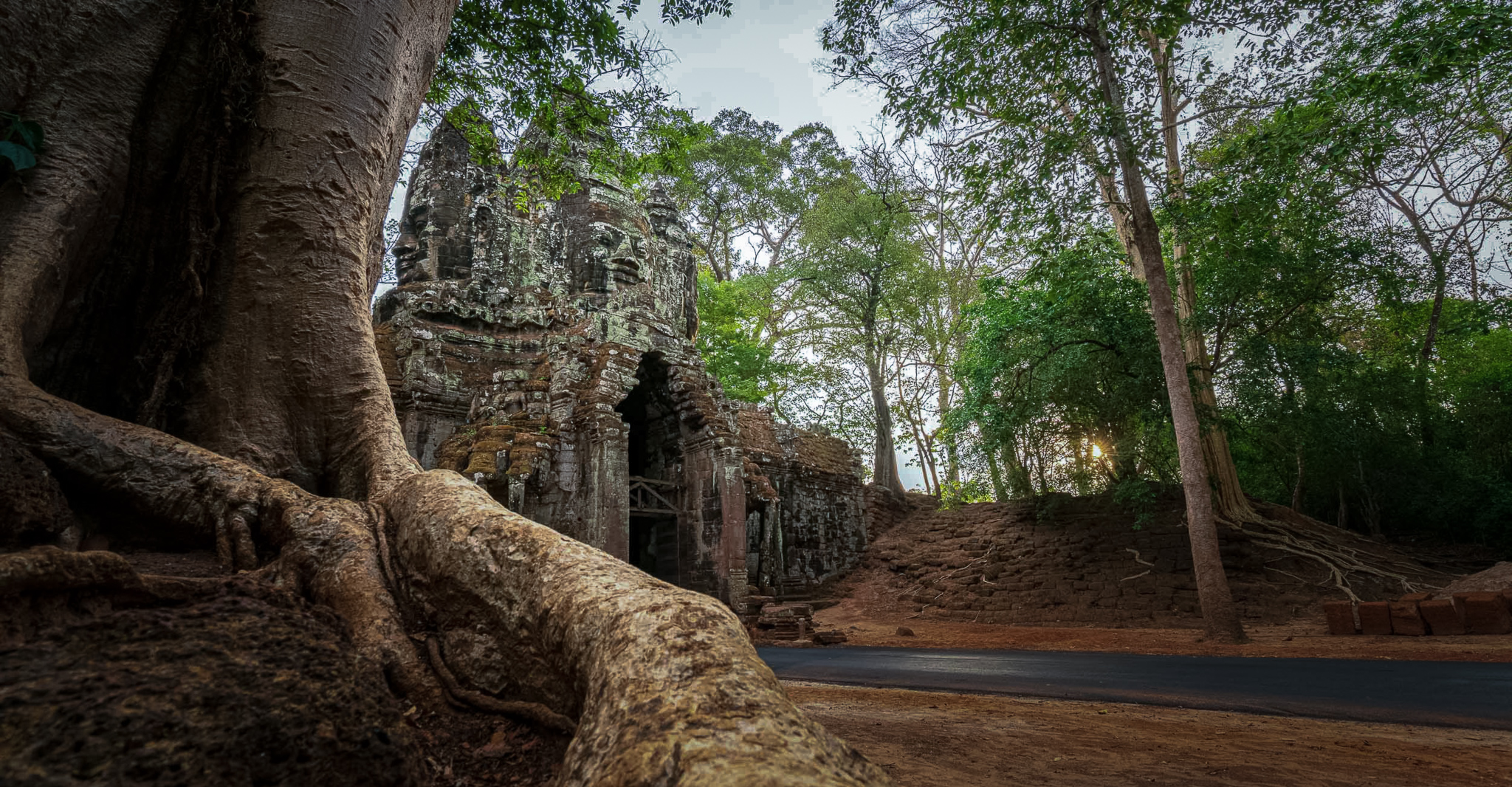
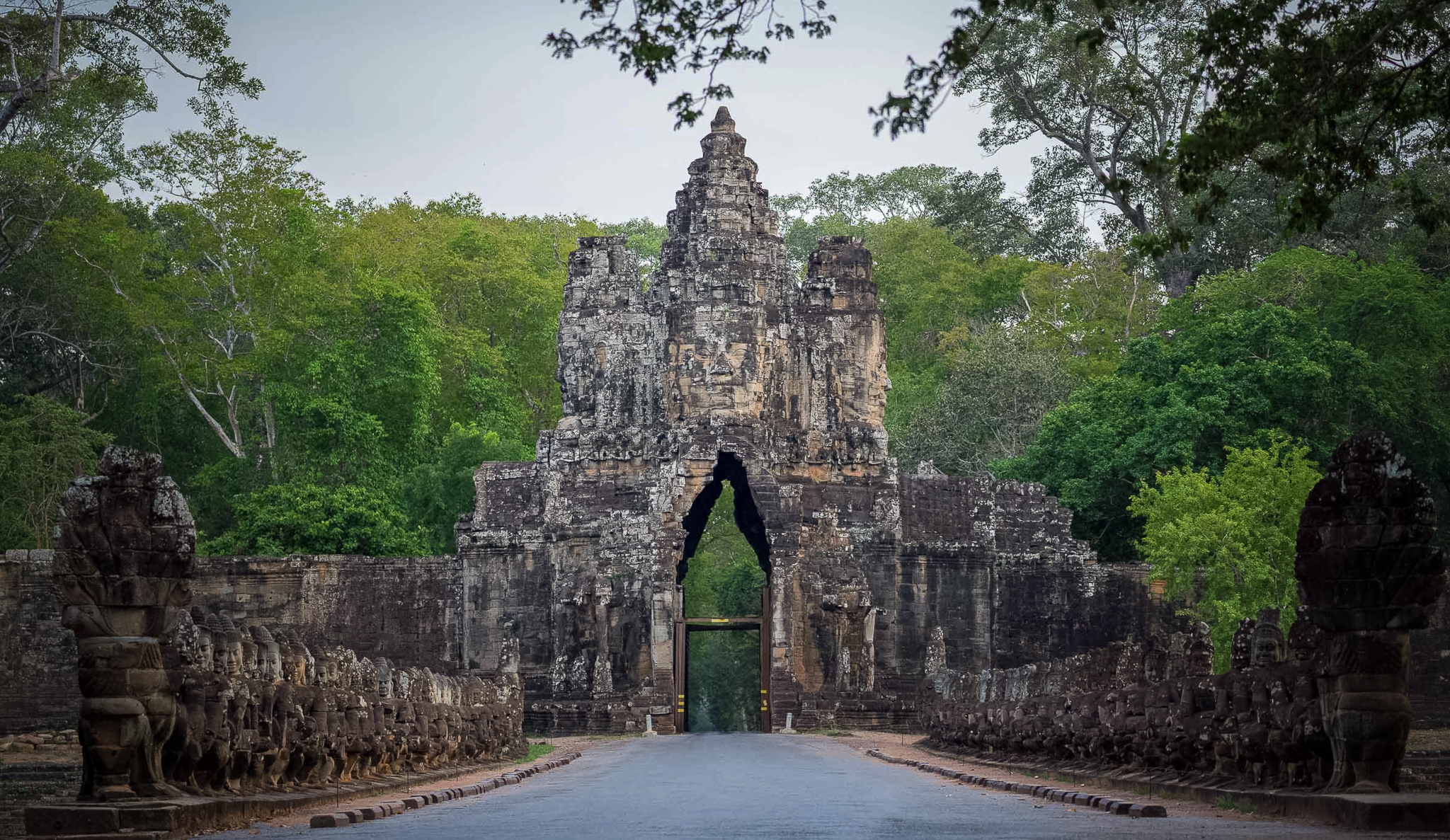
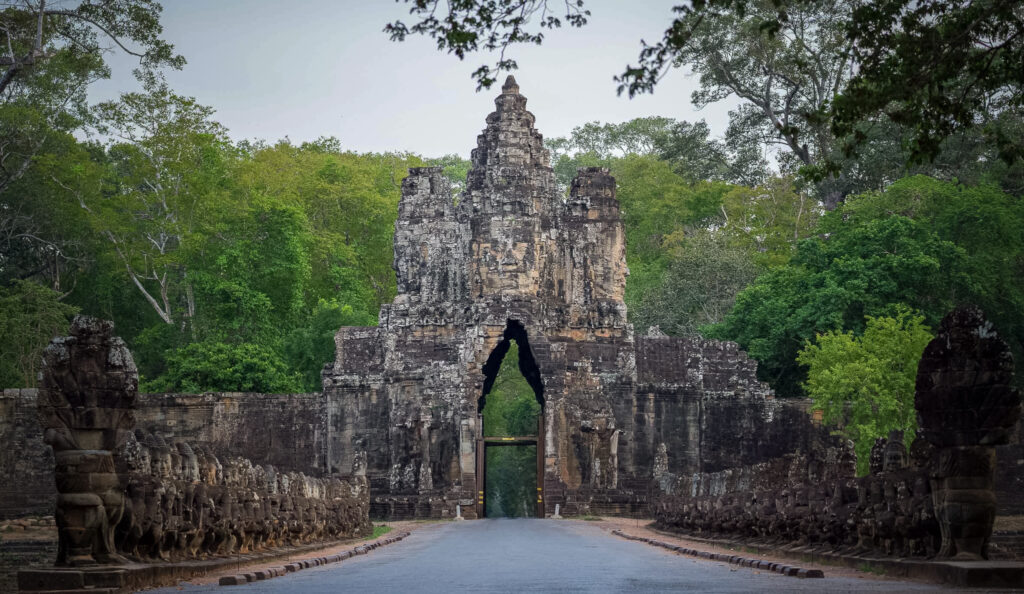
The South Gate of Angkor Thom
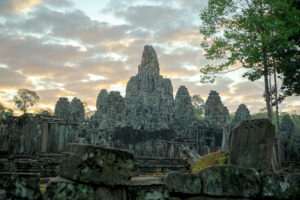
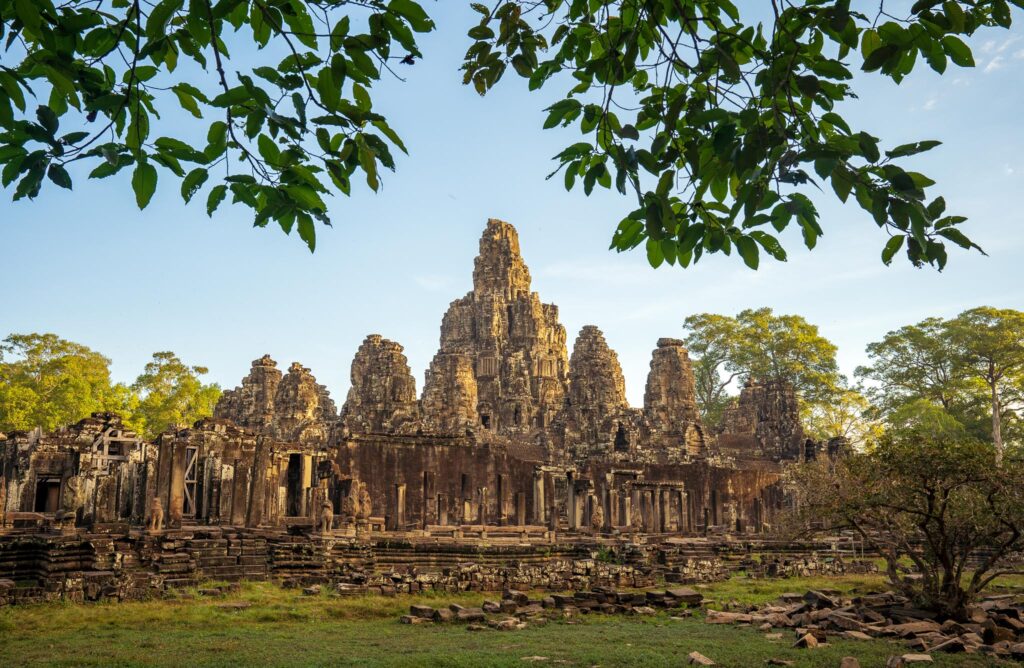
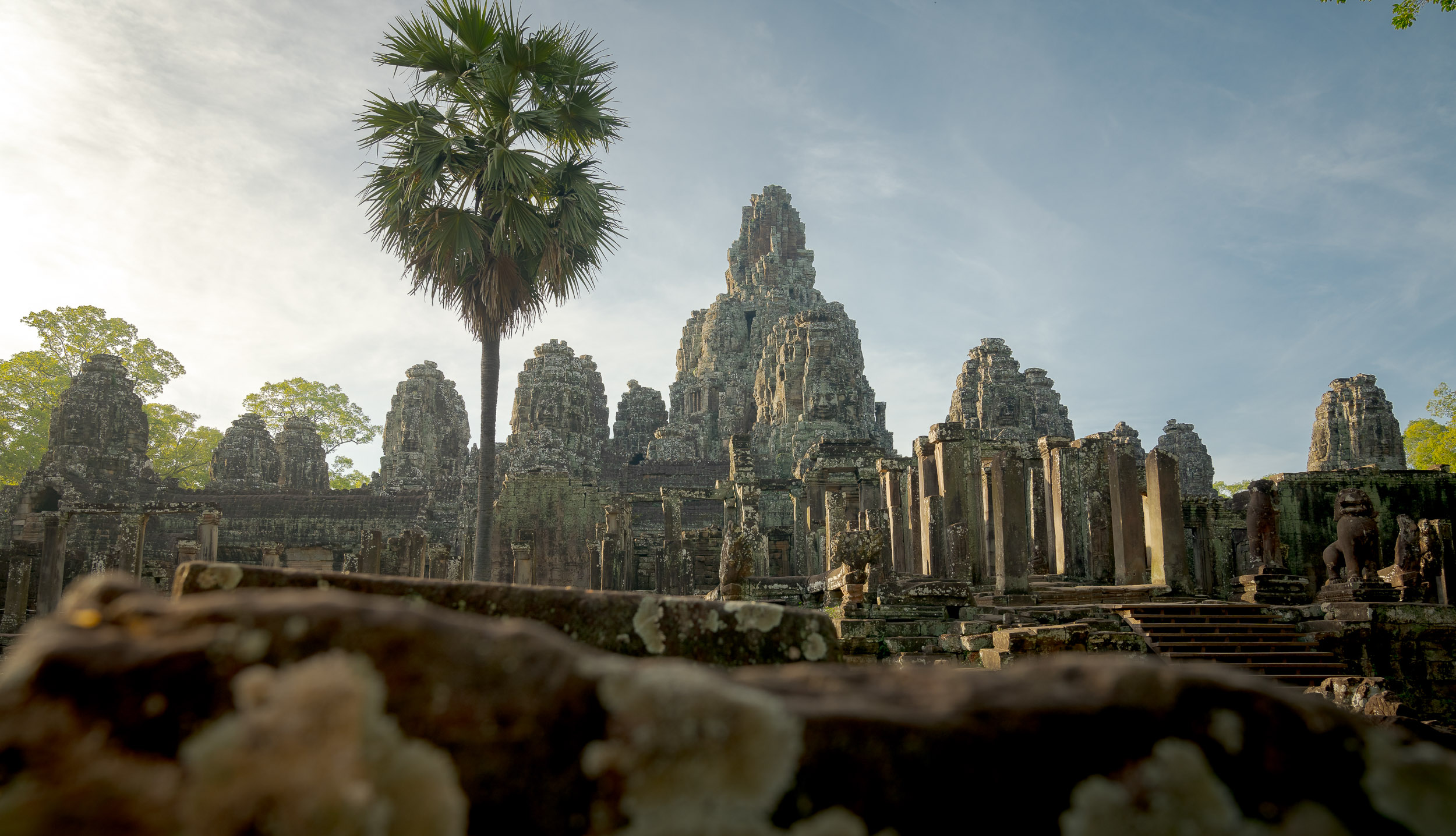
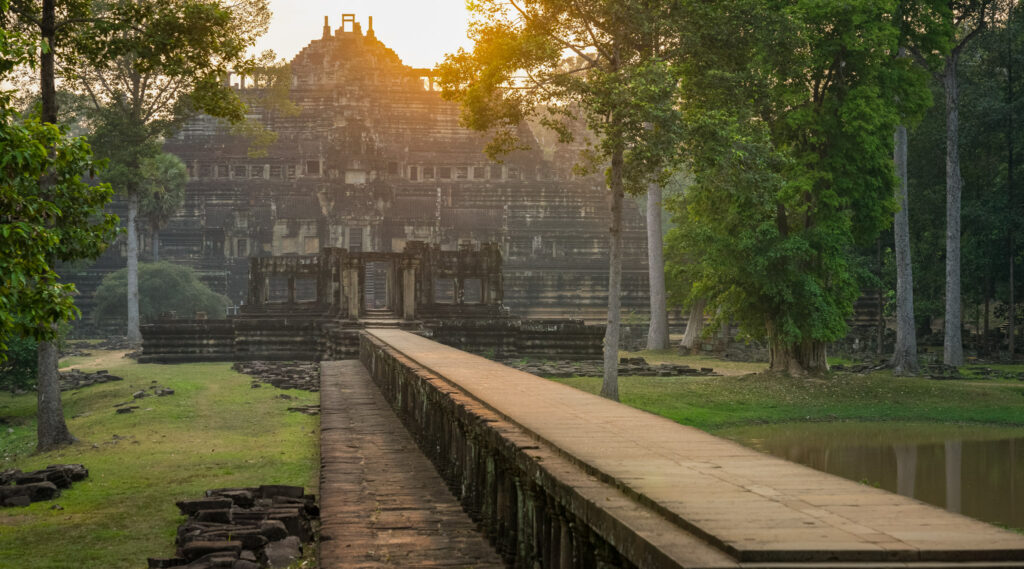
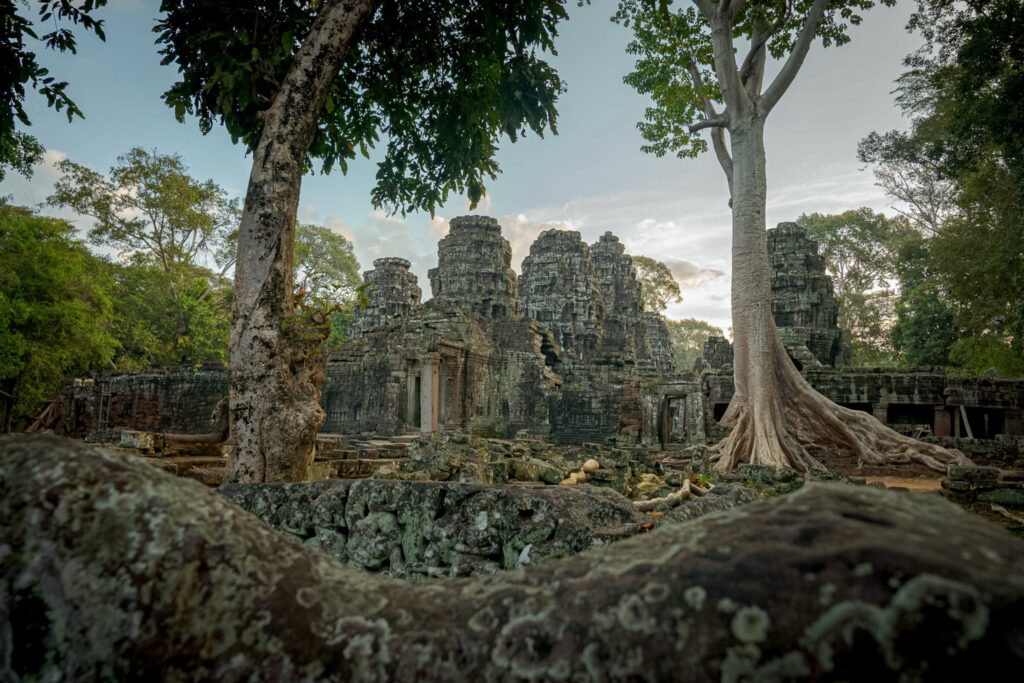
Bayon temple
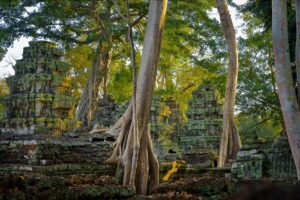
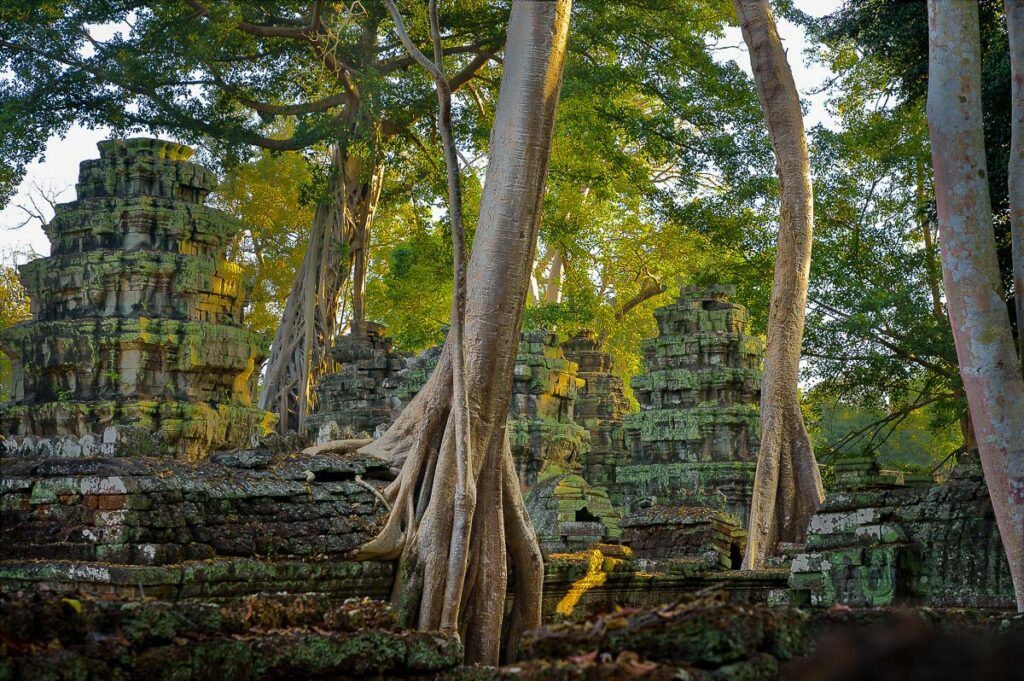
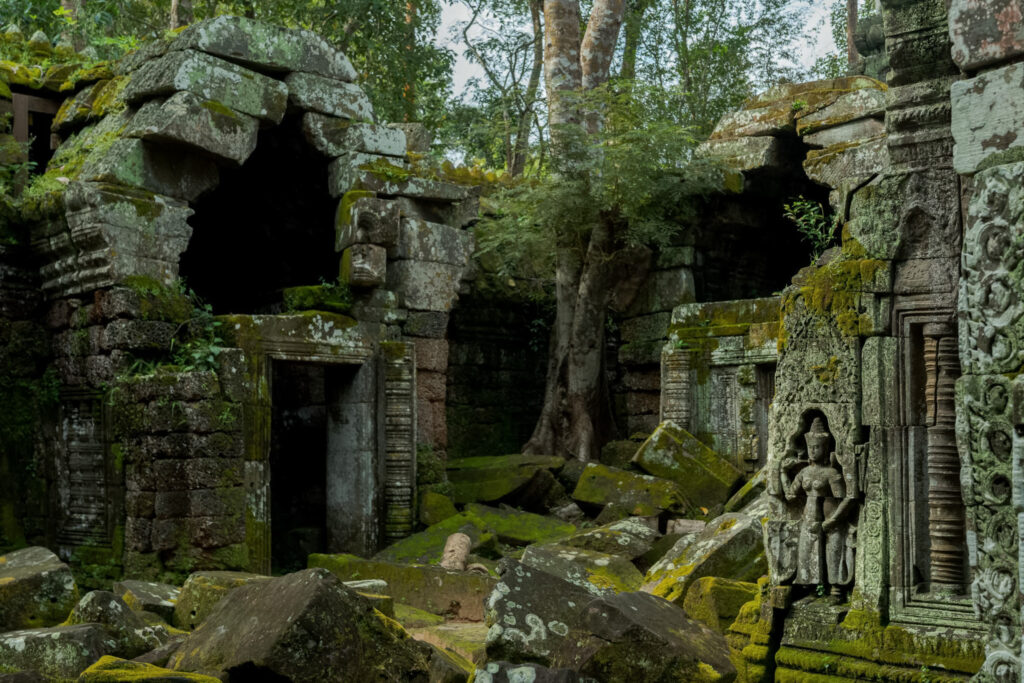
Ta prohm temple
There are other temples included on the popular small circuit route.
Getting there
Angkor Wat is around 5–6 km north of central Siem Reap and is easy to reach by tuk tuk, moto, private car, bicycle or organised tour. From most hotels in Siem Reap, allow around 20–40 minutes, depending on your location, traffic and mode of transport.
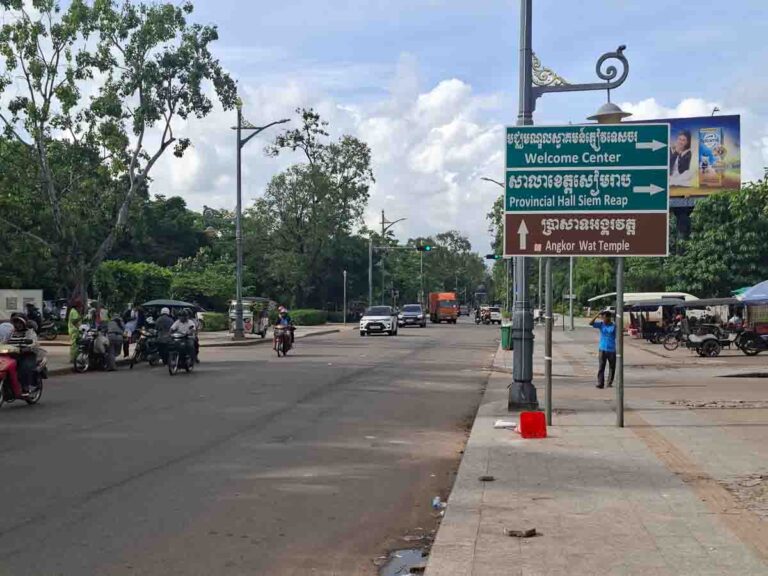
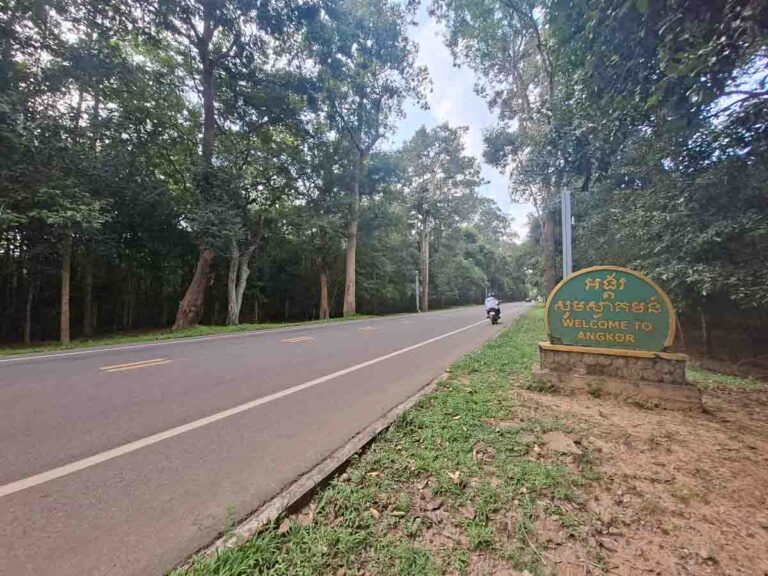
Road signs directing visitors towards Angkor Wat in Siem Reap, Cambodia
The main route north from Siem Reap follows Preah Sihanouk Avenue, formerly known as Charles de Gaulle Boulevard, towards the Angkor Archaeological Park and Angkor Wat. You may still see the former road name used on older maps and travel information.
Road to Angkor Wat through the Angkor Archaeological Park
If you’re visiting Angkor Wat for sunrise, allow additional time for the early-morning journey, ticket checks and the walk from the vehicle drop-off area to your chosen sunrise location.
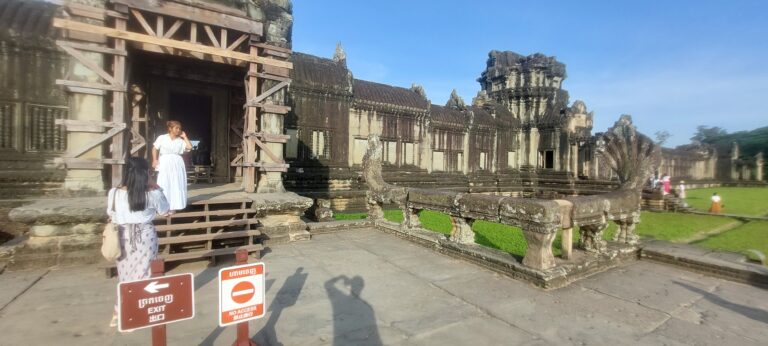
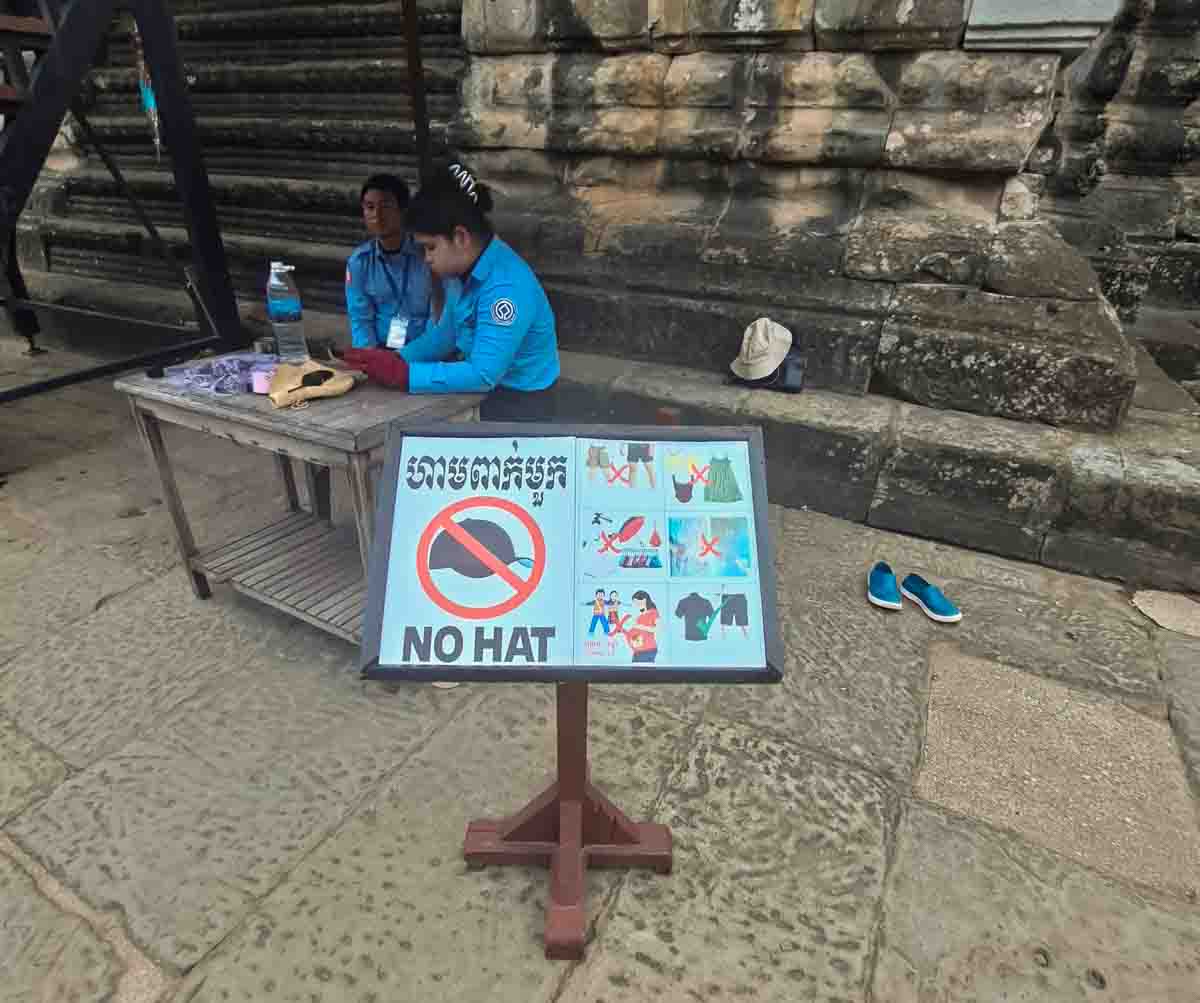
Shoulders and knees should be covered when entering restricted temple areas. This is particularly important when visiting the upper level of Angkor Wat, known as the Bakan. Scarves used to cover otherwise bare shoulders may not be accepted. Hats must be removed in areas like Bakan.
Comfortable walking shoes are strongly recommended. Expect uneven stone, steep steps and dirt paths throughout the temples. Good footwear is particularly important during the rainy season, when stone surfaces and paths can become wet, slippery and muddy.
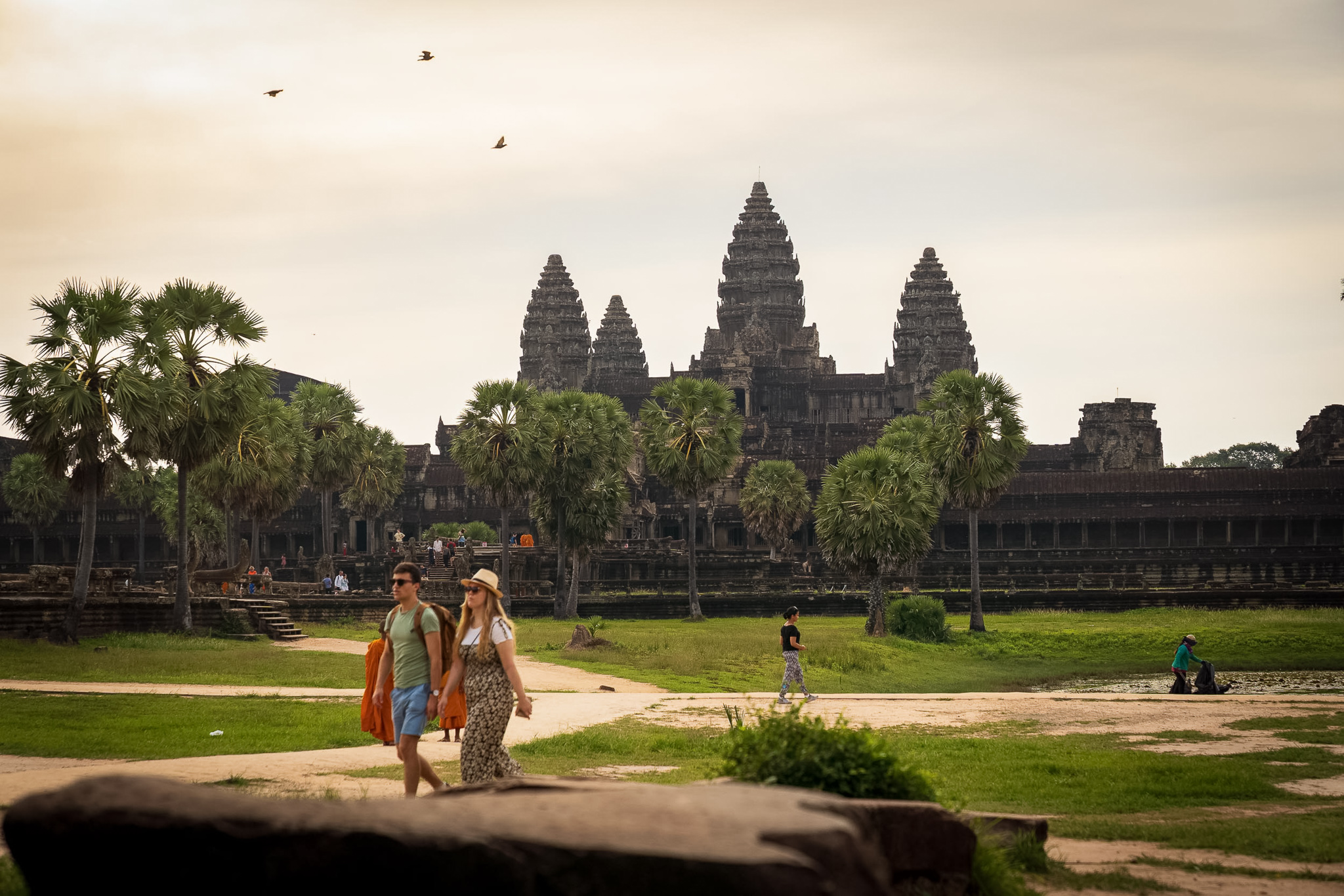
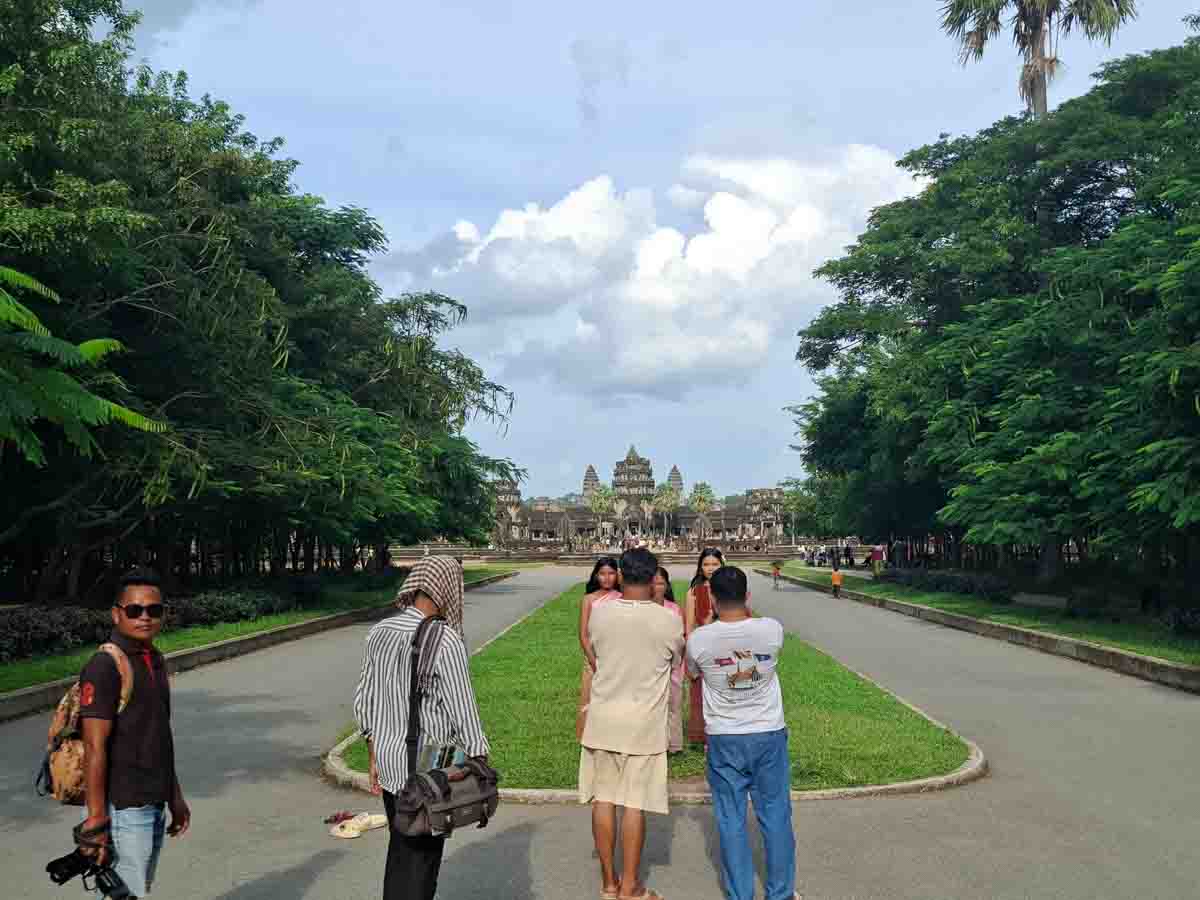
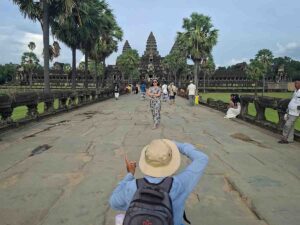
Tourists walking in front of Angkor Wat at sunrise
Angkor is hot and humid throughout the year, and spending several hours walking around the temples can be more tiring than the temperature alone suggests. Lightweight clothing, plenty of water, sunscreen and a hat are worth bringing, particularly if you plan to stay in the park through the middle of the day.
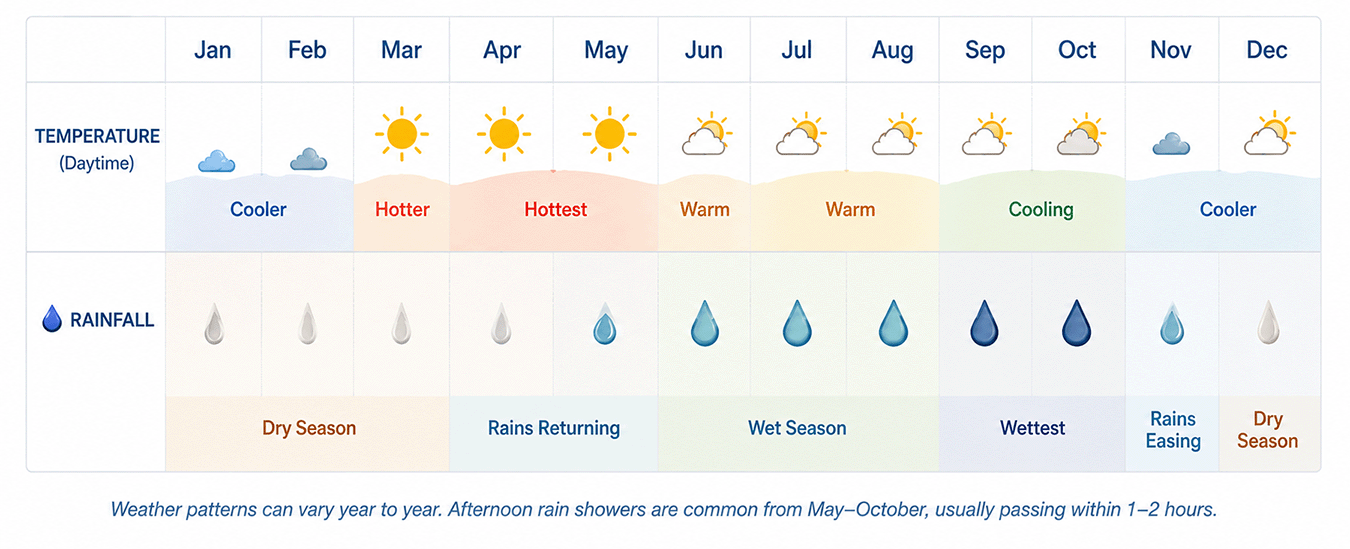
The hottest period is generally March to May, when afternoon temperatures can become uncomfortable around exposed temples such as Angkor Wat. Starting early and taking a break during the hottest part of the day can make a significant difference.
During the green season from May to October, expect higher humidity and occasional heavy rain, but this can also be one of the most beautiful times to visit Angkor. The vegetation becomes intensely green, moss covers the ancient stonework and the moats and reservoirs fill with water. Mornings are often dry, with rain more likely later in the day, so an early start remains a good option during the rainy season.
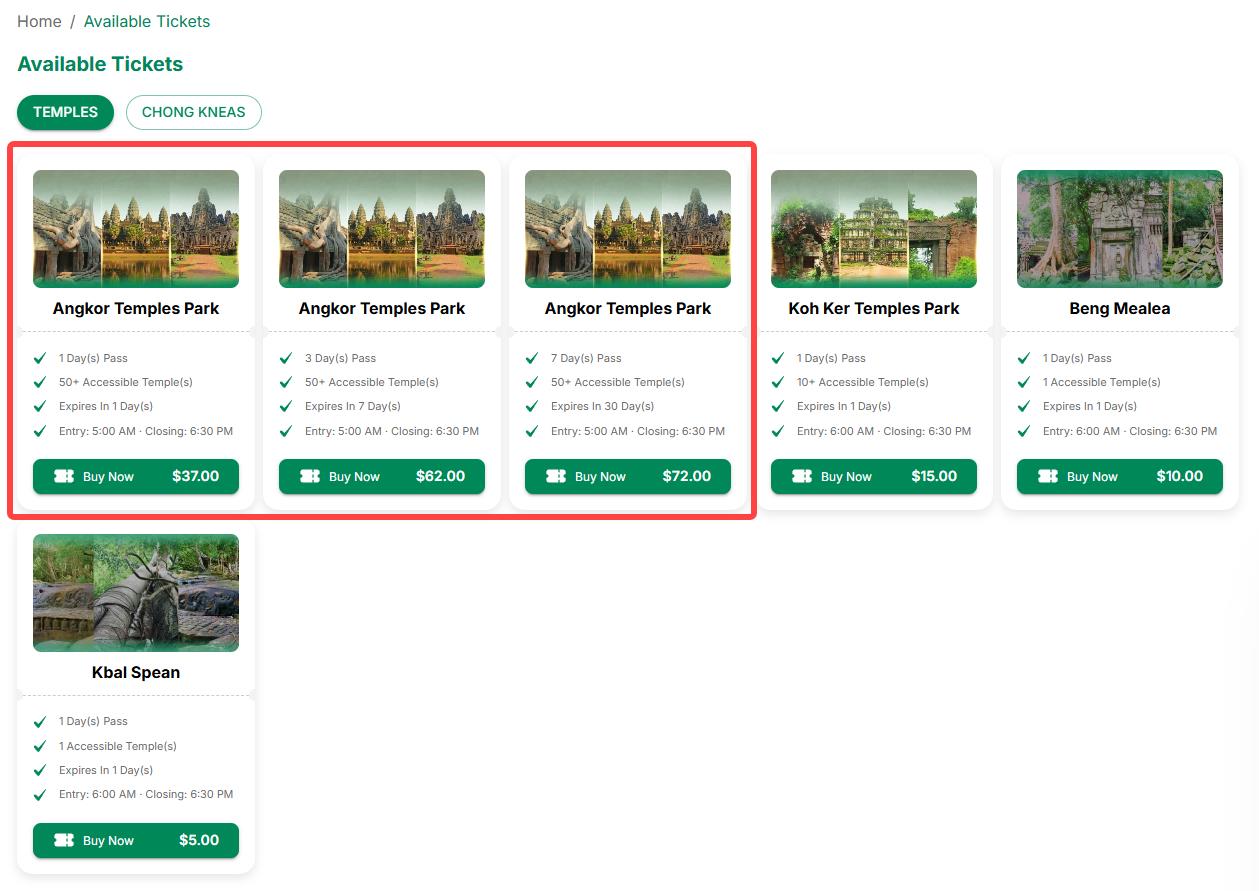
Entry requires an Angkor Pass, currently priced at 1 day – $37 | 3 days – $62 | 7 days – $72. The same pass provides access to most temples within Angkor Archaeological Park.
Buying tickets: See our detailed Angkor Pass section for where to buy tickets, online purchases, the main ticket office and self-service ticket machines in Siem Reap.
Toilets are available at the main visitor areas throughout Angkor Archaeological Park and are free with a valid temple pass. Food, drinks and small shops can also be found around the main Angkor Wat visitor areas. ATMs are available near Angkor Wat, including in the Angkor Parvis shopping area.
Cash is still useful inside Angkor Archaeological Park. Credit and debit cards are accepted at some larger businesses, including places in the Angkor Parvis area, but many smaller food stalls, drink vendors and other sellers may only accept cash or local QR payments. We recommend carrying some US dollars or Cambodian riel rather than relying entirely on your card.
Accessibility
Angkor Wat can be visited by people with limited mobility or wheelchair users, although steps, uneven surfaces and elevated sections make some areas inaccessible.
Getting there
Angkor Wat is around 5–6 km north of central Siem Reap and is easy to reach by tuk tuk, moto, private car, bicycle or organised tour. From most hotels in Siem Reap, allow around 20–40 minutes, depending on your location, traffic and mode of transport.
Road signs directing visitors towards Angkor Wat in Siem Reap, Cambodia
The main route north from Siem Reap follows Preah Sihanouk Avenue, formerly known as Charles de Gaulle Boulevard, towards the Angkor Archaeological Park and Angkor Wat. You may still see the former road name used on older maps and travel information.
Road to Angkor Wat through the Angkor Archaeological Park
If you’re visiting Angkor Wat for sunrise, allow additional time for the early-morning journey, ticket checks and the walk from the vehicle drop-off area to your chosen sunrise location.
Current Angkor Wat Visitor Notes
Last checked: September 2026
Angkor Wat is an active archaeological site, and temporary restoration or maintenance work can sometimes affect a visit. We visit regularly and use this section to highlight significant temporary changes that we think visitors should know about before they arrive. This is not intended as a complete record of ongoing work, but a practical update on anything that may affect your visit.
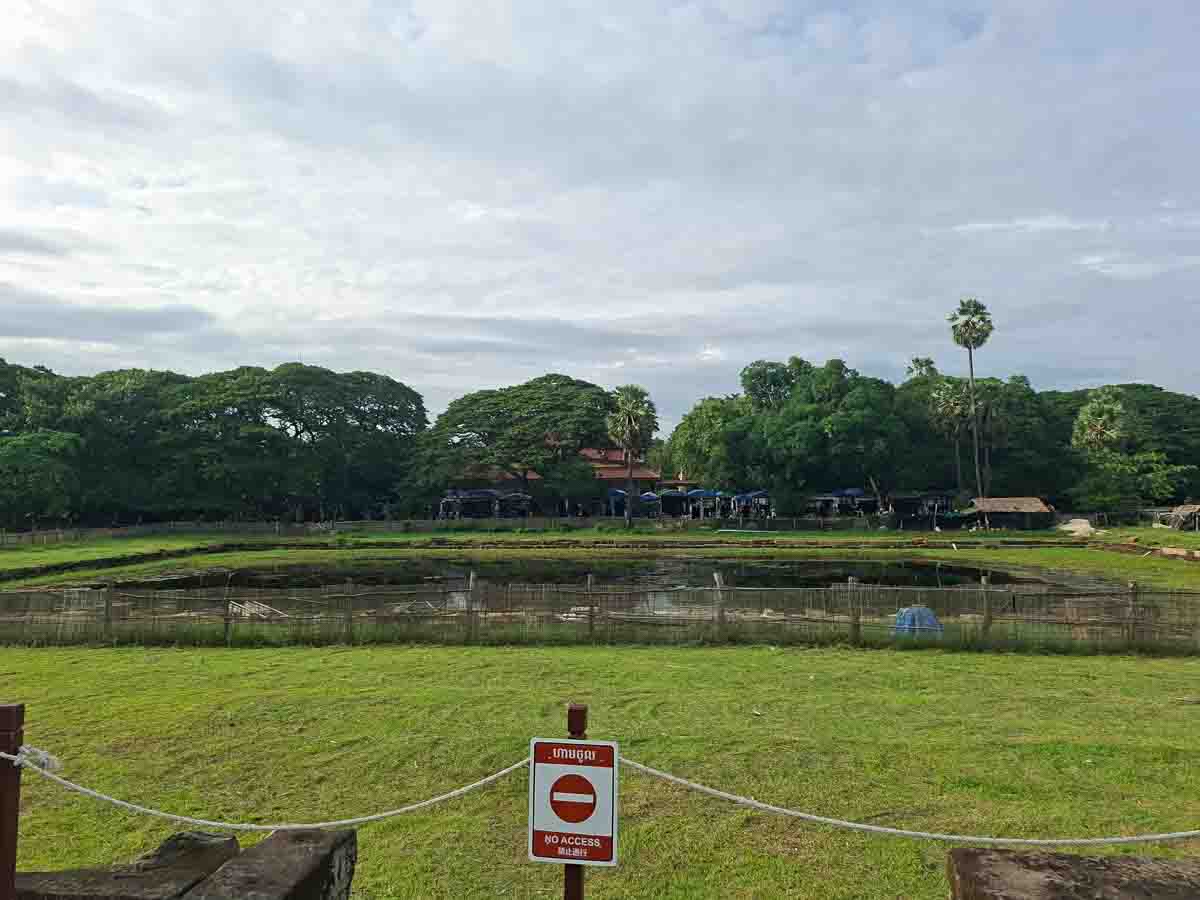
Northern reflecting pool
Northern reflecting pool temporarily closed for restoration, September 2026.
Northern reflecting pool: The northern reflecting pool is currently closed to visitors while restoration work is taking place. Fencing surrounds the pool and access to the immediate area is restricted. This is one of the two famous reflection ponds directly in front of Angkor Wat and is normally a popular place for sunrise photographs.
Last checked: September 2026.
Southern reflecting pool
Southern reflecting pool remains open, with temporary works affecting part of the classic Angkor Wat view. Watch our September 2026 video.
Southern reflecting pool: The southern reflecting pool remains open and accessible to visitors. It still provides the classic view of Angkor Wat reflected in the water, although a large temporary bamboo structure currently affects part of the view towards the temple. You can still photograph Angkor Wat and its reflection from this side, with the exact composition depending on where you stand.
Last checked: September 2026.
Green Season Angkor Pass promotion: During the current Green Season promotion, 1-day Angkor Passes purchased at the Angkor Parvis ticket office can be used for two entries on the same day, instead of the usual single entry. Other Angkor passes remain unchanged. We still recommend buying your Angkor Pass online in advance for most visitors, as explained in our Angkor Pass section below.
Last checked: September 2026.
Conditions and promotions can change quickly. We update this section when we become aware of significant changes that are likely to affect visitors.
When to Visit Angkor Wat
Planning your trip around the weather makes a huge difference in crowd levels, heat management, and photo quality. While standard travel guides divide the year into strict “good” and “bad” seasons, local timing tells a very different story.
Click to expand
Peak Season: Dry & Cool (November to February)
This is Angkor’s most popular time of year, with lower humidity, cooler mornings and little rainfall. Conditions are comfortable for long days exploring the temples, particularly in December and January.
It’s also a lovely time to be in Siem Reap itself. Mornings and evenings can feel surprisingly comfortable, making it pleasant to walk around town, eat outside or spend an evening exploring without the intense heat of other times of year.
The trade-off is larger crowds, especially at Angkor Wat sunrise, Bayon and Ta Prohm. The landscape also becomes progressively drier, with green vegetation beginning to fade as the dry season continues.
Best for: First-time visitors who prioritise comfortable temperatures and predictable weather.
Hot Season: Dry & Intense (March to May)
Exploring exposed temples during the middle of the day can be tiring, so early starts and a break during the hottest hours are particularly worthwhile.
From our experience, the heat at this time of year can be intense, and it’s something you should seriously consider when planning your visit. On hot days with little breeze, exposed areas of Angkor can feel particularly uncomfortable, especially when you’re walking and climbing in direct sunlight.
Shade becomes especially valuable, so forested temples can be more comfortable than large, exposed complexes during the later morning and afternoon. Carry plenty of water, take regular breaks and don’t underestimate how tiring several hours at the temples can become.
The landscape is also at its driest, with yellowing grass, less lush vegetation and more dust. Towards May, the first substantial rains begin transforming the park surprisingly quickly.
Best for: Visitors comfortable with heat who can plan their temple visits around early mornings.
The "Green Season" Secret (May to October)
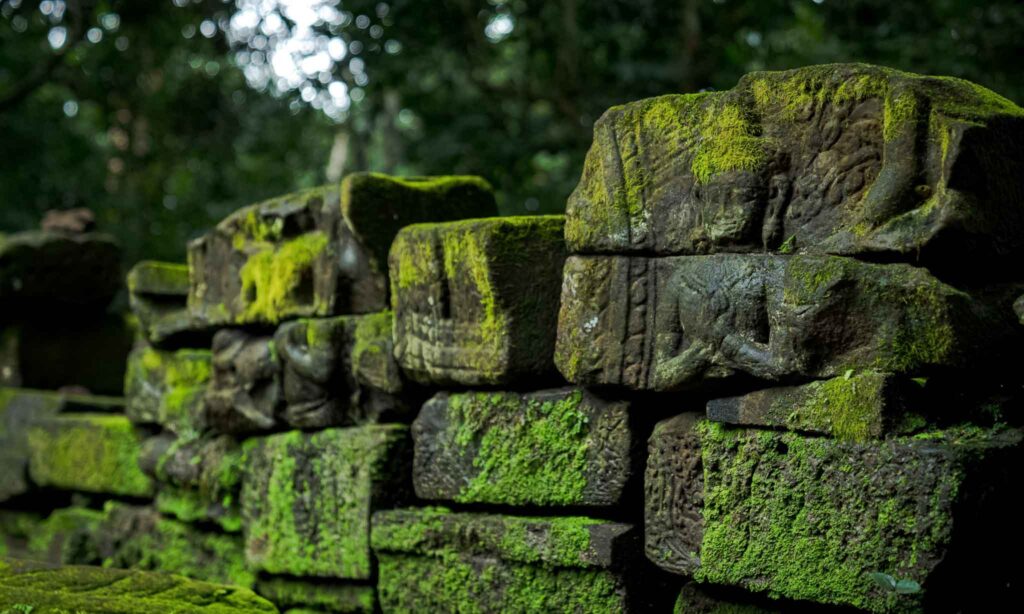
The rainy season is often overlooked, but it can be one of the most beautiful times to visit Angkor. The park becomes intensely green, moats and reservoirs fill, and wet stone, moss and dense vegetation give the jungle temples a particularly atmospheric appearance.
Rain doesn’t necessarily mean losing an entire day, and there are often clear periods between showers. From our experience living in Siem Reap, mornings during the rainy season are often dry, with rain more likely to arrive later in the afternoon. It’s one reason we recommend getting an early start at the temples, especially during the green season.
You’ll need to accept higher humidity and occasional heavy rain, but lush landscapes, dramatic skies and potentially fewer visitors can more than compensate.
Best for: Photographers and visitors who value lush scenery, atmosphere and potentially fewer crowds.
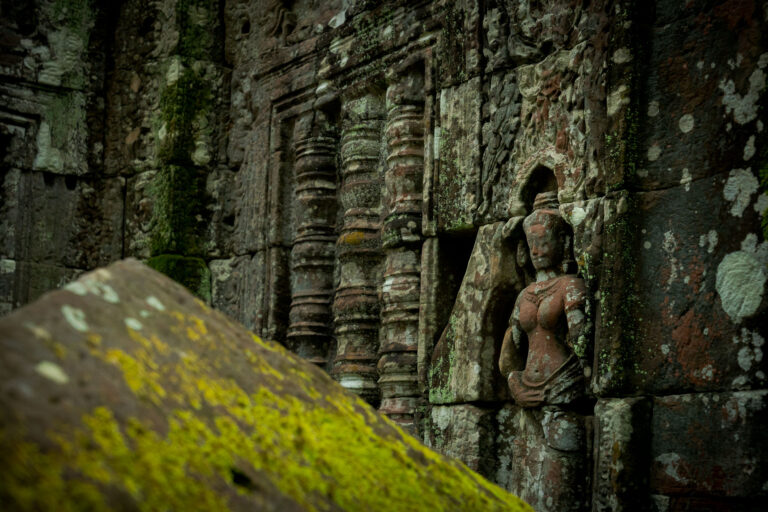
Moss-covered sandstone blocks beside Preah Palilay temple, showing how Angkor's temples transform during the green season.
How many days do you need for Angkor Wat?
For most visitors, two or three days is the ideal amount of time to explore Angkor. You can see Angkor Wat and several of the major temples in a single day, but it will only give you a small taste of the wider archaeological park.
If you only have one day at Angkor, I recommend concentrating on Angkor Wat, Angkor Thom and Ta Prohm rather than trying to fit too much in. These are the major highlights and already make for a fairly long day, particularly if you start with sunrise.
With two days, you can explore the main temples at a much more comfortable pace and add some quieter sites without spending the entire day rushing between temples. Three days gives you considerably more flexibility and makes it easier to include places further from the main circuits, such as Banteay Srei.
Personally, I think two days is the sweet spot for most first-time visitors. Three days is worthwhile if you are particularly interested in the temples, history or photography, while one day is perfectly possible if your time in Siem Reap is limited.
One thing I hear quite often from visitors is that they wish they had stayed a little longer in Siem Reap. It’s easy to plan a trip around Angkor Wat and think of Siem Reap as just the place you sleep between temple visits, but there is much more to do here than Angkor. Siem Reap is a laid-back town and a great place to slow down for a few days, with excellent restaurants, cafés, markets and plenty to see beyond the temples. If your itinerary allows it, I’d give yourself some extra time rather than leaving as soon as you’ve finished exploring Angkor.
2026 Ticket Prices & Which Pass to Buy
For most visitors, we recommend buying your Angkor Pass online before you visit. It’s the fastest and easiest option, and means you can travel directly to the temples without stopping to buy a ticket first.
If you buy your pass online, you’ll receive an e-ticket. We recommend sharing a copy with everyone in your group in case your phone runs out of battery, as your ticket may be checked several times during your visit to Angkor.
The official Angkor Enterprise website. The outlined 1-day, 3-day and 7-day passes cover Angkor Wat and the temples of Angkor Archaeological Park.
Pass Type
Official Price
Pass Validity
Best For
1-Day Pass
$37 USD
Valid for 1 single calendar day
Quick trips or short layovers
3-Day Pass
$62 USD
Valid for any 3 days within a 7-day window
Recommended for 80% of visitors
7-Day Pass
$72 USD
Valid for any 7 days within a 30-day window
Photographers & deep temple enthusiasts
Need more help choosing or buying your ticket? Our complete Angkor Wat Tickets Guide explains the differences between the 1-day, 3-day and 7-day passes, which temples are included, how to buy tickets online, Parvis ticket machines, multiple-entry rules and other practical ticket information.
Yes. There are several places to buy an Angkor Pass in person in Siem Reap, including the main Angkor Ticket Centre on Road 60 and self-service ticket machines at Angkor Parvis and The Heritage Walk. The ticket types and conditions are not identical at every location, so where you buy your pass can affect how it can be used.
Main ticket office (Road 60)
The main Angkor Ticket Centre on Road 60 offers the standard Angkor Pass options and remains the main physical ticket office for the Angkor Archaeological Park. It is particularly useful for tour groups or visitors who prefer to buy their pass in person, although most independent travellers will find buying online more convenient.
Angkor Parvis
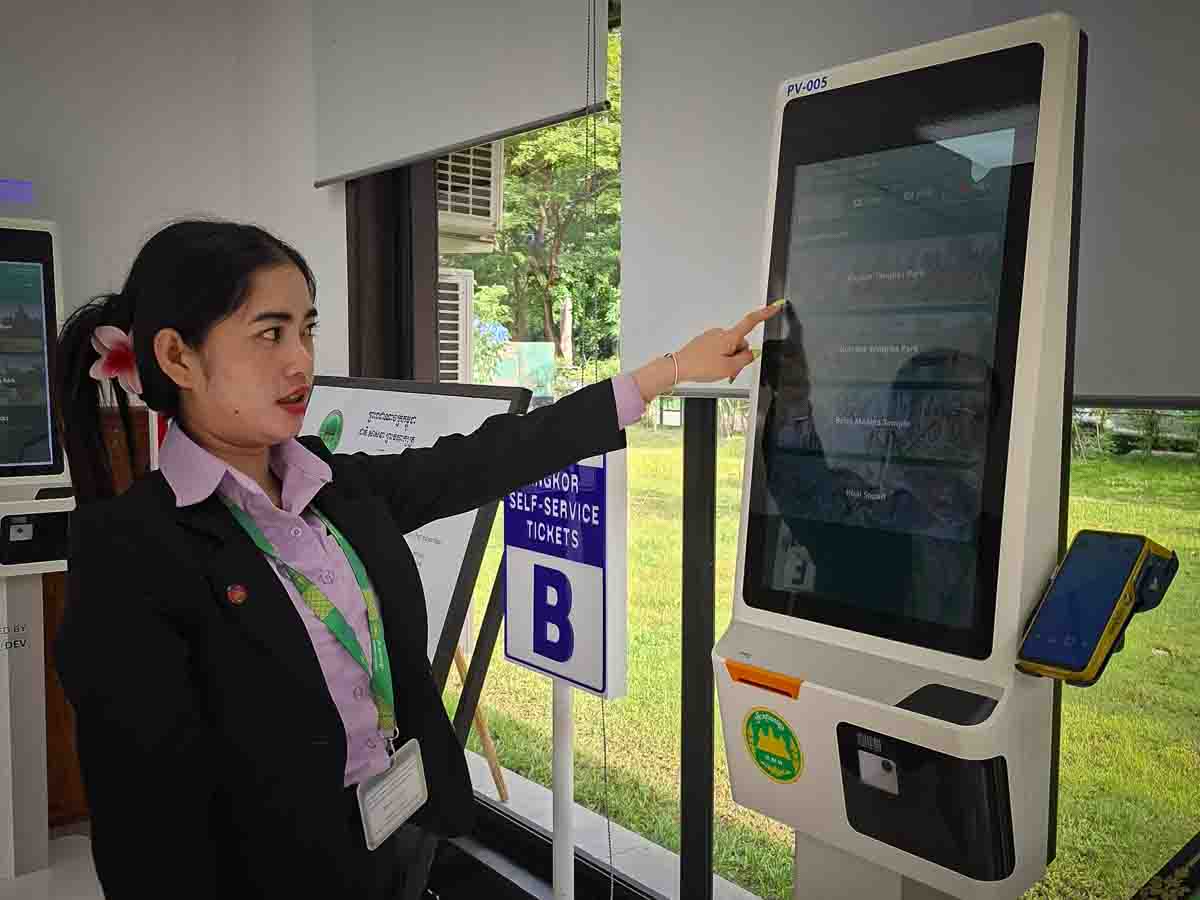
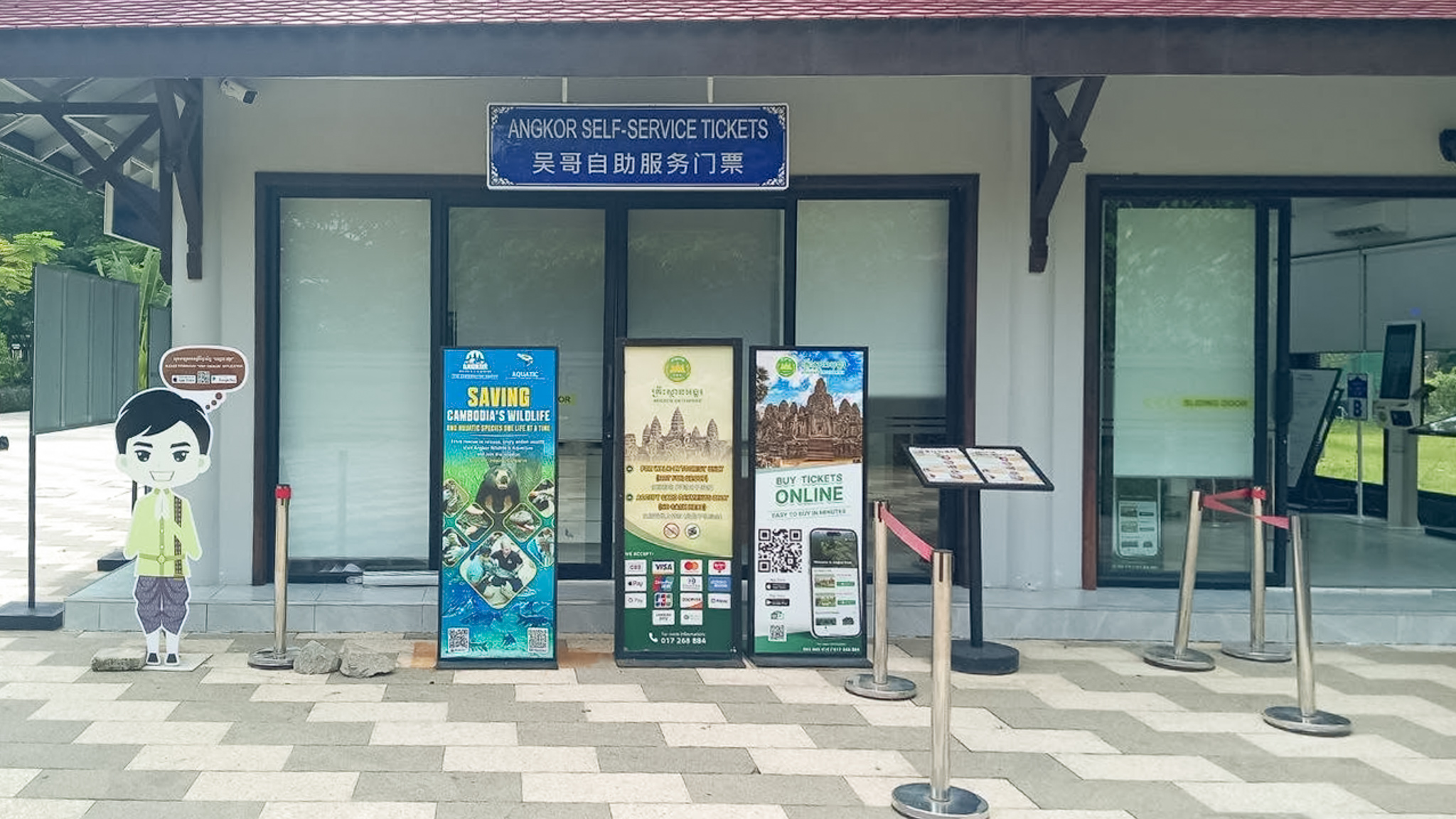
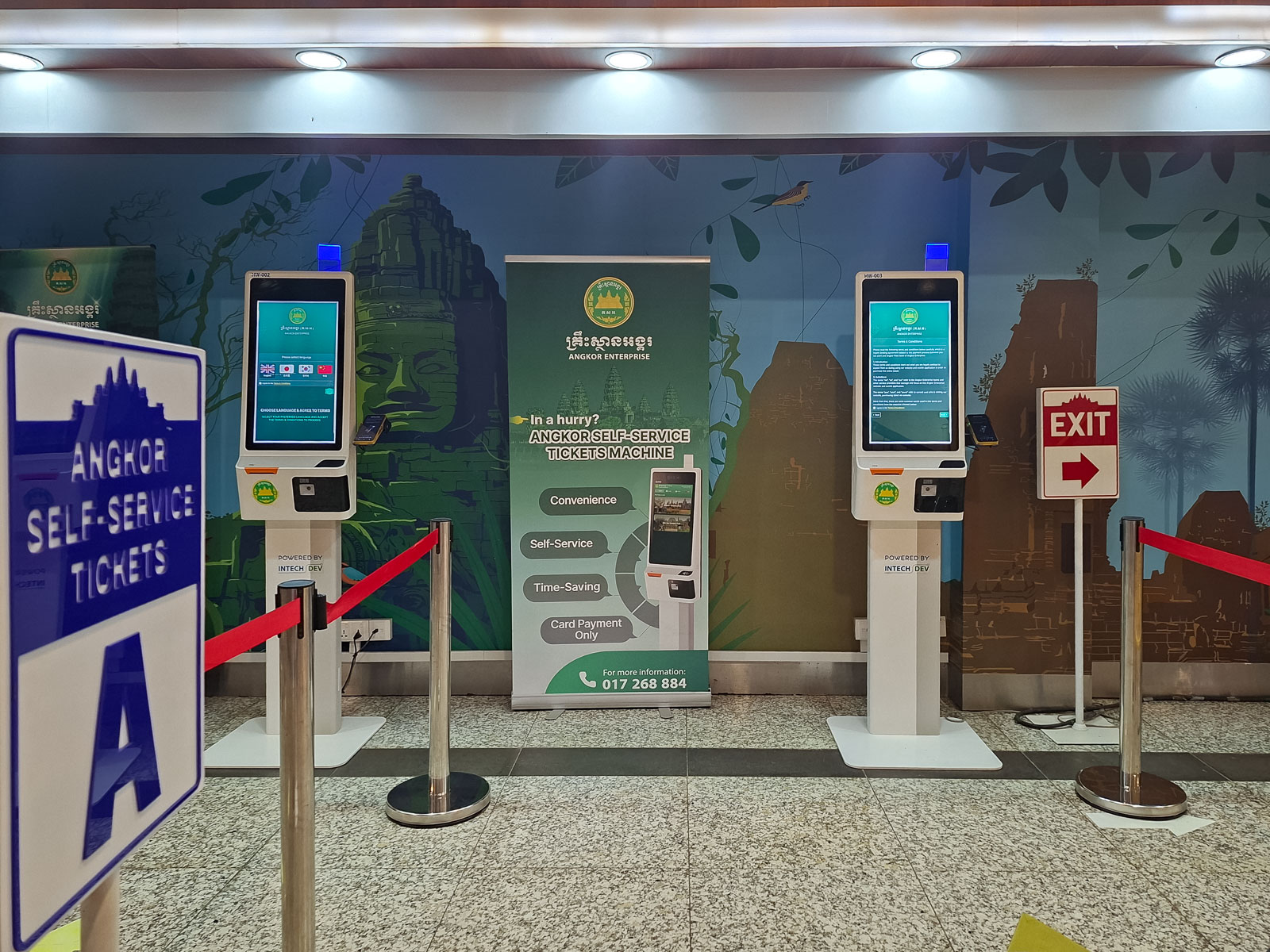
You can also buy an Angkor ticket directly in front of Angkor Wat. Self-service ticket machines are available inside the Angkor Parvis shopping area, next to the main Angkor Wat parking area.
The machines only accept card payments; cash is not accepted. Unlike the standard Angkor Pass, tickets issued by these machines do not include your photograph, which is why they are normally issued as single-entry tickets.
During the current Green Season promotion, tickets purchased from these machines can temporarily be used for two entries to the Angkor Archaeological Park. This is a seasonal promotion and may change, so don’t assume the additional entry will be available outside the promotional period.
For most visitors planning to explore several temples, we still recommend checking the current ticket conditions and comparing them with the standard Angkor Pass before purchasing.
Angkor Parvis staff demonstrating the ticket machine.
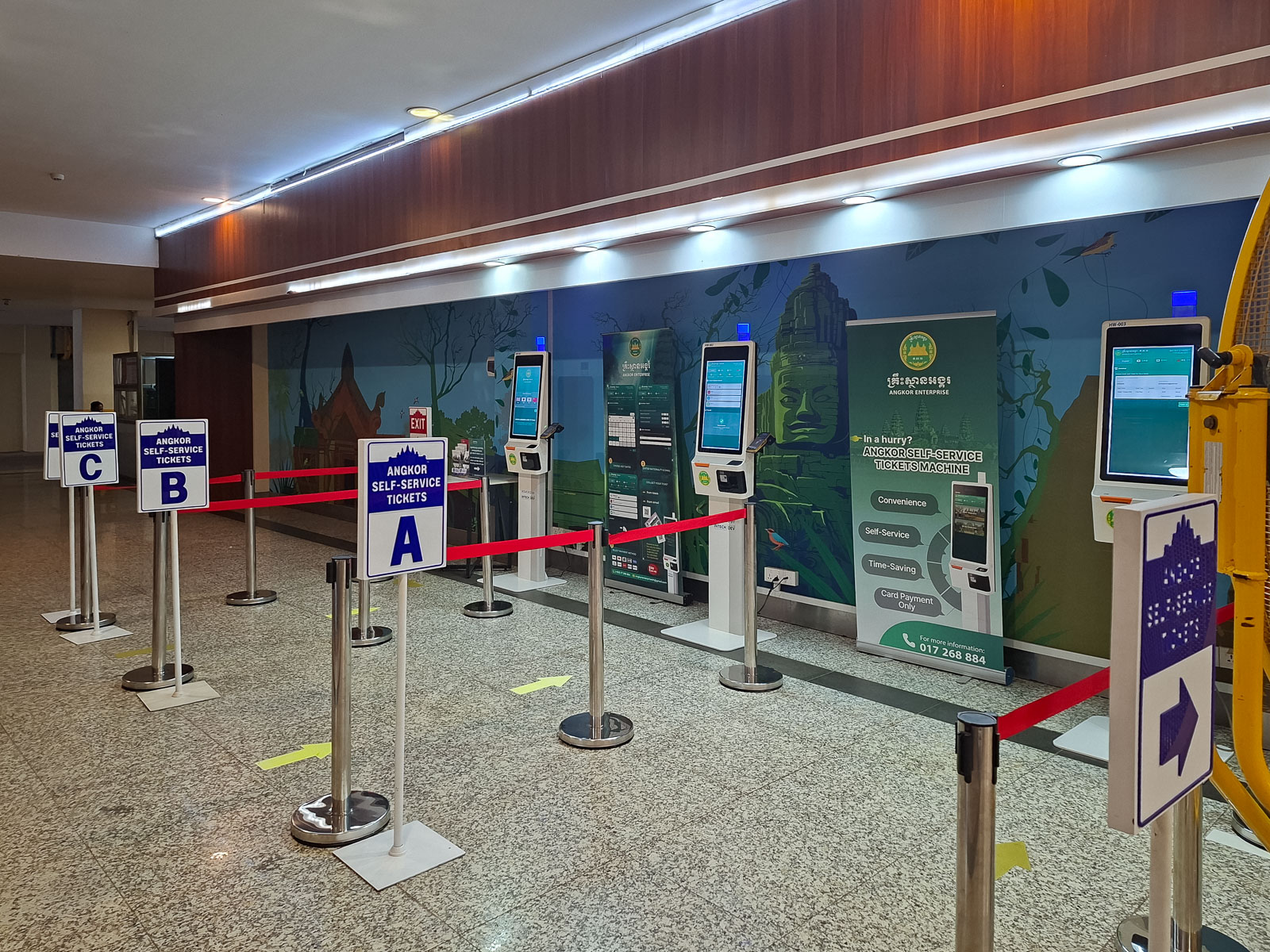
Angkor Enterprise has self-service ticket machines inside The Heritage Walk shopping center in central Siem Reap, giving visitors another option for buying an Angkor Pass in person. The machines accept card payments and issue tickets without the need to travel to the main Angkor Ticket Center on Road 60.
The machines only accept card payments; cash is not accepted. Tickets issued by these machines do not include your photograph, which is why they are normally marked as single entry.
During the current Green Season promotion, these tickets can temporarily be used for two entries to the Angkor Archaeological Park. This is a seasonal promotion and may change, so check the conditions displayed on the machine when purchasing.
We visited the Heritage Walk machines in September 2026 to check the current ticket options and payment process.
Pro Tip (The 4:45 PM Sunset Rule): If you purchase a 1-day pass online or at the ticket center after 4:45 PM, your ticket is stamped for the following day, but you are allowed entry into the park immediately for free same-day sunset viewing.
Note for Cambodian Nationals & Diaspora:
Cambodian citizens enter free of charge. While official guidelines mention carrying a local ID, real-world experience shows that speaking Khmer is usually all the proof needed to be waved right through.
If you are Cambodian living abroad (Khmer Kieu) visiting with a foreign passport: Don’t stress—if you speak the language and look the part, guards will almost always welcome you straight in without any hassle.
Note: Children under 12 enter free. Bring a physical passport or a clear photo of their passport on your phone as proof of age at ticket checkpoints.
What to wear at Angkor Wat: dress code & temple rules
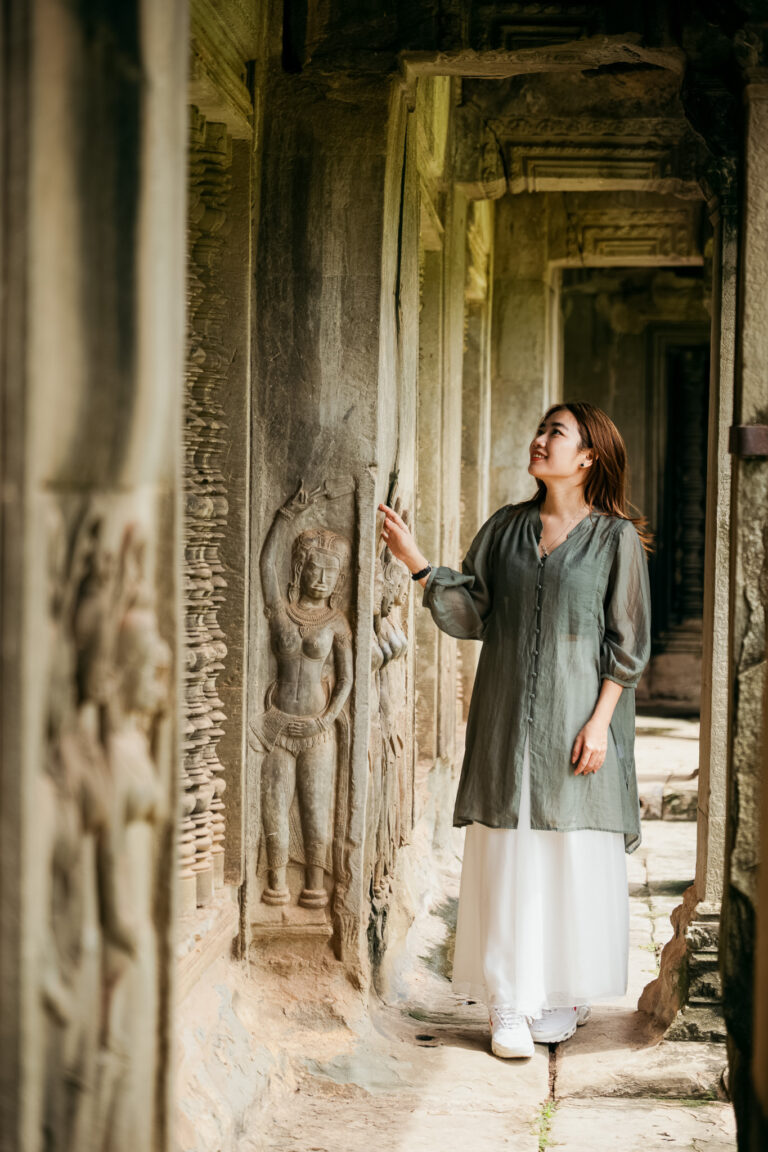
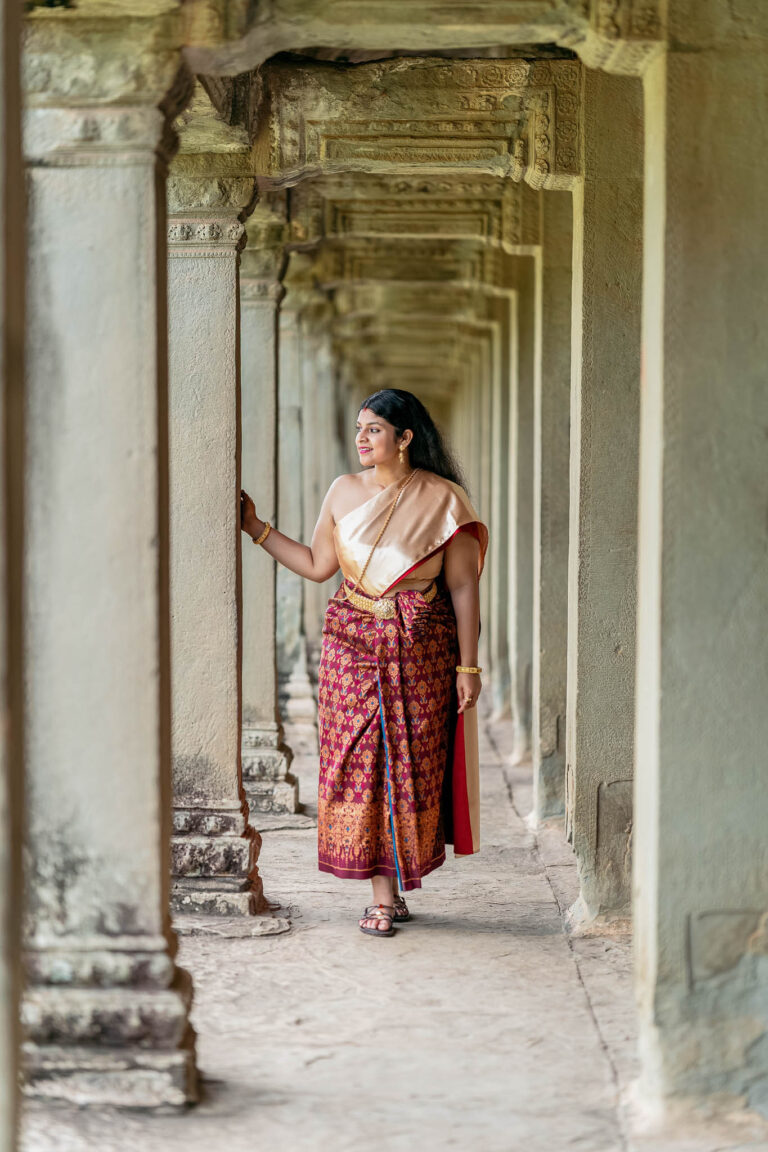
Angkor Wat and many of the surrounding temples remain important religious sites, so visitors should dress modestly and behave respectfully. The basic rule is to wear clothing that covers your shoulders and knees, particularly when entering sacred areas.
Angkor Wat dress code
Cover your shoulders and knees, that’s the general rule for visiting the temples. It matters most at sacred areas, and enforcement gets stricter as you go.
The Bakan, the upper level of Angkor Wat, has the strictest checks. Shoulders and knees need to be properly covered here, and just draping a scarf or shawl over bare shoulders often isn’t enough to get you in. You must remove your hat at the upper level of Angkor Wat.
Skip the very short shorts and revealing tops. It’s a religious site, so dress with that in mind.
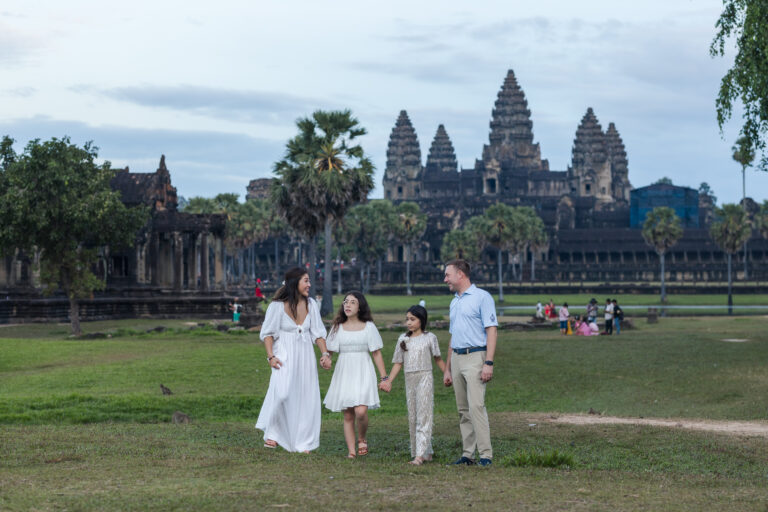
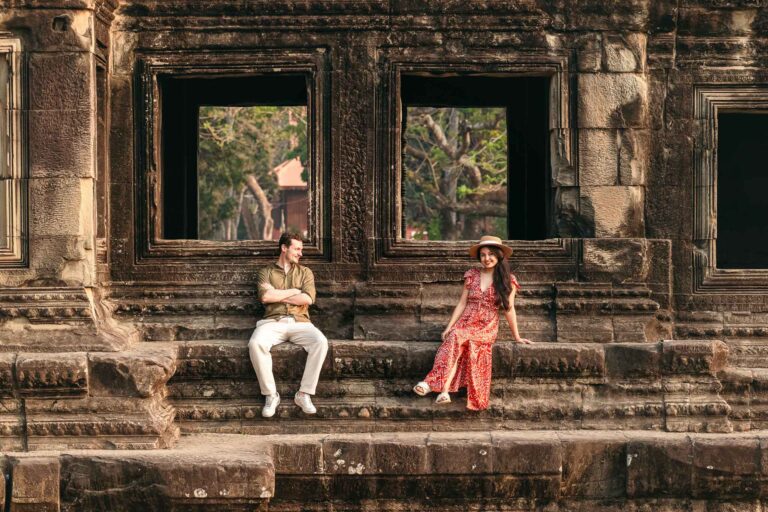
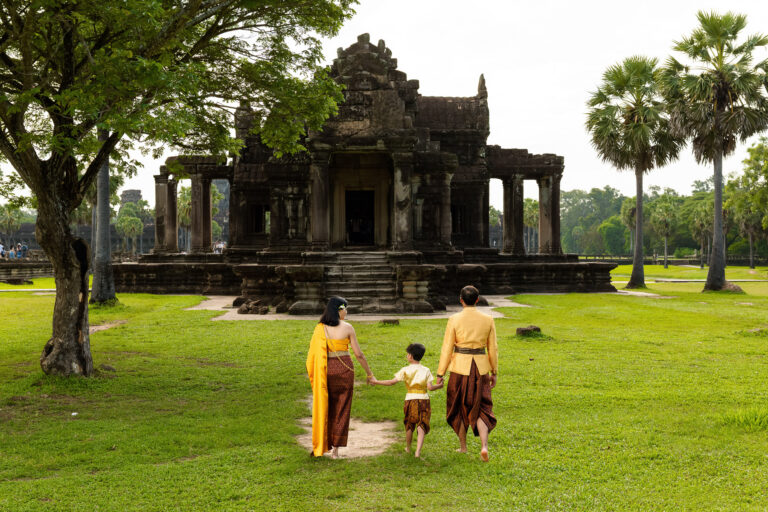
Family at angkor wat
What Should You Wear?
Light, breathable clothing is your best bet. Cambodia is hot and humid most of the year, so loose-fitting clothes in light fabric will serve you a lot better than jeans or heavy trousers.
You’ll be walking a fair amount too, often over uneven stone, steep steps, and sandy paths, so wear comfortable shoes or sandals that stay on your feet. A hat and sunglasses help during the hotter parts of the day.
Tourists walking in front of Angkor Wat at sunrise
Temple Etiquette
These are archaeological sites, but they’re also active religious and cultural places. Don’t climb on closed or restricted structures, go into roped-off areas, or touch or sit on the carvings.
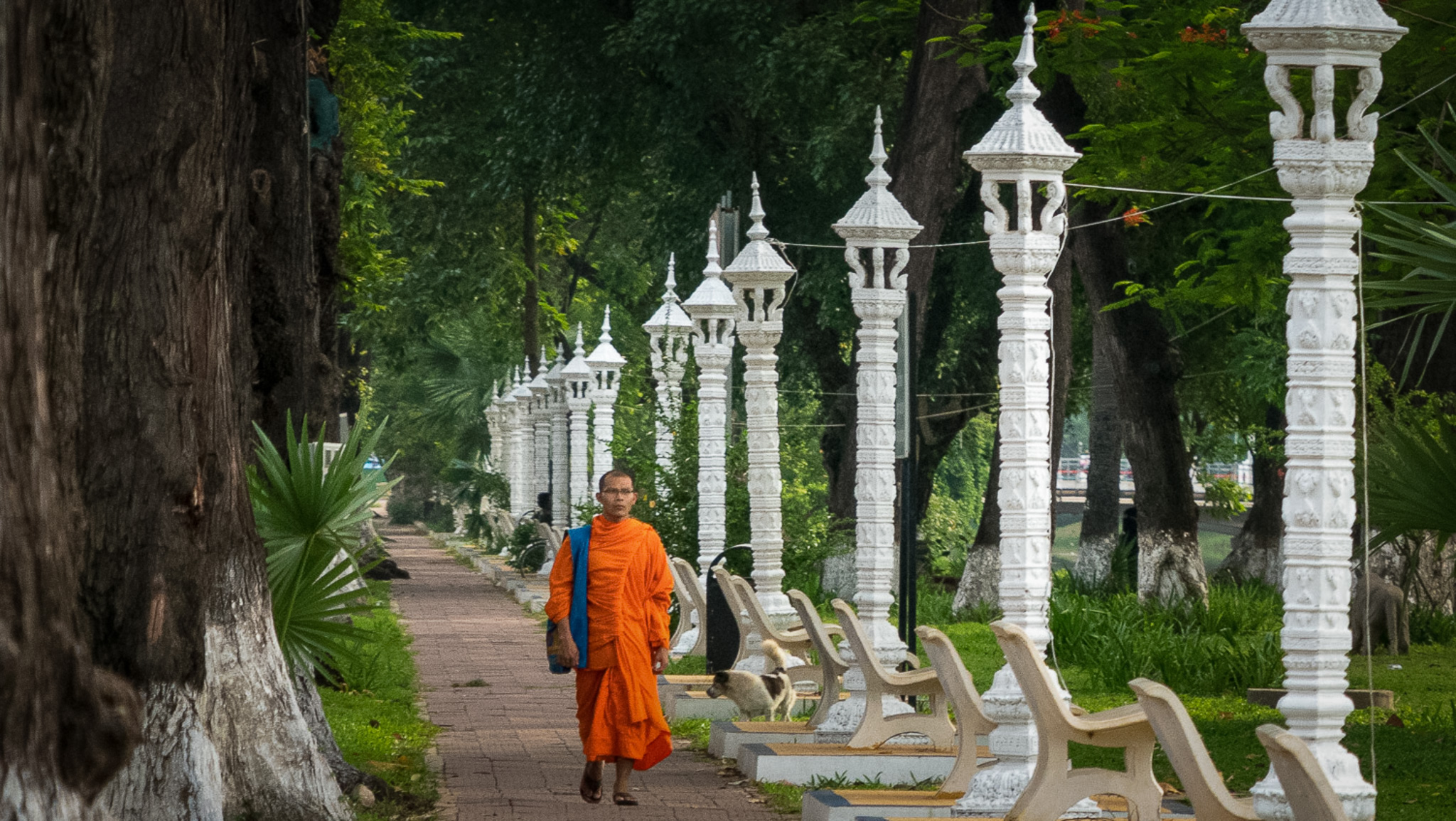
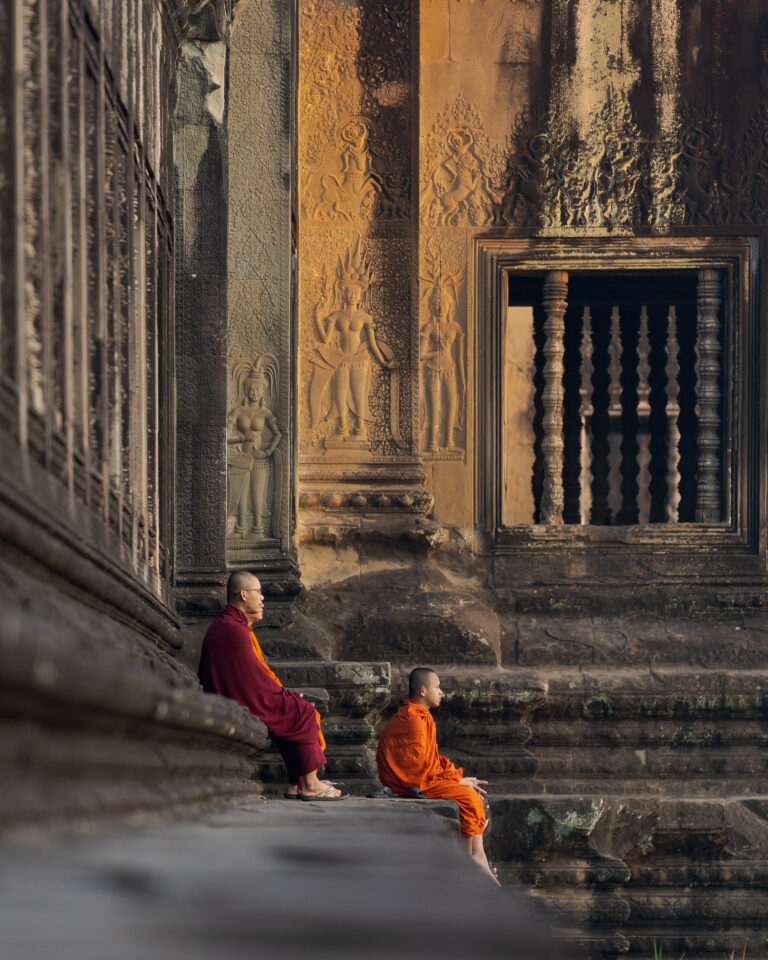
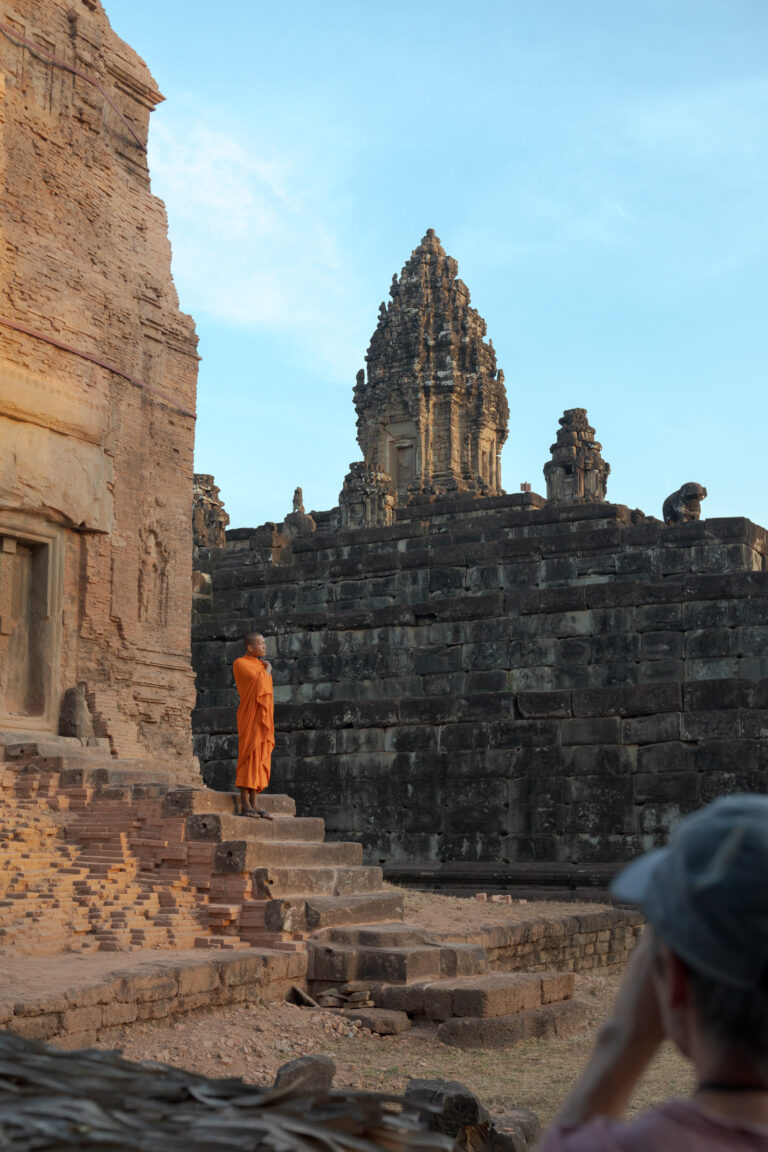
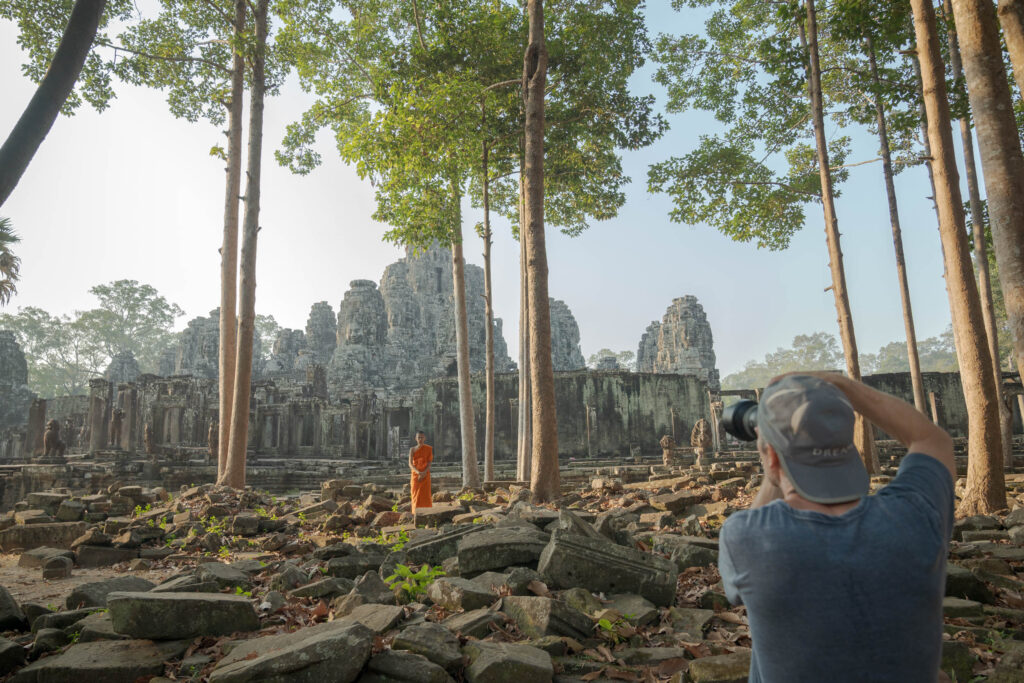
Be mindful around monks, shrines, and anyone praying. Photography is fine in most of the park, but watch for signs that restrict it, and ask before taking close-up photos of monks or people in the middle of religious activities
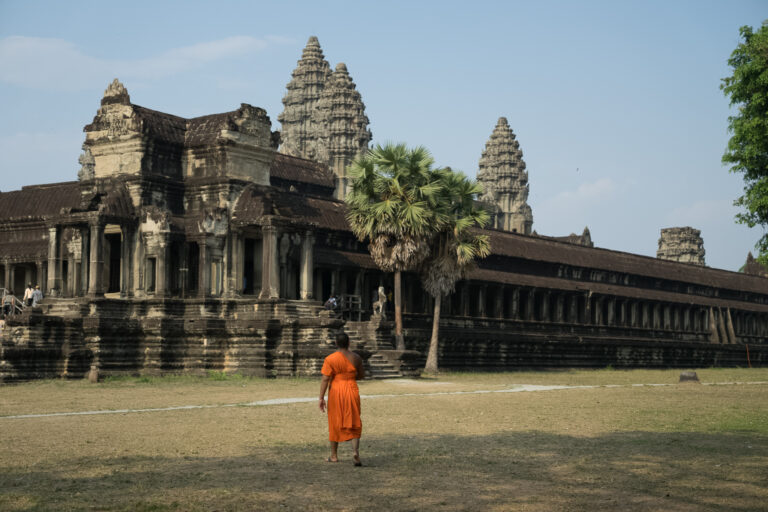
A monk in an orange robe walking across the grounds of Angkor Wat, with the temple's towers in the background.
What money to use at Angkor Wat
Cambodia has an unusual system when it comes to money. Both US dollars and Cambodian riel are widely used, and around Angkor Wat you can generally pay with either. Prices aimed at tourists are often quoted in US dollars, while riel is commonly used for smaller purchases and as change.
As a simple rule, you can treat $1 USD as roughly 4,000 Cambodian riel. This makes conversions easy: 4,000 riel is about $1, 2,000 riel about 50 cents, and 1,000 riel about 25 cents. Whilst the exchange rate does fluctuate, for everyday cash use you can generally treat it as around 4,000 riel to $1. In some places they may display a note saying $1 USD equals 4,100 riel. This is common and they are covering themselves, not ripping you off.
You’ll also notice that official Angkor ticket prices are quoted in US dollars.
Should I get dollars or riel out?
Either is fine, but US dollars are particularly convenient for visitors to Angkor Wat. It’s still useful to have some Cambodian riel for smaller purchases, such as drinks, snacks and other inexpensive items, mainly because with larger USD notes, small merchants are unlikely to have enough change. If you have a good amount of small notes ($1 and $5), you should be fine. If you pay in dollars, don’t be surprised if you receive some or all of your change in riel.
Are there ATMs at Angkor Wat?
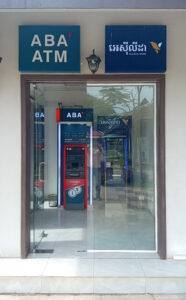
Yes. There are ATMs near the entrance to Angkor Wat, inside the Angkor Parvis shopping area. These are the only ATMs inside Angkor Archaeological Park, so I recommend withdrawing cash here if you need it before continuing to other temples.
The ATMs are convenient if you’re walking from the Angkor Wat parking area towards the temple. If you’re arriving by tuk tuk or car, they are slightly out of the way, as your driver will normally drop you much closer to the entrance.
Where are the ATMs near Angkor Wat?
The ATMs are located inside the Angkor Parvis shopping area, between the main Angkor Wat parking area and the temple entrance.
If you’re walking from the parking area, you’ll pass through Angkor Parvis on your way towards Angkor Wat. The ATMs are inside the shopping area, close to Starbucks and the pedestrian route towards the temple.
ATM location:Google Maps link GPS coordinates: 13.410459, 103.857294
If you’re continuing to other temples after Angkor Wat, withdraw any cash you need here. There are no other ATMs elsewhere inside Angkor Archaeological Park.
There are also ATMs at the main Angkor ticket office, although this is outside Angkor Archaeological Park. If you’re travelling from central Siem Reap towards Angkor Wat, there are ABA ATMs on Preah Sihanouk Avenue, opposite Kantha Bopha Hospital and near Sofitel. These are before you enter the Angkor area.
Location personally checked: August 2026.
Choosing Which Day to Visit Angkor Wat
While deciding what time of day to arrive dictates your sunrise experience, picking the right day of the week can be the difference between a smooth visit and dealing with massive local crowds or unexpected road closures.
1. Weekdays vs. Weekends (The Local Crowd Shift)
International Tourist Flow: Foreign visitor numbers stay fairly consistent on any given day throughout a month.
The Weekend Spike: Cambodian locals heavily visit the temples on weekends—especially Sundays. If you have flexibility in your travel schedule, book your main Angkor Wat day on a Tuesday, Wednesday, or Thursday for the quietest overall experience.
2. Cambodian Public Holidays & Seasonal Spikes
While single-day observances (like Constitution Day or Labor Day) have little impact on temple traffic, major multi-day national holidays draw massive domestic crowds to Siem Reap. During these periods, main roads around the park experience heavy traffic, and popular photo spots will be at peak capacity.
Khmer New Year (Mid-April): The largest celebration of the year. Expect huge festive crowds, road closures, and busy temple grounds across the entire park.
Pchum Ben / Ancestors’ Day (September / October): A sacred multi-day religious festival when Cambodians return to their home provinces and visit pagodas and temples.
Water Festival / Bon Om Touk (November): A major holiday period that brings long-weekend travel spikes to Siem Reap.
Central Sanctuary (Bakan) access is strictly closed roughly four times a month according to the lunar calendar (Buddha Days).
Planning Tip: If standing atop the central spire of Angkor Wat is a priority for you, double-check that your chosen day does not fall on a Buddhist Holy Day before finalizing your itinerary.
4. Marathons & Special Sports Events
Events like the Angkor Wat International Half Marathon (held annually in December) and regional cycling races use the roads surrounding the Archaeological Park.
Road Impact: Main access routes around Angkor Wat, Angkor Thom, and Ta Prohm are often blocked or heavily restricted until early afternoon. If you aren’t participating in the race, avoid scheduling your main temple tour on race day to prevent severe transit delays.
5. The Vernal & Autumnal Equinox (March & September)
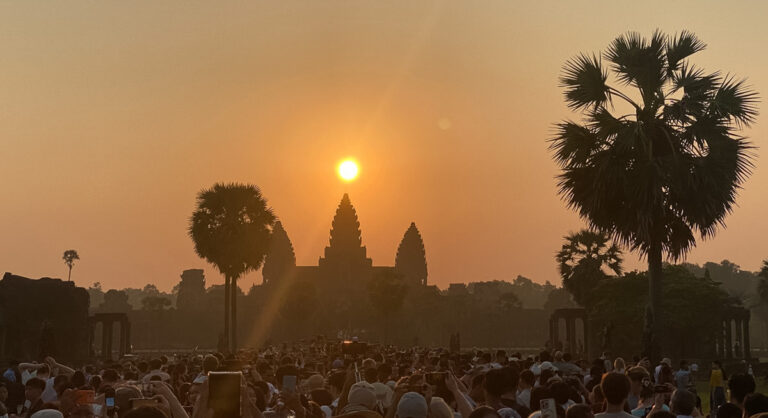
Twice a year—during the Spring/Vernal Equinox (around March 21–23) and the Autumnal Equinox (around September 21–23)—an astronomical alignment occurs where the sun rises directly behind the tip of Angkor Wat’s central tower.
The Crowd Reality: Thousands of spectators and professional photographers gather on the main causeway and reflection ponds hours before dawn to capture this exact symmetrical alignment.
The Verdict: If capturing this rare alignment photo is on your bucket list, arrive extra early (by 4:30 AM). If you dislike massive, shoulder-to-shoulder crowds, avoid visiting the main causeway on these specific equinox dates.
The iconic equinox alignment: the sun rises directly over the central peak tower of Angkor Wat, drawing large early-morning crowds along the main causeway
Getting Around: Transport Options Compared
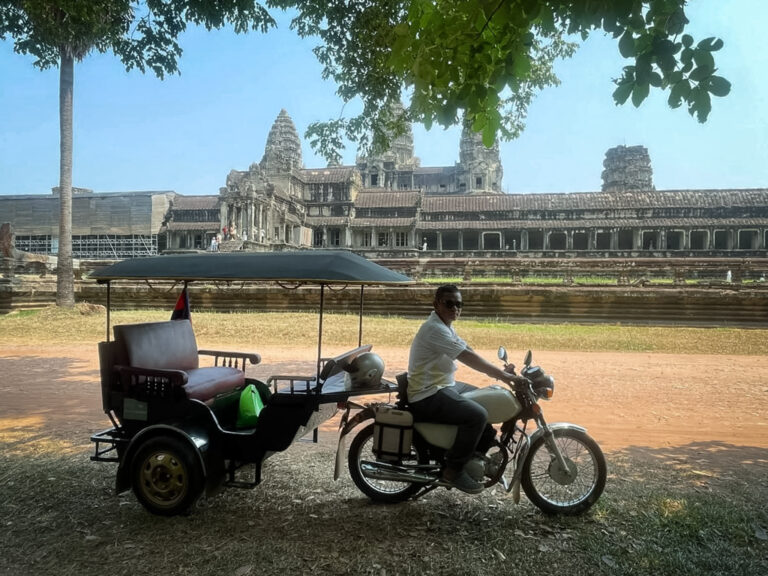
Tuk-Tuk (Remorque): $18 – $30 per day
depending on the circuit (Small vs. Grand Circuit). Best balance of open-air viewing, price, and flexibility.
Best for: Budget-friendly, flexible temple exploring Downside: Can get hot during the middle of the day
Tuk Tuk and driver at Angkor Wat Temple
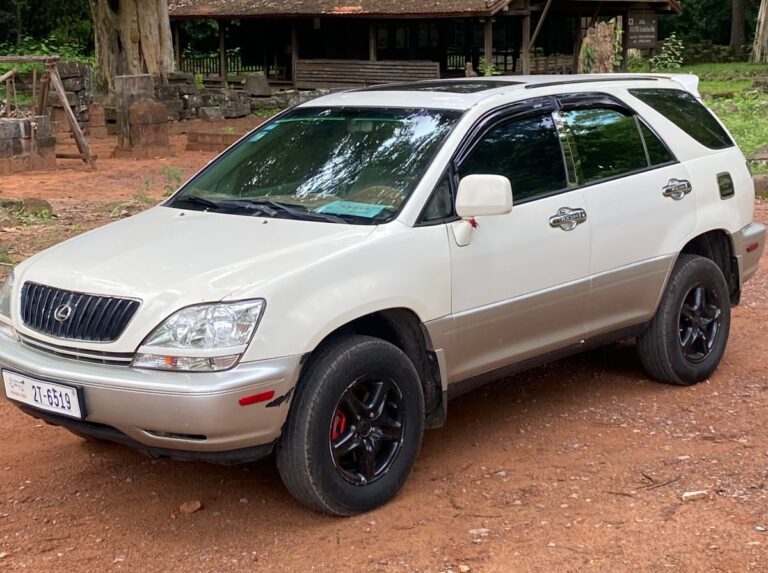
Private Air-Conditioned SUV
$40 – $50/day (local street hire) to $80+ (pre-booked online sunrise packages including full driver service, water/towels, and hotel transfers).
Best for: Comfort, sunrise starts, families and longer temple days Downside: More expensive than hiring a tuk-tuk locally
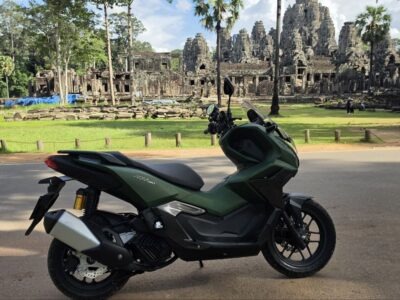
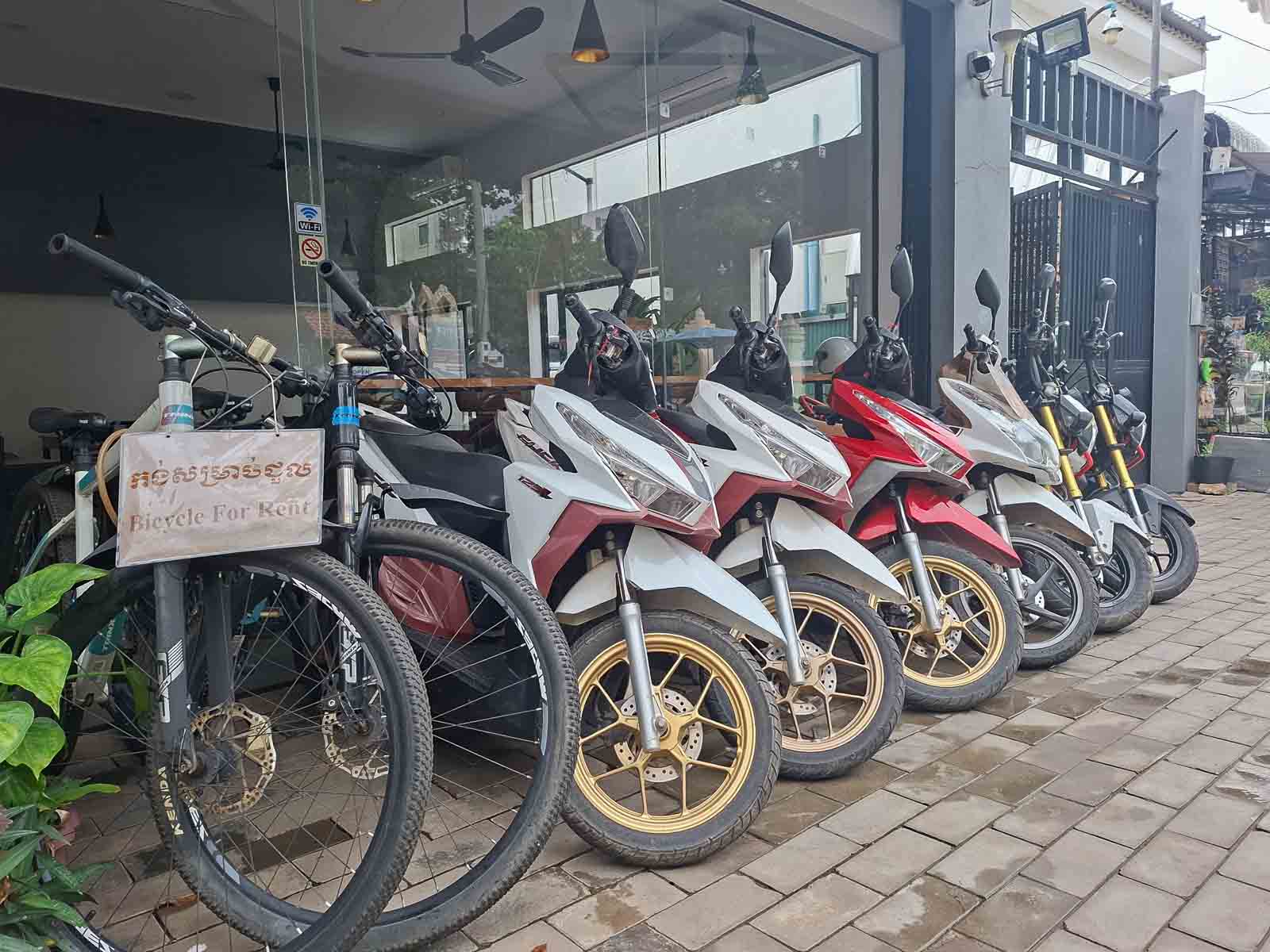
Exploring Angkor by motorbike or scooter gives you complete freedom over your route and schedule. Scooters can be rented throughout Siem Reap, with typical prices around $8–$15 per day for a 110cc–125cc scooter.
Rental deposits and ID requirements vary between shops. One rental shop we checked required a copy of the renter’s passport, plus either their passport, driving licence or a $200 cash deposit as security.
Parking at Angkor Wat
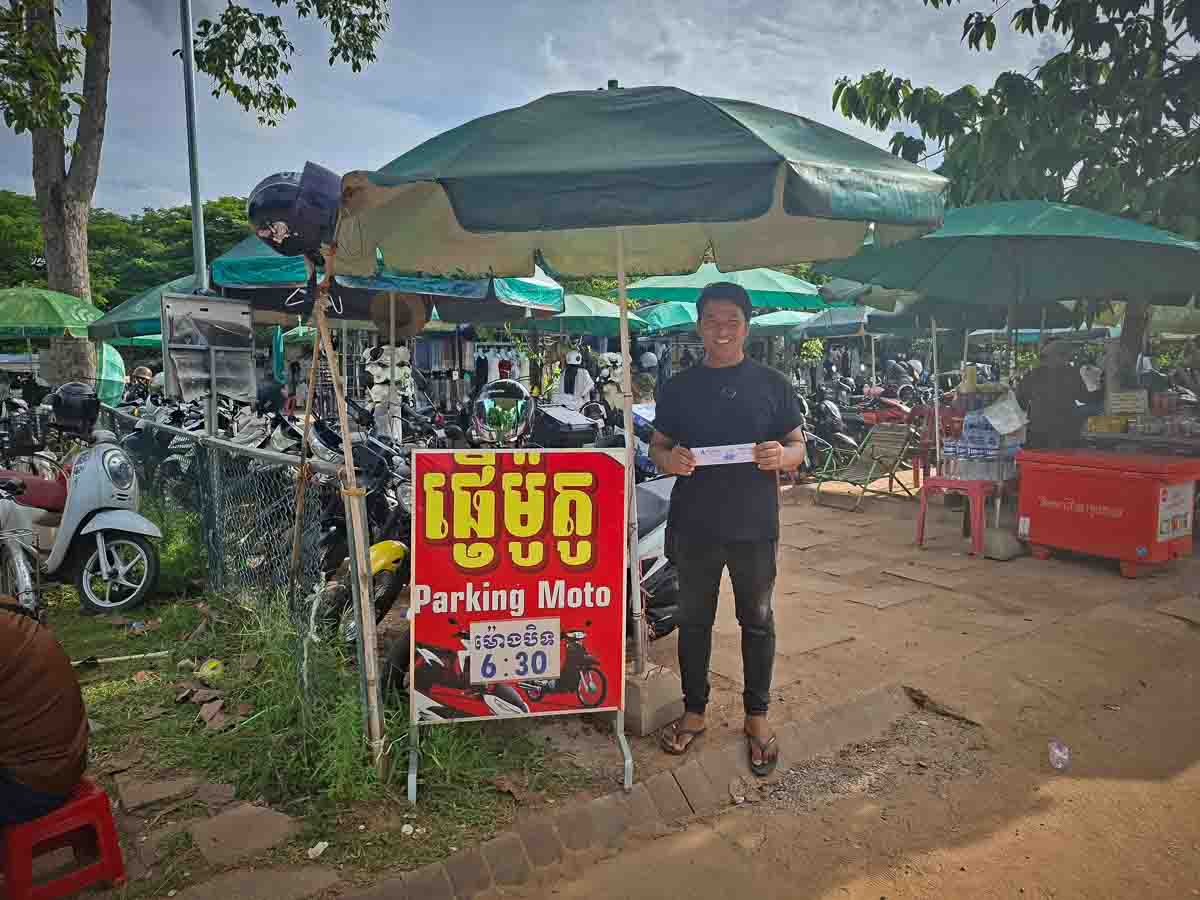
At Angkor Wat, motorbikes cannot be taken to the main temple entrance. You need to leave your bike in the parking area across from the moat and walk to the entrance.
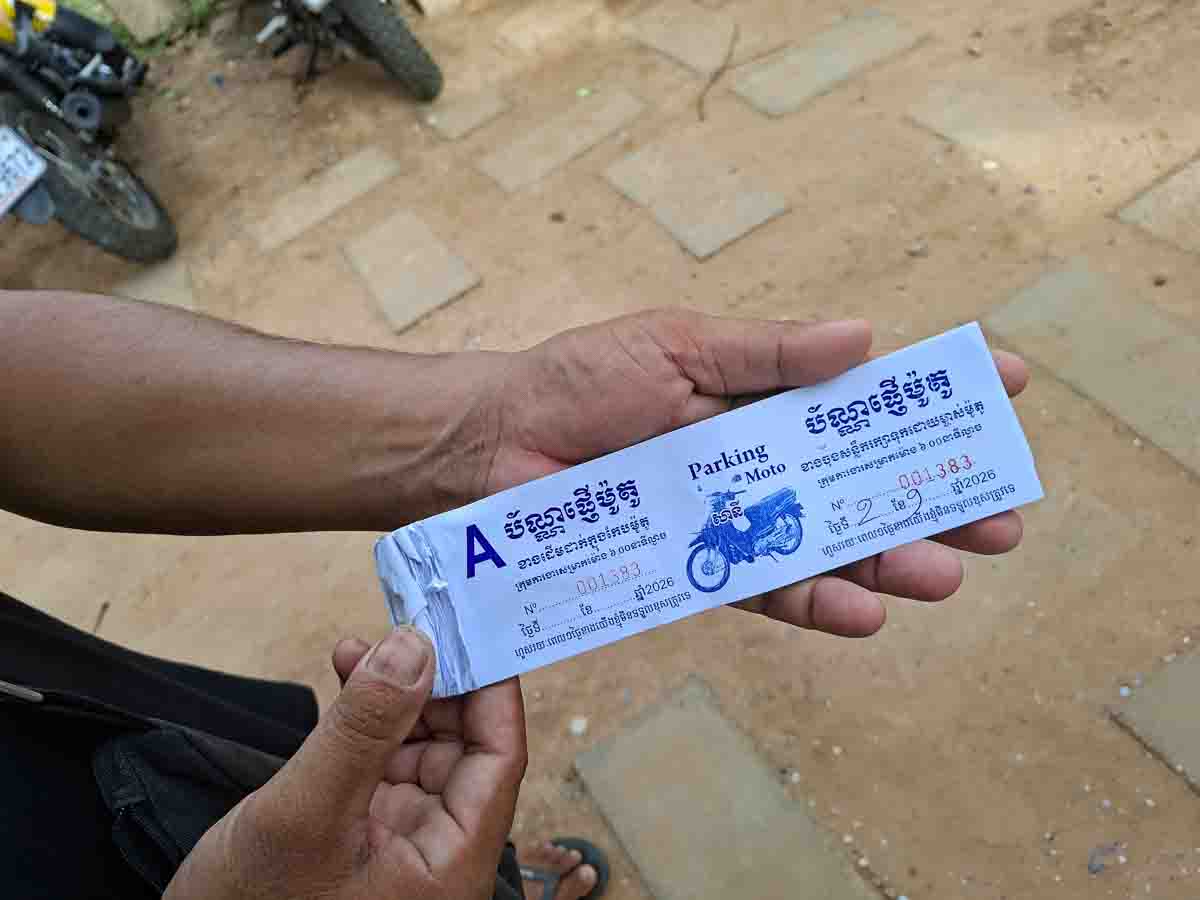
You can park your motorbike for free in the main parking area, but there are also attended motorbike parking areas. When we visited in September 2026, attended parking cost 2,000 KHR (around $0.50) and we were given a numbered parking ticket.
Cambodia is generally very safe, and we wouldn’t be particularly concerned about leaving a motorbike at the temples. However, for just 2,000 KHR, we recommend using the attended parking when it is available. It gives you the reassurance that someone is watching the bike while you spend several hours exploring the temple.
Not every Angkor temple has attended motorbike parking. At quieter and more remote temples you may simply park in the designated area near the entrance. At busier temples, attendants and paid parking areas are more common.
Best for: Independent visitors who want maximum flexibility exploring Angkor.
Our recommendation: If you’re comfortable riding in Cambodia, a scooter is one of the most flexible ways to explore the temples independently.
Exploring Bayon and the Angkor temples by motorbike gives you the flexibility to travel at your own pace.
Need to rent a scooter?
Siem Reap Scooter Rental offers scooter and motorbike rentals with delivery available in Siem Reap.
Bicycle / E-Bike
$3 – $10 per day. Feasible for early morning rides to Angkor Wat, but heat and long distances between outer temples (20+ km per day) make this challenging for most travelers.
$3 – $10 per day. Feasible for early morning rides to Angkor Wat, but heat and long distances between outer temples (20+ km per day) make this challenging for most travelers.
Best for: Budget-friendly, flexible temple exploring Downside: Can get hot during the middle of the day
How you'll enter Angkor Wat
The front entrance of Angkor Wat, viewed across the water.
The approach to the Angkor Wat Main Entrance
Most visitors enter Angkor Wat from the west, through the main entrance facing the long causeway and reflection ponds. This is the classic approach to the temple and the route almost all first-time visitors should take. There is also a quieter entrance on the east side of Angkor Wat. It can be useful in certain situations, but it gives you a very different arrival experience. Below, we’ll explain both entrances, where they take you and which one we recommend.
Angkor Wat viewed across the moat at the main western entrance
The Main West Entrance (Standard Route - most Visitors):
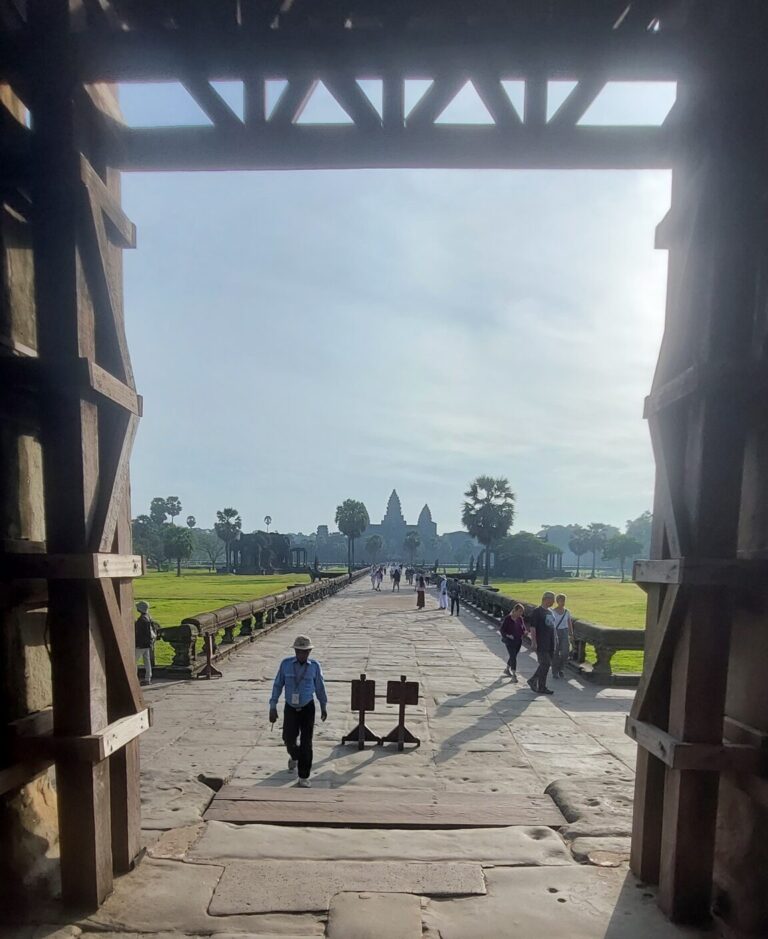
Entry to the temple complex is primarily through the West Entrance, where staff scan and verify your Angkor Pass at the outer checkpoint. From here, you walk across the ancient stone bridge spanning the main moat and pass through the grand outer gopura (gatehouse). This route delivers the iconic full-frontal view of the five spires as you approach the reflection ponds.
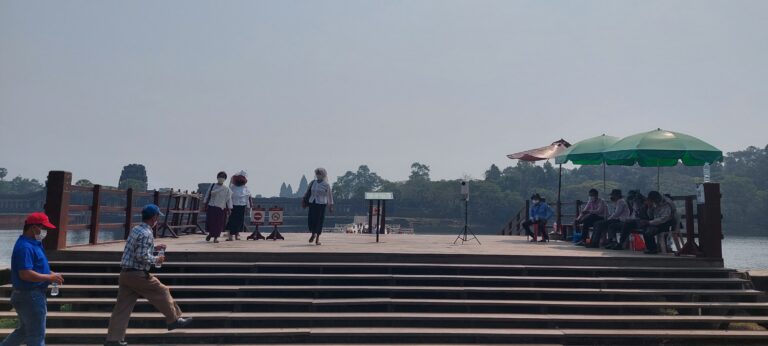
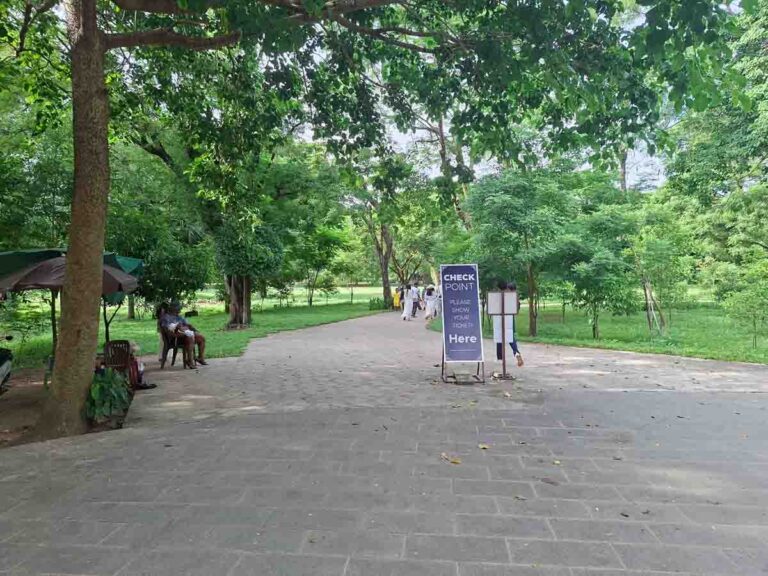
The main ticket checkpoint area positioned along the stone walkway before crossing over to the outer entrance gate of Angkor Wat.
Ticket checkpoint at Angkor Parvis
Note on Walking Distances:
The main approach from the vehicle drop-off area across the moat to the central temple towers is approximately 450 meters (1,500 feet) over open, exposed sandstone and unpaved paths. If you or someone in your group has trouble with long walks, heat exposure, or uneven steps, explore our accessible Angkor Wat tour options designed with shortened walking routes, golf cart options, and ramp access.
Looking back through the outer gatehouse toward the main causeway. In the far distance across the moat is the outer ticket checkpoint where your Angkor Pass is checked before you cross.
Insider Tip: The Peaceful East Gate Alternative
Angkor Wat at sunrise from the quiet East Gate entrance
If you want to avoid the pre-dawn crowds on the main causeway, ask your driver to drop you off at the East Gate (Back Entrance).
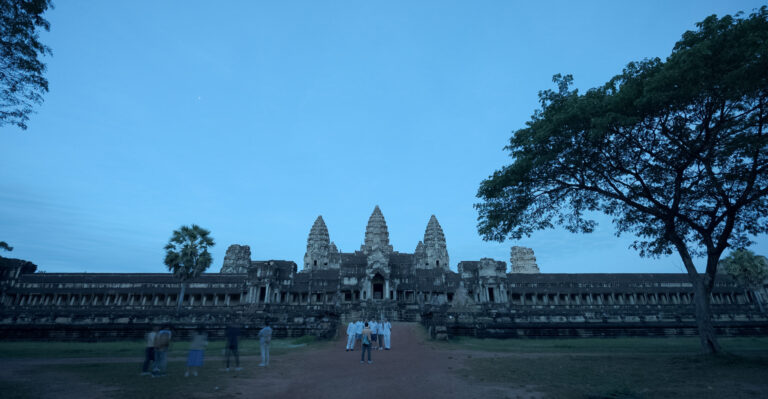
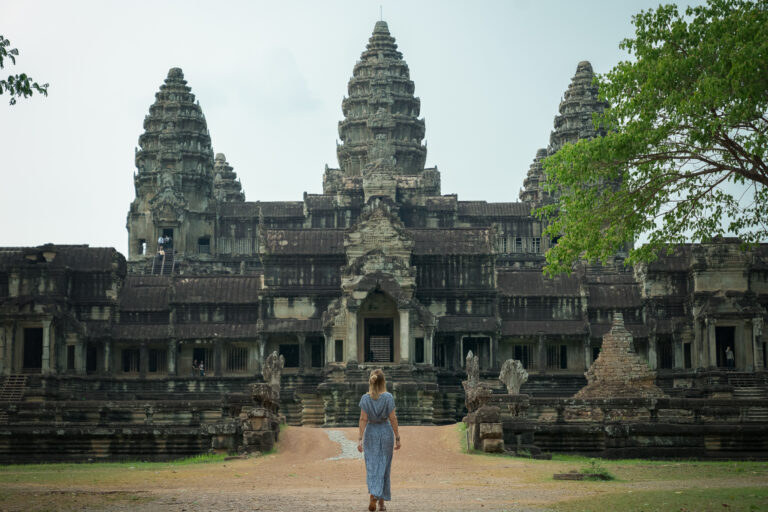
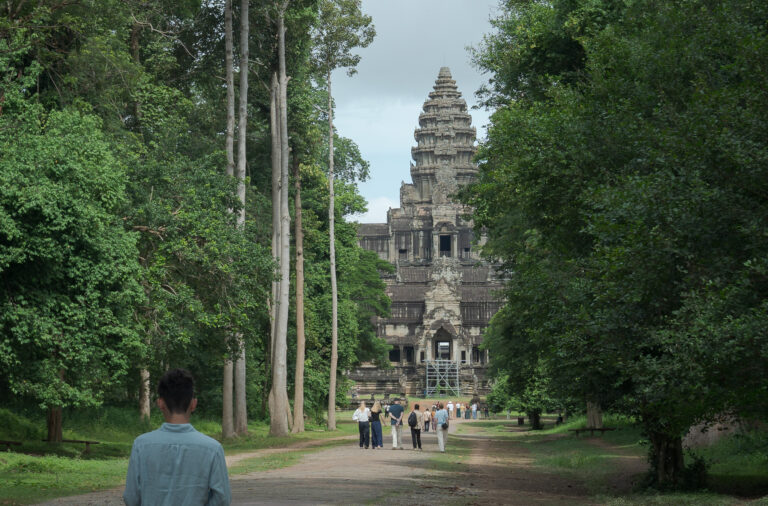
While the approach is less grand and requires a walk through the quiet eastern grounds in the dark, the trade-off is immense: you arrive in near-total serenity, avoiding the shoulder-to-shoulder rush of hundreds of tourists at the main entrance. Keep in mind that from this side, the sun rises behind you rather than behind the temple towers, so you won’t get the classic Angkor Wat sunrise silhouette seen from the western entrance.
A female visitor walking along the quiet dirt path toward the eastern back entrance towers of Angkor Wat
Tree-lined path leading to the East Gate entrance of Angkor Wat
Key Highlights along the East Route:
Uncrowded Atmosphere: You will likely be one of only a handful of people walking through the forest path early in the morning.
The East Library: One of the first major stone structures you encounter as you emerge from the trees, offering incredible early morning light free of crowds.
Rear Photography Angles: The eastern facade of Angkor Wat provides dramatic, leafy frame shots framed by massive jungle trees, perfect for wide-angle photography before heading inside the main enclosure.
Quiet eastern view of Angkor Wat back entrance towers framed by large leafy green trees under dramatic clouds
The eastern library structure, one of the first impressive stone buildings you see when entering Angkor Wat from the quiet rear East Gate.
Angkor Wat Sunrise Strategy: Best Spots, Timings & Crowds
Watching the sun rise behind the five lotus-towers of Angkor Wat is the quintessential Siem Reap experience. However, because hundreds of travelers gather at the same moat edges every morning, a bit of advance planning makes the difference between a serene morning and standing shoulder-to-shoulder in a crowd of sometimes loud visitors.
Prefer a hassle-free morning? Let our experienced local drivers handle the early 4:30 AM wake-up logistics. Check out our Private Angkor Wat Sunrise Tour for custom transport, cold water, and direct hotel pick-up.
Key Timings & Seasonal Shifts
5:00 AM: Main park gates and the outer moat checkpoints open year-round.
Dry / Cool Season (November – February): Sunrise occurs between 6:05 AM and 6:25 AM. Expect the largest crowds of the year.
Hot / Monsoon Season (March – October): Sunrise shifts earlier to between 5:30 AM and 5:55 AM.
Arrival Recommendation: Leave your hotel in Siem Reap town by 4:30 AM. This gives you a 20-minute drive, time to clear the ticket checkpoint, and a 10-minute walk across the main causeway in the dark before dawn breaks.
What to bring for Angkor Wat sunrise
You don’t need much for an Angkor Wat sunrise visit, but a few things make the early start considerably easier:
Phone with a flashlight: You’ll arrive while it’s still dark and some paths around Angkor Wat are poorly lit. Make sure your phone is charged and the flashlight is easy to access. A small torch is useful if you have one.
Water: Bring water with you, particularly during the hotter months. Drinks are also available from vendors around Angkor Wat after sunrise.
A small snack: With such an early start, you may want something to eat while waiting for sunrise or afterwards. Food is available around the temple, but choices are limited and bringing a small snack is convenient.
Temple-appropriate clothing: You’ll be entering an active religious and archaeological site after sunrise, so arrive dressed appropriately rather than planning to cover up later.
Your Angkor Pass: Buy your temple pass in advance and have it ready on your phone or as a printed copy so you don’t need to visit the ticket office that morning.
Camera or phone: Sunrise conditions change quickly, so have your camera ready before the colour starts to appear.
Essential Logistics Tip: Never stop at the physical ticket office on the morning of your sunrise trip unless absolutely necessary. Purchase your Angkor Pass online at least one day prior so your driver can head straight to the temple gates.
Essential Photography Tip: If you’re using a camera with interchangeable lenses, don’t leave it in an air-conditioned room overnight. Taking a cold camera straight outside into Cambodia’s humidity can cause heavy condensation and fog your lens, sometimes for quite a while. If possible, keep your camera somewhere without air conditioning overnight, such as the bathroom. Otherwise, keep it sealed inside your camera bag when you first go outside and give it time to gradually warm up before opening the bag.
1. The South Reflection Pond (The Primary Reflection Spot)
The Experience: Because of ongoing conservation work at the northern pond, the South Pond is currently the main spot to capture the iconic mirror-reflection of Angkor Wat’s five towers in the water.
The Reality: It is by far the most crowded area at sunrise. To secure a front-row spot directly at the water’s edge without someone’s phone or tripod in your shot, you need to arrive in the dark around 5:00 AM.
Best For: Visitors who consider the traditional water-reflection photo an absolute must-have for their trip.
Sunrise over Angkor Wat reflected in the northern pond, one of the classic sunrise viewpoints inside the temple complex.
2. The North Reflection Pond (Restoration & Construction)
The North Reflection Pond offers a different perspective of Angkor Wat and was once another good option for sunrise photography. It sits away from the main sunrise crowds and gives you a wider view of the temple, palms and surrounding landscape.
However, ongoing restoration work has changed this area considerably, so we don’t currently recommend relying on the northern pond as your main sunrise spot. The photos below show how the area looked before the current work began.
• The Ground Reality: The northern pond is undergoing long-term restoration and embankment repairs by the APSARA Authority. Depending on the current stage of work, you may see scaffolding, drained sections or active work areas, making it less reliable for sunrise reflections.
• Best For: Passing by after sunrise to see the area and ongoing conservation work, but we wouldn’t currently rely on it for your main Angkor Wat sunrise photo.
Sunrise from behind the northern reflection pond at Angkor Wat, with the sun rising to the south of the central towers. The sunrise position moves across the horizon throughout the year. This photograph was taken before the current restoration work around the pond.
The North Reflection Pond before the current restoration work, showing the classic reflection of Angkor Wat.
3. Northwest Pavilion – A Quiet Sunrise Spot
For a quieter Angkor Wat sunrise, the area near the Northwest Pavilion is a good alternative to the busy reflection ponds. It’s closer to the temple than the classic sunrise viewpoints, giving you a different perspective of the towers, and we’ve found this area is usually very quiet in the early morning.
The main disadvantage is that it can be tricky to find in the dark, particularly on your first visit. Save the coordinates before you arrive so you can navigate directly to the area.
Crowds: Usually very quiet Best for: A peaceful sunrise and closer views of Angkor Wat Downside: No reflection, and slightly difficult to locate before daylight Coordinates:13.413307, 103.866037
Our tip: Save the location before leaving your hotel. Once there, you may want to explore a little bit to find somewhere comfortable to view sunrise from.
Angkor Wat at sunrise from near the Northwest Pavilion, a quiet viewpoint away from the reflection ponds
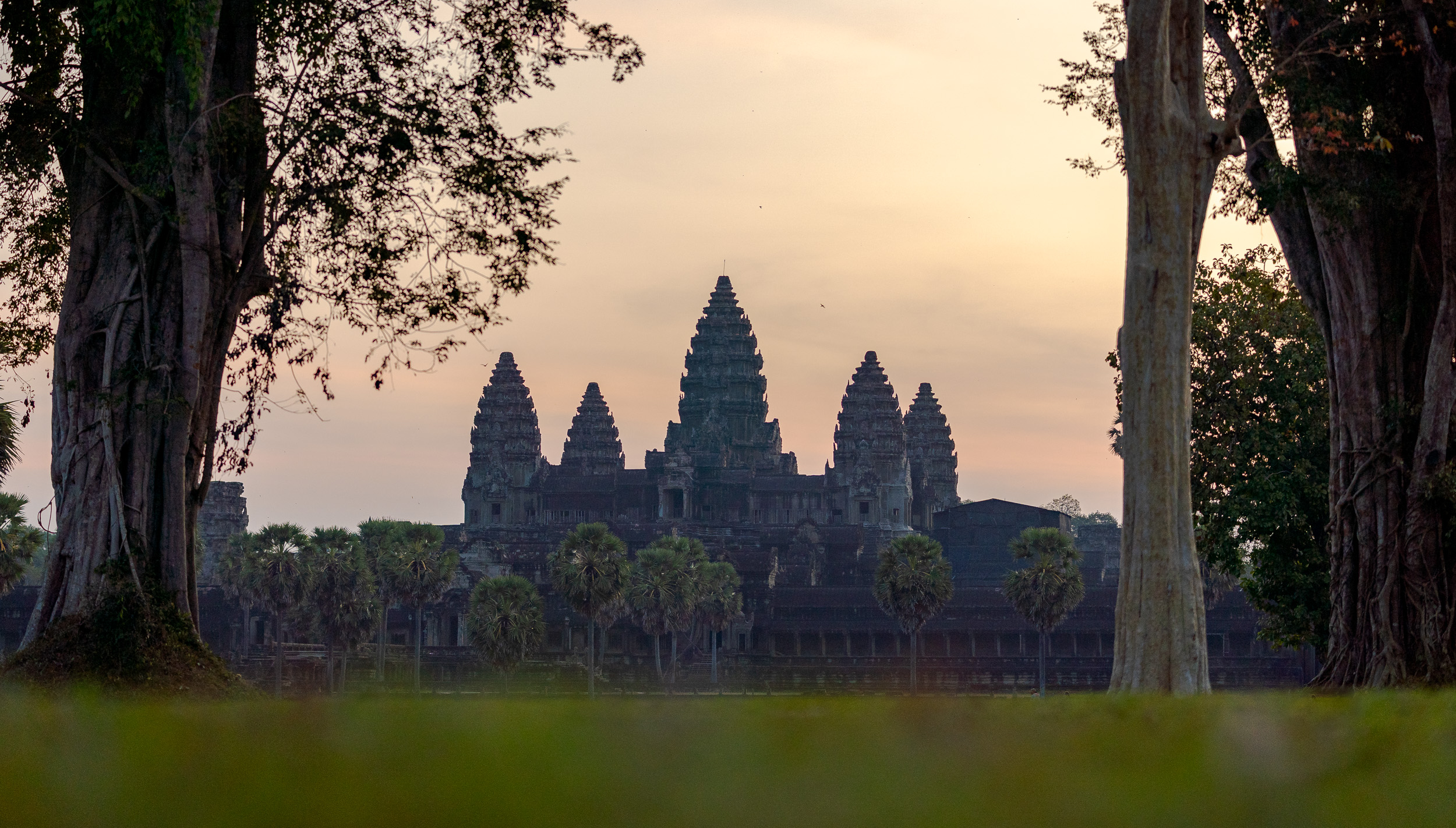
Angkor Wat temple towers silhouetted against early morning sky viewed from ground level through trees
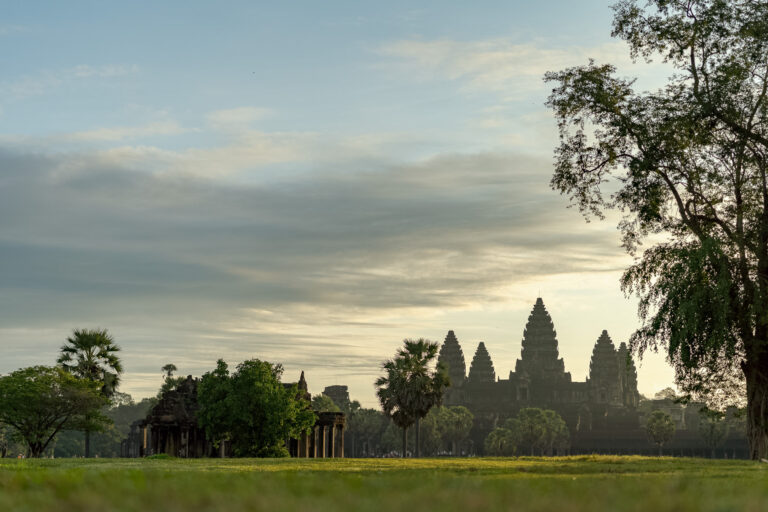
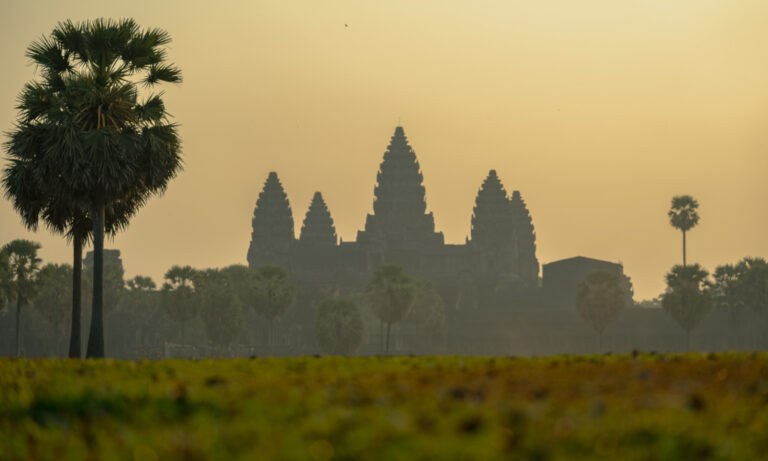
4. The Southern Lawn (One of our Favorite Uncrowded Spots)
If the reflection ponds are too crowded, walk 50–100 metres back from the southern pond onto the open lawn. Very few sunrise visitors come this far back, despite it offering a clear view of Angkor Wat and plenty of space to find your own position.
Crowds: Usually very quiet Best for: Open views, photography and avoiding the reflection pond crowds Downside: You lose the classic reflection and Angkor Wat appears smaller in the frame
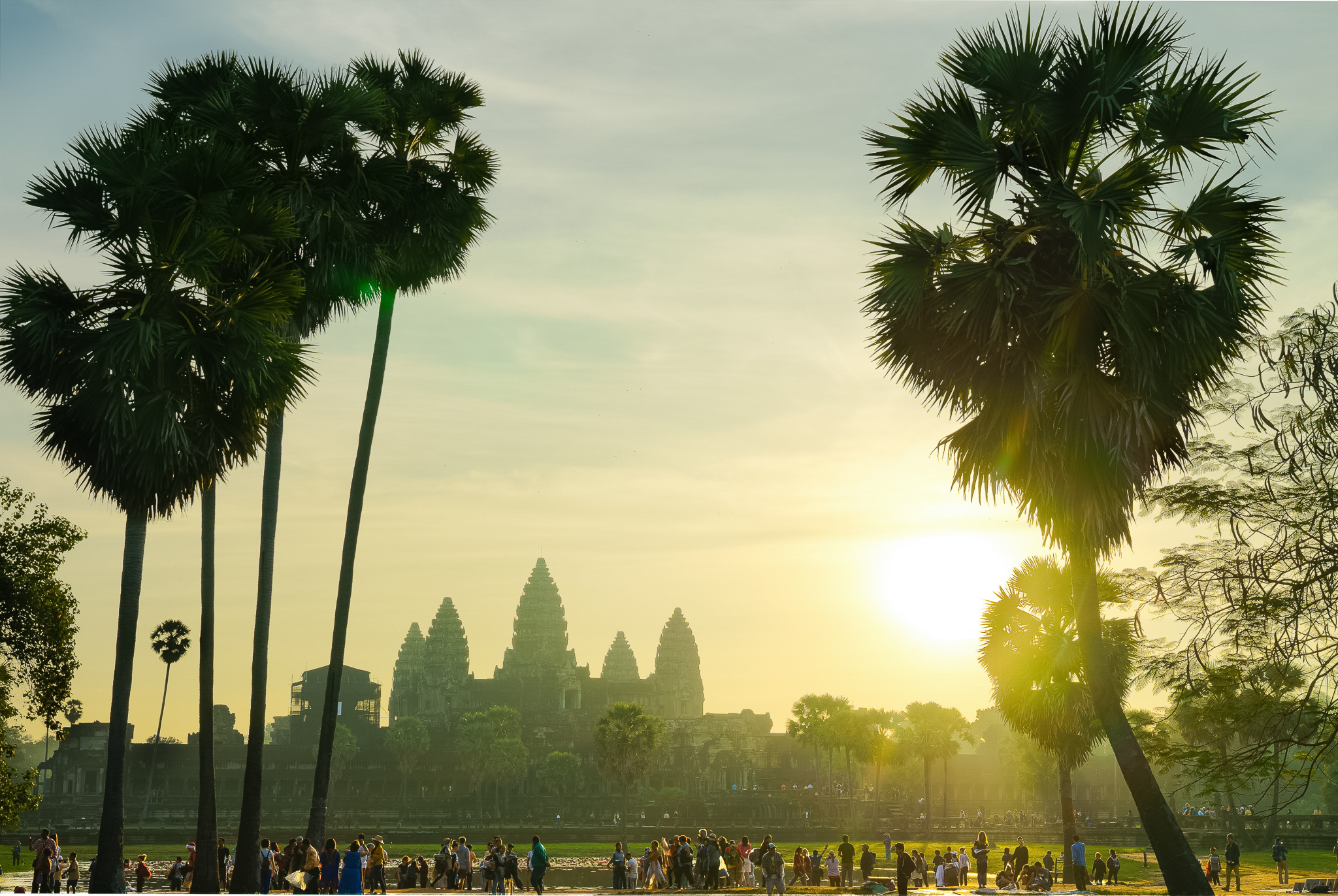
The view is quite different from the reflection ponds. From here, palm trees can be used to frame the towers, while the open grass gives you much more freedom to move around and choose your composition. The temple also catches the early morning light beautifully once the sun begins to rise.
Our photography tip: You may still be able to see the reflection pond crowd in the distance, but the slightly raised ground makes them surprisingly easy to hide. Get your camera or phone lower to the grass and use the foreground to block the people below. The photograph shown here was taken using this technique – there were plenty of visitors near the reflection pond, even though none are visible in the image.
Sunrise from the southern lawn, a quieter viewpoint away from the main reflection pond crowds.
Angkor Wat from the Southern Lawn shortly after sunrise, with open grass and very few visitors away from the main reflection ponds.
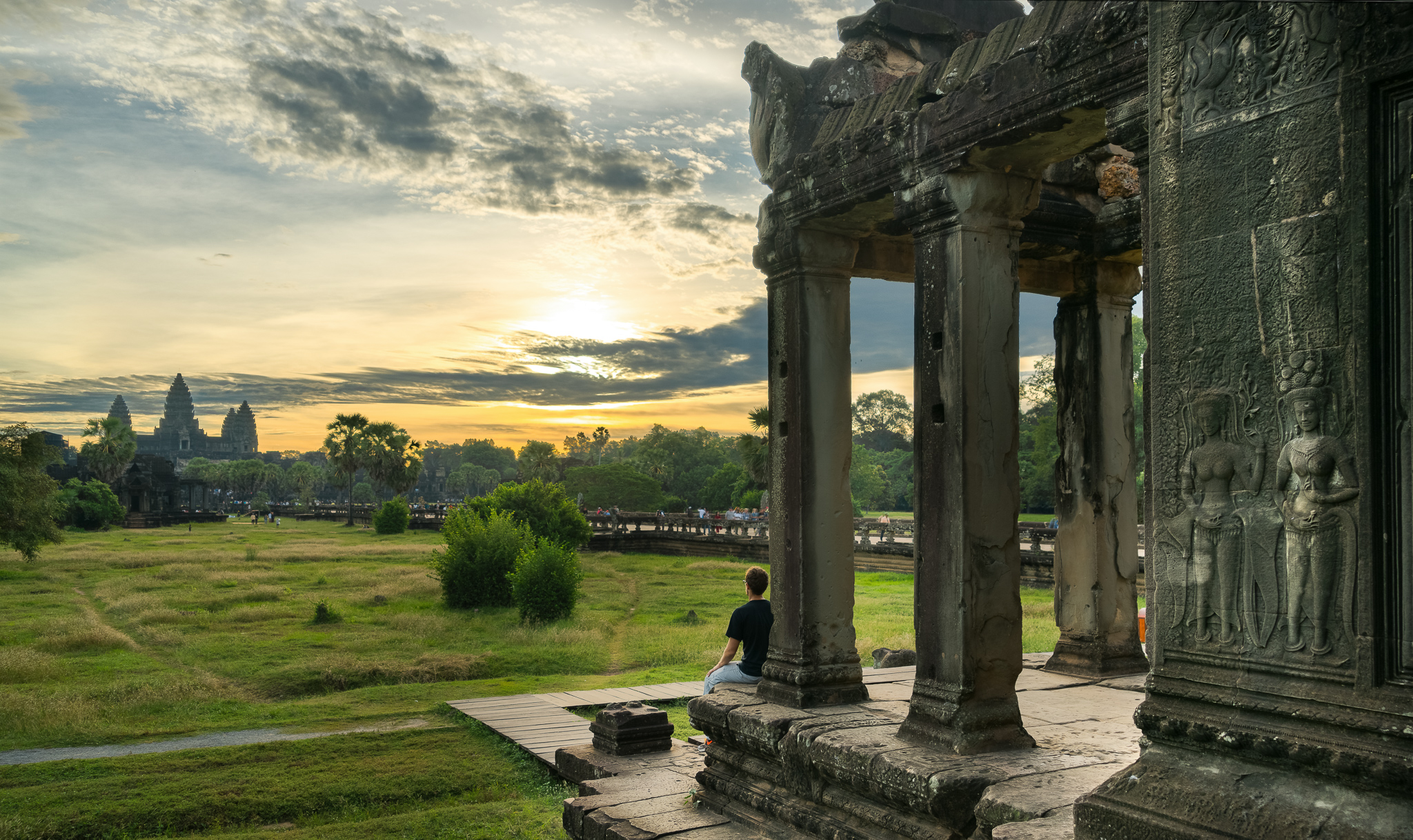
5. Outer West Gatehouse – An Easy, Quiet Sunrise Spot
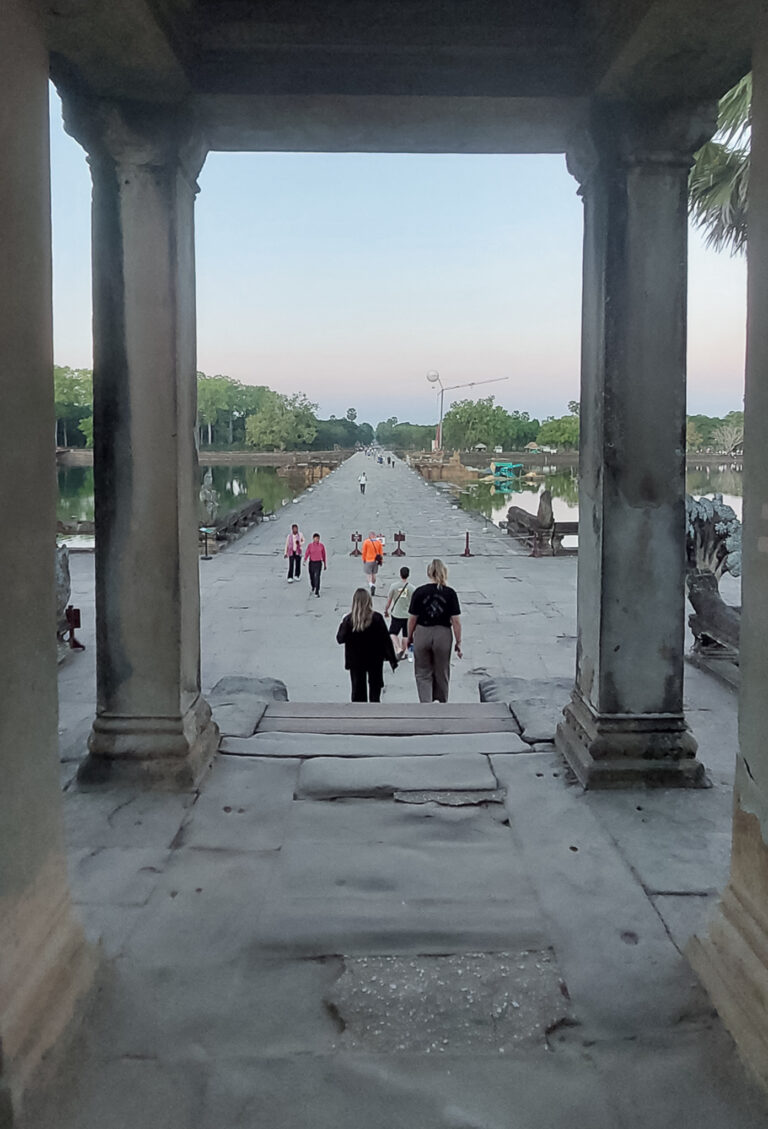
Most visitors walk straight through the West Gatehouse and continue along the causeway towards the reflection ponds. Instead, stop as soon as you pass through the gate. The stone ledges around the entrance provide an elevated place to sit and watch the early light change over Angkor Wat and the causeway, without joining the main sunrise crowd
Crowds: Usually very quiet Best for: An easy-to-find alternative to the reflection ponds, sitting down and experiencing sunrise away from the main crowd Downside: No reflection, and the temple towers are more distant than at some of our other recommended viewpoints Coordinates:13.412799, 103.861974
Where to sit: After walking through the West Gatehouse, look for the raised stone ledges beside the entrance. The photograph above looks back towards the gatehouse, away from Angkor Wat. The person sitting on the stone ledge is at the exact area we’re recommending.
Our tip: Save the coordinates before leaving your hotel, although this is one of the few alternative sunrise locations that is genuinely difficult to miss. Don’t automatically follow the crowd down the causeway when you enter. Stop here for a few minutes, find a comfortable position and watch the early light before continuing towards Angkor Wat.
Looking back towards Angkor Wat's West Gatehouse. The person sitting on the stone ledge shows the quiet sunrise location at 13.412799, 103.861974.
When you see this view of Angkor Wat from inside the West Gatehouse, turn left before stepping onto the causeway to reach our quiet sunrise viewpoint.
What to Do After After Viewing Sunrise
Between 6:15 AM and 6:45 AM, depending on the time of year, the sunrise crowd begins to disperse. Some visitors stop for breakfast near the reflection ponds, while many head straight across the causeway and into Angkor Wat.
Our strategy: Head inside, but don’t immediately follow everyone towards the central towers. Instead, spend some time exploring the outer galleries and bas-reliefs. The long stone corridors contain some of Angkor Wat’s most remarkable carvings, including the famous Churning of the Ocean of Milk.
The galleries are particularly atmospheric in the early morning. Low sunlight enters through the openings and falls across the carvings, bringing out details that can be much harder to see in flatter midday light.
After exploring the galleries, continue towards the centre of Angkor Wat and the Bakan, the elevated central sanctuary containing the temple’s iconic towers. This gives the initial post-sunrise rush a little time to move through while you’re seeing an important part of Angkor Wat that many visitors hurry past.
Early morning light falling across the stone bas-reliefs inside Angkor Wat's outer galleries.
Proceed inside the temple
Once you’ve finished exploring the outer galleries, continue deeper into Angkor Wat towards the central towers. From here, the temple changes noticeably as you leave the long bas-relief corridors behind and enter a series of courtyards, galleries and increasingly elevated levels.
There’s no need to rush. Take your time moving through this part of the temple – the central sanctuary is ahead, and we’ll look at what to see there next.
Detailed stone bas-relief carvings of figures inside an Angkor Wat gallery
Visiting Angkor Wat with Limited Mobility
Angkor Wat can still be a rewarding place to visit if you have limited mobility, although some parts of the temple are much easier to access than others. The main approach to the temple is relatively flat, but there are uneven surfaces, stone steps and raised thresholds as you move further into the complex.
Visitors who are comfortable walking shorter distances can still experience the main exterior views, reflecting ponds and significant parts of the lower levels of Angkor Wat. Taking your time and allowing longer for the visit makes a considerable difference, particularly in the heat.
Wheelchair access becomes more difficult inside the temple because of steps, narrow passages, uneven ancient stonework and changes in level. Assistance may be needed in some areas, and not every part of the complex can be reached in a wheelchair.
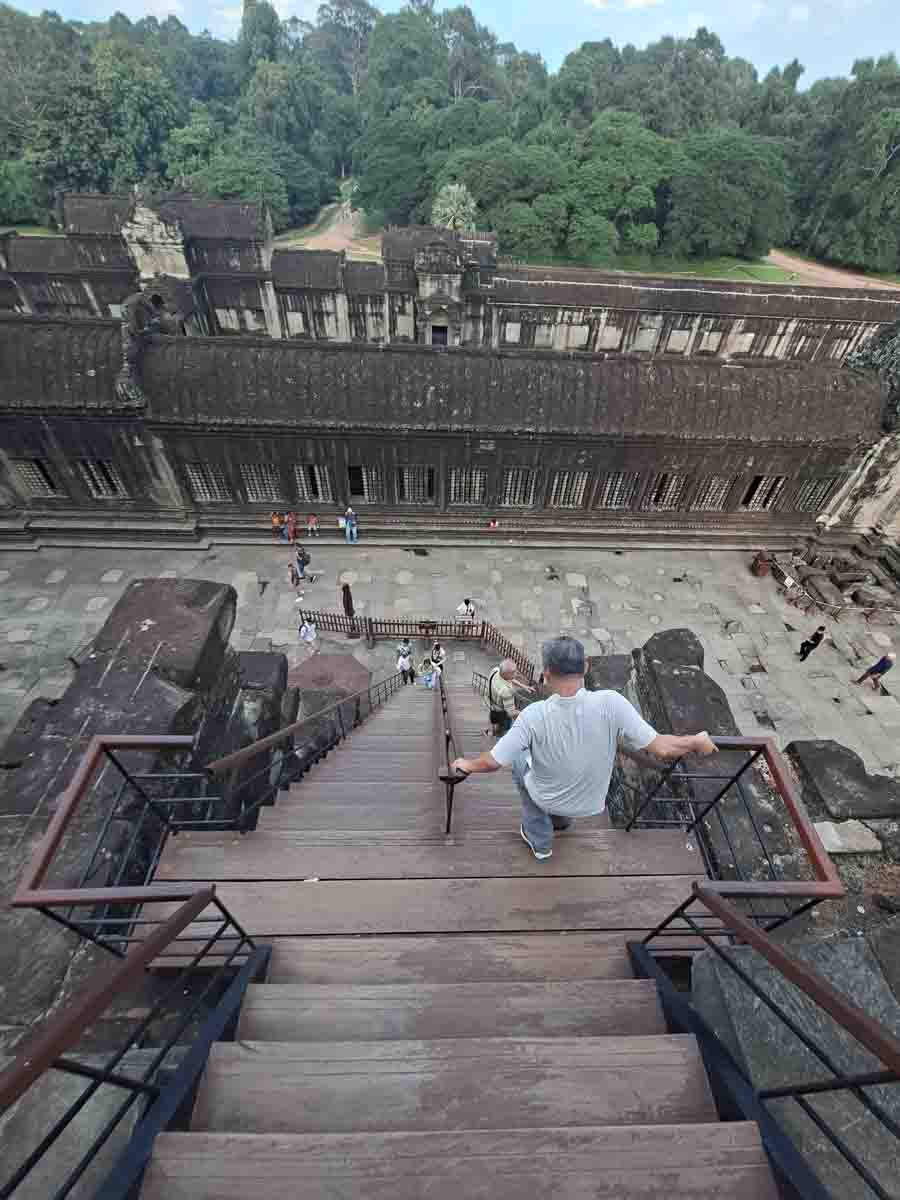
The Bakan, the uppermost level of Angkor Wat, requires climbing a very steep staircase and is not suitable for wheelchair users or visitors who are uncomfortable with steep steps. There is still plenty to see without going to the upper level.
If mobility is a concern, a private vehicle can also make exploring the wider Angkor Archaeological Park considerably easier, as your day can be planned around shorter walks, convenient drop-off points and temples that are easier to access.
Planning an accessible visit?
We can arrange private accessible tours with suitable transport and additional assistance where needed.
Angkor Wat works well with children if you plan around the heat. Children under 12 currently enter without an Angkor Pass, though staff may ask to see a passport to confirm age, so bring one for each child. The site is open and shaded in places, but there is a lot of walking on uneven stone, so comfortable closed shoes matter more than they do for adults.
Go early. The 5:00 AM opening is the coolest part of the day, and most families do better with sunrise or a morning visit and a long break at the hotel pool in the afternoon. By late morning the heat and the crowds can wear children out quickly. Bring more water than you think you need, along with hats and sunscreen, and plan on stopping for shade and a snack partway through.
The steep stairs are the main concern. Several of the staircases are narrow and very steep, with high steps, and the upper level of the central sanctuary is the hardest to reach. Younger children may not be allowed up to that level, so check the current rules at the site before you plan your visit around it. Strollers are difficult on the stone causeways and steps, so a carrier is easier for toddlers.
A private driver is usually the easiest way to manage the day with kids, because the car or tuk-tuk can wait while you explore and gives you somewhere cool to rest between temples. You can arrange one through our Angkor wat tour page.
Visiting the Central Sanctuary: The Bakan Upper Level
The Bakan rises above the second-tier courtyard at the centre of Angkor Wat. From here, visitors continue to the controlled staircase leading to the upper level.
The Bakan is the highest and most sacred level of Angkor Wat, rising above the surrounding galleries at the centre of the temple. From the second-tier courtyard, you get a dramatic view looking up towards the central sanctuary before reaching the staircase to the top. Access to the upper level is controlled and involves a steep climb, so there are a few things worth knowing before you head up.
Looking up at the central lotus tower of Angkor Wat (Bakan level) from the courtyard of the second enclosure.
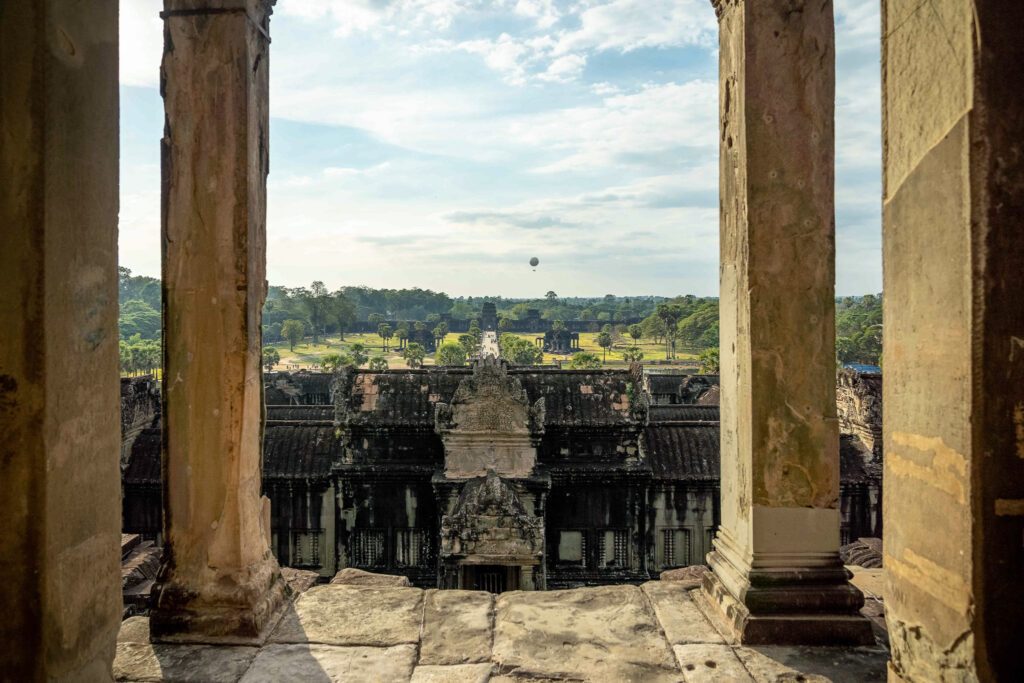
Looking out from the Bakan, the uppermost level of Angkor Wat.
Essential Rules & Access Restrictions
Enforced Dress Code: Unlike the outer grounds where guards might occasionally let small dress violations slide, the Bakan entry point is strictly policed. Shoulders and knees must be covered by actual garments with sleeves and full length—scarves, shawls, or wraps thrown over tank tops are strictly prohibited and guards will turn you away at the stairs.
No hat sign at Bakan, Angkor Wat
Hats Off in Sacred Spaces: You must remove your hat as soon as you enter covered gallery shrines, approach sacred images, or step onto the Bakan upper level platform. Guards and local tour guides will strictly enforce this and ask you to take it off immediately. It’s very easy to forget when you’re focused on taking photos or beating the heat, so be mindful to keep it off while inside the central sanctuary.
Age & Physical Restrictions: Children under 12 years old and pregnant women are not permitted to climb the Bakan stairs.
If members of your group have trouble with high steps or severe mobility challenges, see our accessible Angkor Wat tour for alternative routes around Angkor Wat.
View from the top of the steep Bakan stairs at Angkor Wat
Timing, Lines, & Local Crowd Dynamics
Queue Management: A maximum of 100 to 300 visitors are allowed on the Bakan level at a time. If you do not climb early (around 7:00 AM – 7:30 AM right after sunrise), lines rapidly build up under the open sun. By late morning and afternoon, wait times can easily exceed 45 to 60 minutes on the exposed wooden staging platform.
The “Local Crowd” Shift (Sundays & Khmer Holidays): While international tourist numbers remain relatively steady day-to-day throughout a given month, local Cambodian visitors heavily favor weekends—especially Sundays and public holidays (like Pchum Ben, Khmer New Year, or Water Festival). If your itinerary is flexible, plan your main Angkor Wat visit on a weekday to avoid peak domestic crowd surges.
Buddhist Holy Days (Sacred Closures): The Bakan level is strictly closed to all visitors roughly 4 times per month during Buddhist Holy Days (Buddha Days / Sabbath Days following the lunar calendar). The rest of the temple remains open, but you will not be allowed up the central tower on these dates.
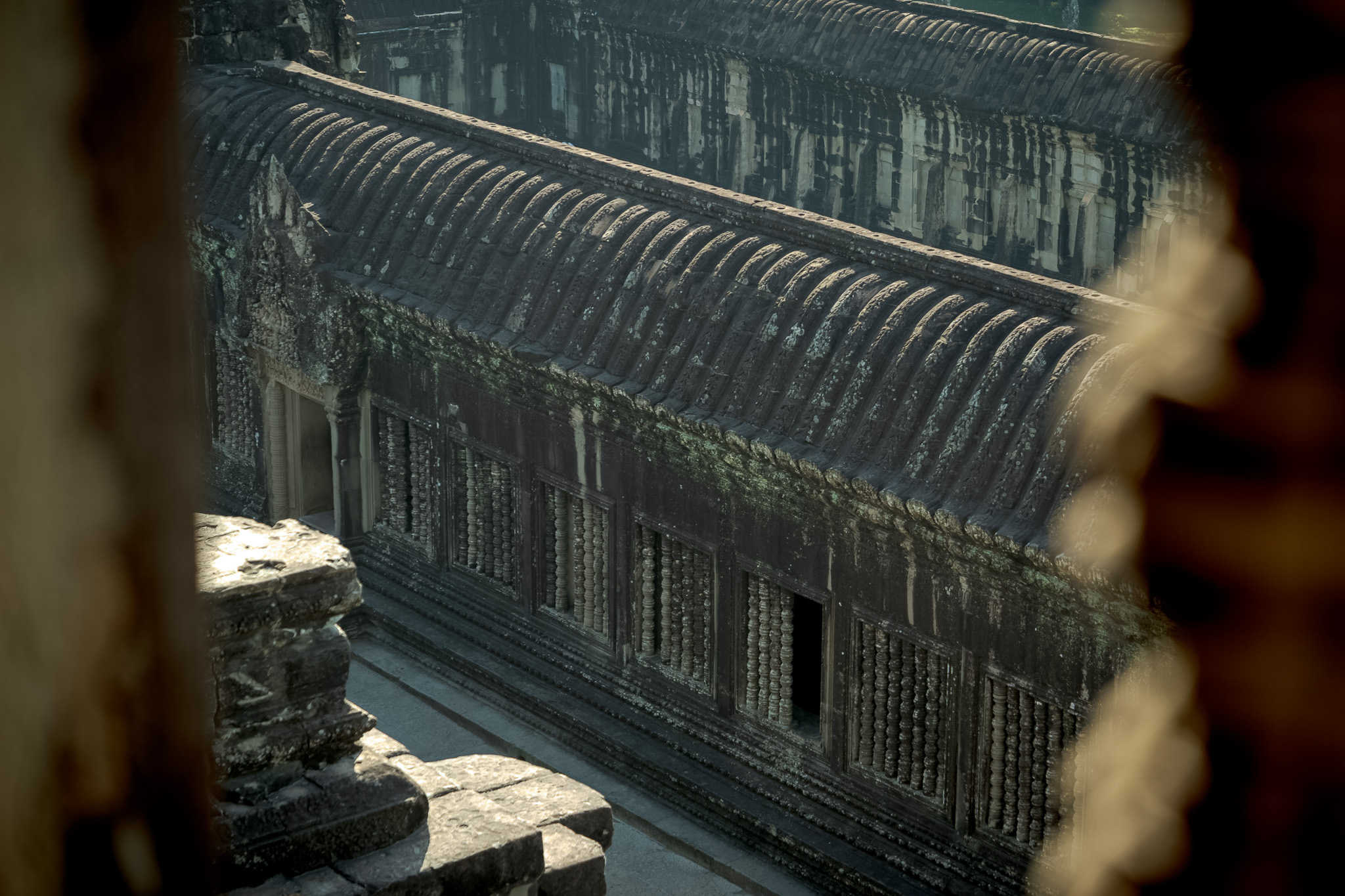
A view down onto one of Angkor Wat's stone galleries from the Bakan upper level.
Pro Tip (Marathons & Major Events):
Annual events like the Angkor Wat International Half Marathon or major cycling races temporarily close or heavily congest the main access roads around the park. If you are planning your trip dates, check our Choosing Which Day to Visit section to avoid unexpected road closures, weekend spikes, and event traffic.
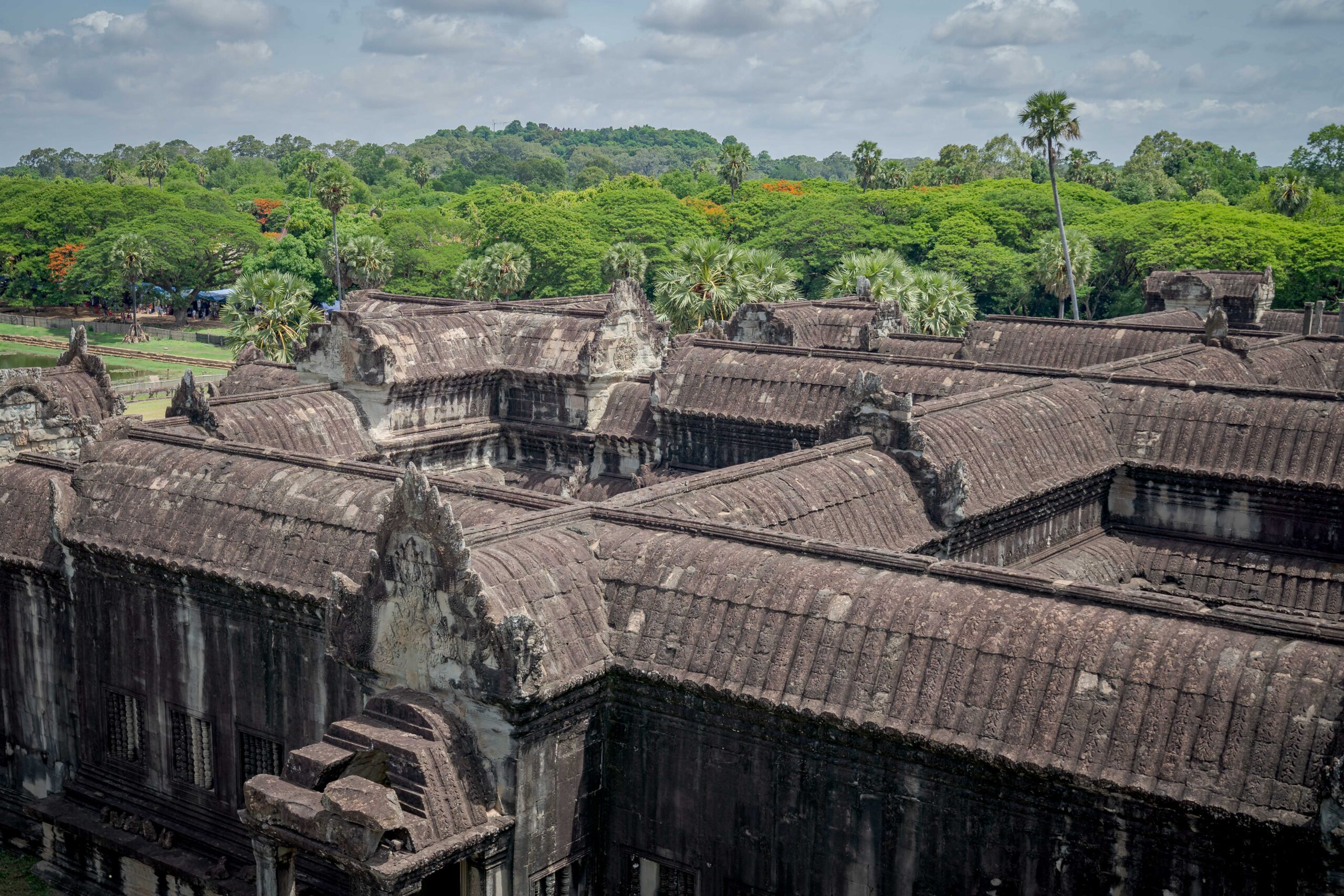
Elevated view looking down at the stone galleries and surrounding jungle canopy from the Bakan upper level of Angkor Wat
A useful tip for leaving Angkor Wat
Most visitors leave Angkor Wat the same way they entered, walking back along the main causeway to the western entrance.
If you have a tuk-tuk or private driver, you can also arrange to enter from the west and be collected from the eastern side of Angkor Wat. This lets you walk through the temple in one direction, see a different side of the complex, and saves you from retracing your steps back to the main entrance.
There is a trade-off. Most visitors continue from Angkor Wat to Angkor Thom, and being collected from the eastern side means your driver has to travel back around Angkor Wat before heading north. You save on walking, but add some driving time.
Our tip: If you’re following the standard Small Circuit, exiting from the west may still make the most sense. On our private Angkor tours, we can plan the pickup point around the itinerary, including less common routes through the park where exiting from the eastern side can work particularly well.
After Angkor Wat: Small Circuit vs. Grand Circuit
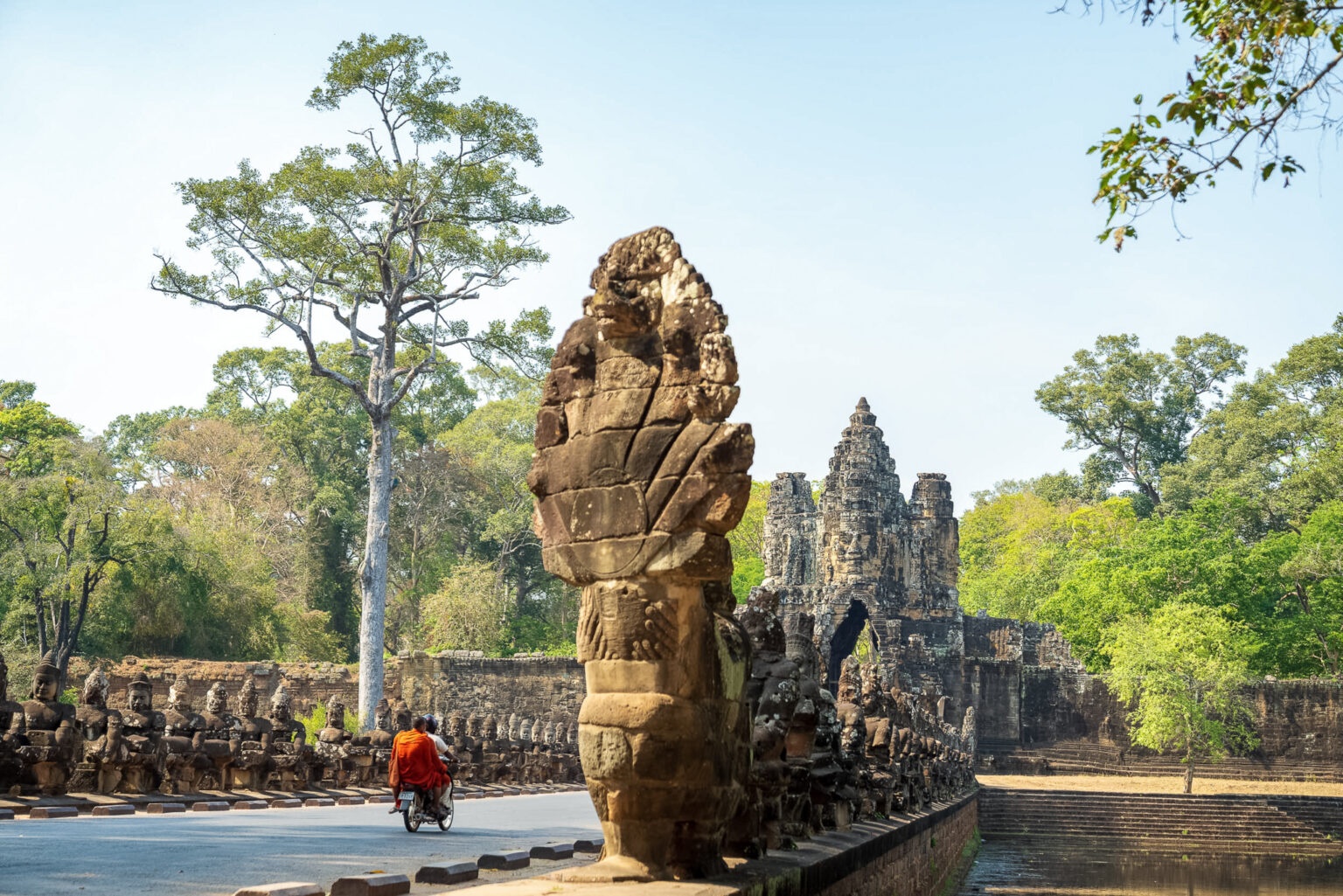
South Gate of Angkor Thom with stone naga balustrade and face tower, Angkor Archaeological Park, Cambodia
Why Do Some Stones at Angkor Look Brand New?
If you see lighter, uncarved sandstone blocks mixed into ancient structures, you are looking at active UNESCO restoration work (anastylosis). Modern teams replace missing or looted stones with smooth blocks to prevent structural collapse while keeping historical repairs distinct from original 12th-century carvings.
Want to learn more about how Angkor was built and restored? Read our full Angkor History & Restoration Guide(coming soon).
The Angkor Archaeological Park spans over 400 square kilometers. To help visitors navigate the park, routes are divided into two main loops: The Small Circuit (Petit Circuit) and The Grand Circuit (Grand Circuit).
For most travelers, the Small Circuit is more than enough. It covers the big highlights like Angkor Wat, Bayon, and Ta Prohm. The Grand Circuit is better suited for history enthusiasts or anyone spending multiple days at the park.
In reality, after 3 to 4 hours of climbing stone steps in intense tropical heat, temple fatigue sets in fast. Taking a mid-day break is strongly recommended – ideally heading back to your hotel for lunch and a swim after exploring 2 of the main temples, then returning late afternoon. Just keep in mind that some drivers or tour operators charge a small extra fee for mid-day hotel returns, so be sure to clarify this before setting off.
1. The Angkor Wat Small Circuit
Best for: First-time visitors, one-day pass holders, and anyone wanting to see Angkor’s most famous temples in one day.
Main highlights: Angkor Wat, Bayon and Ta Prohm.
Standard route: Angkor Wat → South Gate → Angkor Thom (Bayon & Baphuon) → Terrace of the Elephants → Victory Gate → Ta Prohm.
Time needed: Most visitors should allow the majority of a day.
Crowds: Generally the busiest of Angkor’s standard temple circuits, particularly at Angkor Wat, Bayon and Ta Prohm.
The usual small circuit route:
Angkor wat sunrise and reflection
South gate of Angkor Thom
Bayon Temple surrounded by trees in Angkor Thom, Cambodia
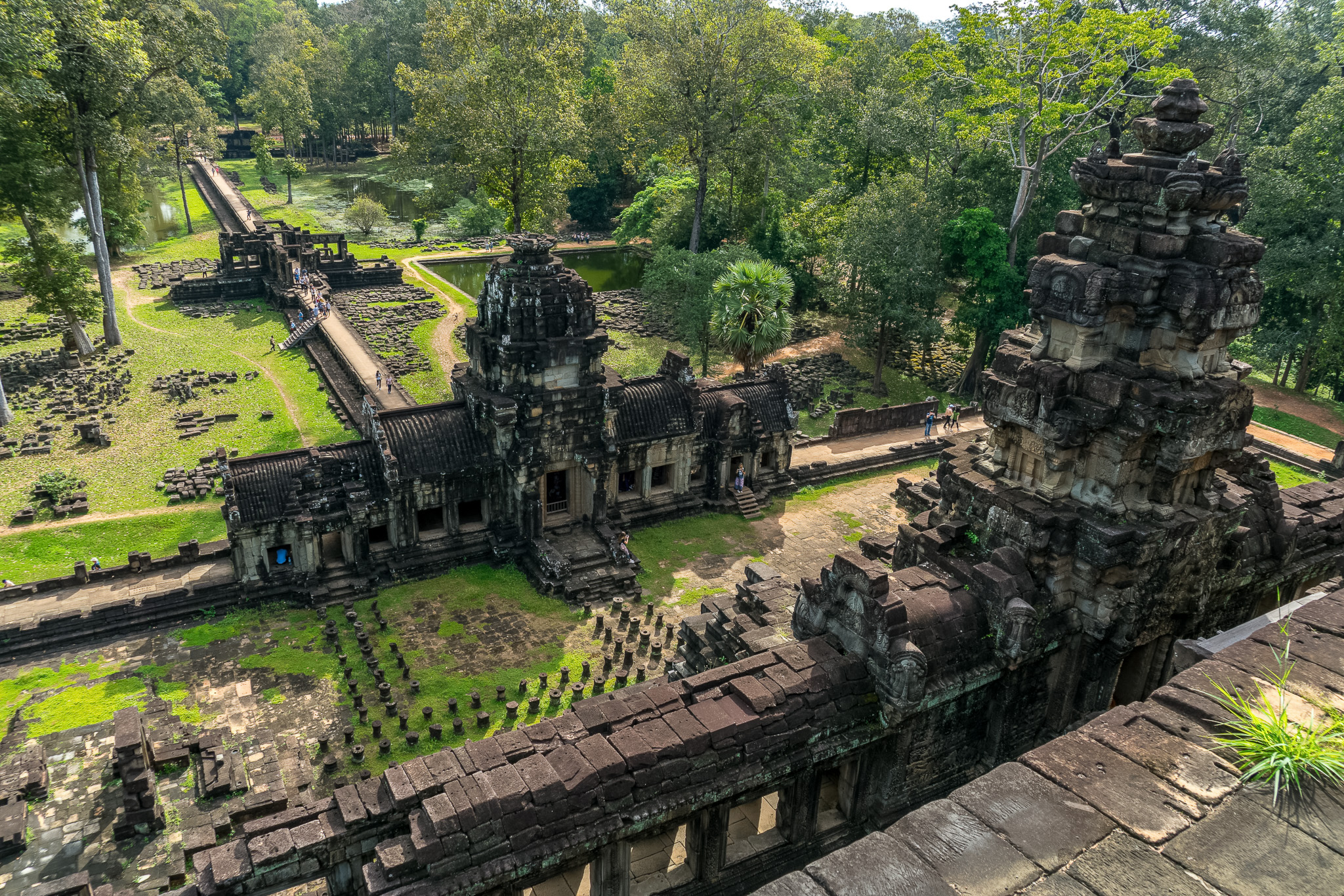
Baphuon temple
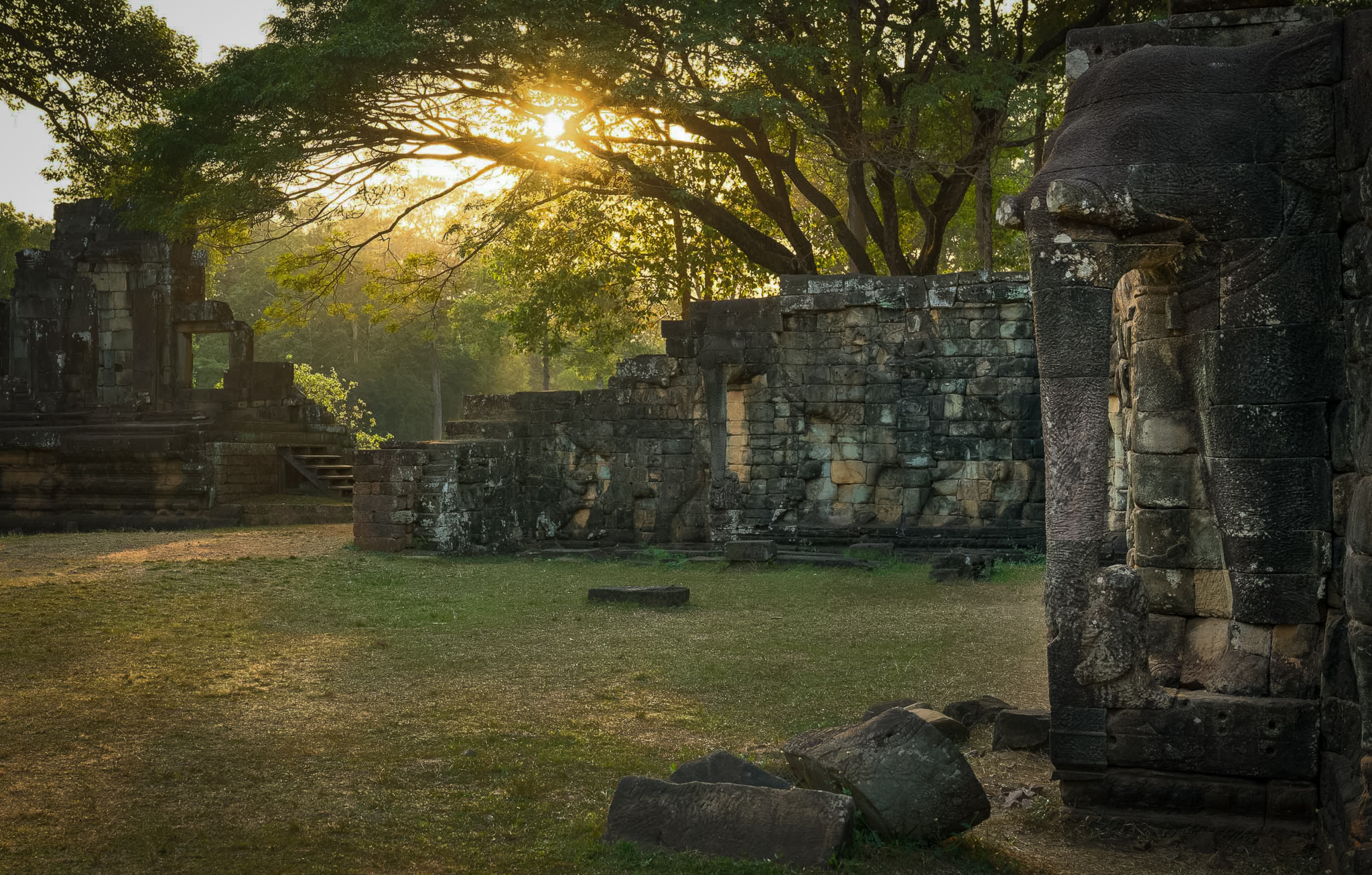
Terrace of the Elephants
Victory Gate
Ta prohm temple
The Angkor Wat Small Circuit is the classic one-day temple route and the itinerary I would recommend to most first-time visitors to Angkor. Despite the name, there is nothing particularly small about it: the circuit connects many of the most important temples and monuments in the central Angkor Archaeological Park and can easily fill an entire day.
The route usually begins with Angkor Wat, before continuing through Angkor Thom and around the eastern side of the archaeological park towards Ta Prohm. There are numerous temples and smaller monuments along the way, which means the exact itinerary can be adjusted considerably depending on how much time you have and how thoroughly you want to explore.
For most visitors, however, the Small Circuit revolves around three major temples: Angkor Wat, Bayon and Ta Prohm. These are the sites that receive the most attention and where most people spend the greatest amount of time.
Why don't tour drivers take you to every stop on the Small Circuit?
While the full Small Circuit list includes plenty of minor temples along the road, the reality is that temple fatigue and heat exhaustion hit fast.
After spending hours climbing steep stone steps, walking through massive complexes, and dealing with intense tropical humidity, most visitors are completely exhausted after seeing the big three, Angkor Wat, Bayon and Ta Prohm. Drivers streamline the route to focus on these highlights so you don’t burn out before midday.
If you do want to visit smaller stops on the Small Circuit like Ta Nei, Chau Say Tevoda, or Banteay Kdei, simply ask your driver in advance, just be prepared for extra walking.
Angkor Wat sunrise
Angkor Wat Sunrise
For most visitors, the Small Circuit starts before dawn at Angkor Wat. Arriving early gives you time to find a sunrise position before exploring the temple itself as the light improves.
We cover Angkor Wat and sunrise photography in detail earlier in this guide, including where to stand, what time to arrive and what to do after sunrise. Once you have finished at Angkor Wat, the usual Small Circuit route continues north towards Angkor Thom and the South Gate.
Angkor Wat Sunrise with reflection
Angkor Thom, South Gate
The South Gate of Angkor Thom
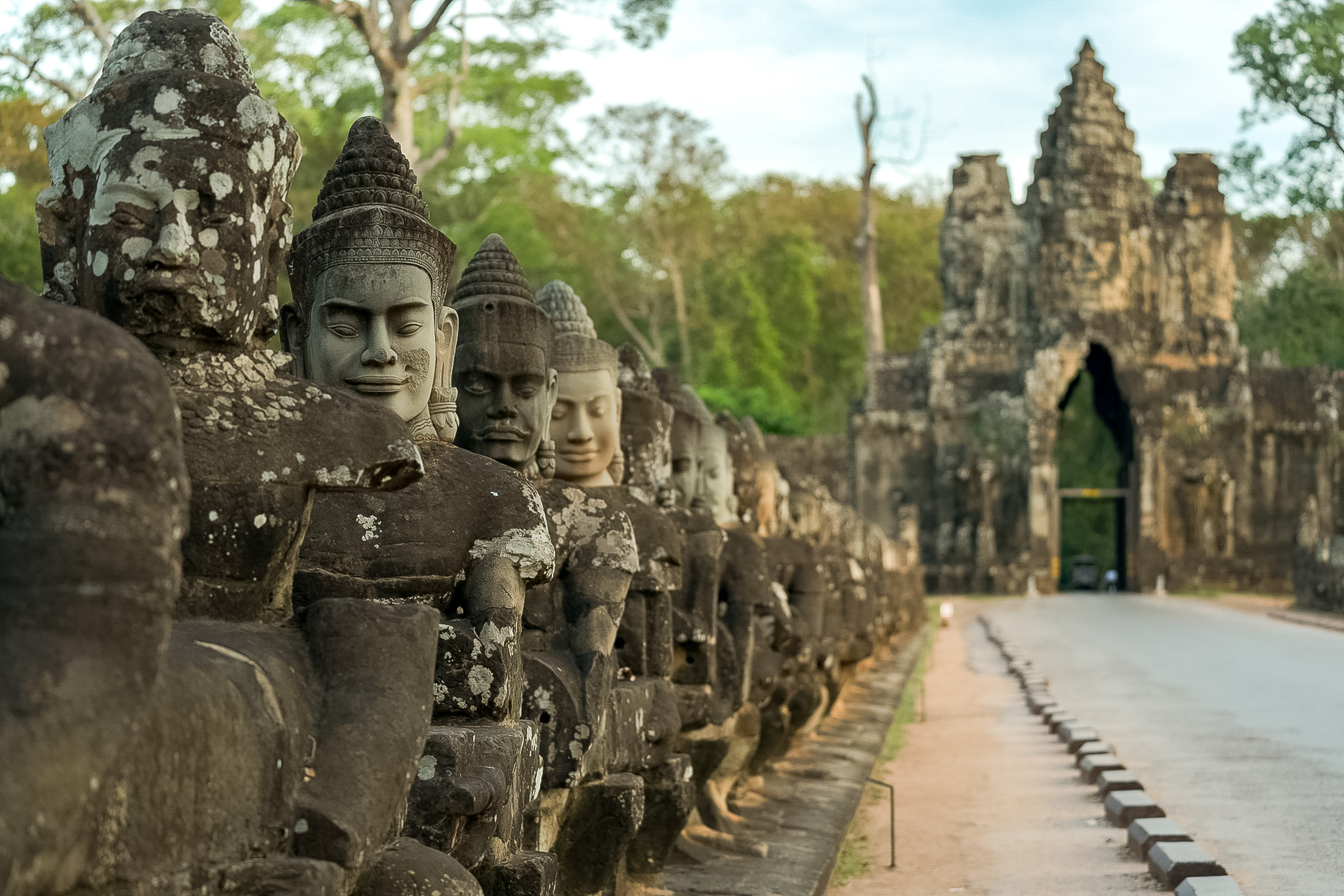
The South Gate is the main entrance to Angkor Thom and, for most visitors, the first glimpse of the enormous walled city built by King Jayavarman VII. The road crosses the moat along a causeway lined with 54 gods on one side and 54 demons on the other, each holding the body of a giant naga in a scene associated with the Churning of the Ocean of Milk.
The gate itself is one of five entrances to Angkor Thom. Look up as you approach and you’ll see the huge stone faces above the gateway, facing in four directions. Cars, tuk-tuks and even larger vehicles still pass directly beneath it, which gives the South Gate a very different atmosphere from a temple that exists purely as an archaeological site.
The South Gate is busy for much of the day. Even very early in the morning, before most tourists arrive, locals use this road to travel through Angkor Thom for work, markets and everyday journeys. Not long afterwards, the tour traffic starts. Early morning is still your best chance of seeing the gate relatively quiet, but don’t count on having it completely empty.
Planning to stop here? Read our complete Angkor Thom South Gate guidefor the history of the gate, what to look for, the best viewpoints, when to visit and our first-hand tips from exploring the area.
South gate of Angkor Thom
Why Do Some Stones at Angkor Look Brand New?
If you see lighter, uncarved sandstone blocks mixed into ancient structures, you are looking at active UNESCO restoration work (anastylosis). Modern teams replace missing or looted stones with smooth blocks to prevent structural collapse while keeping historical repairs distinct from original 12th-century carvings.
Want to learn more about how Angkor was built and restored? Read our full Angkor History & Restoration Guide(coming soon).
Bayon: The Smiling Faces
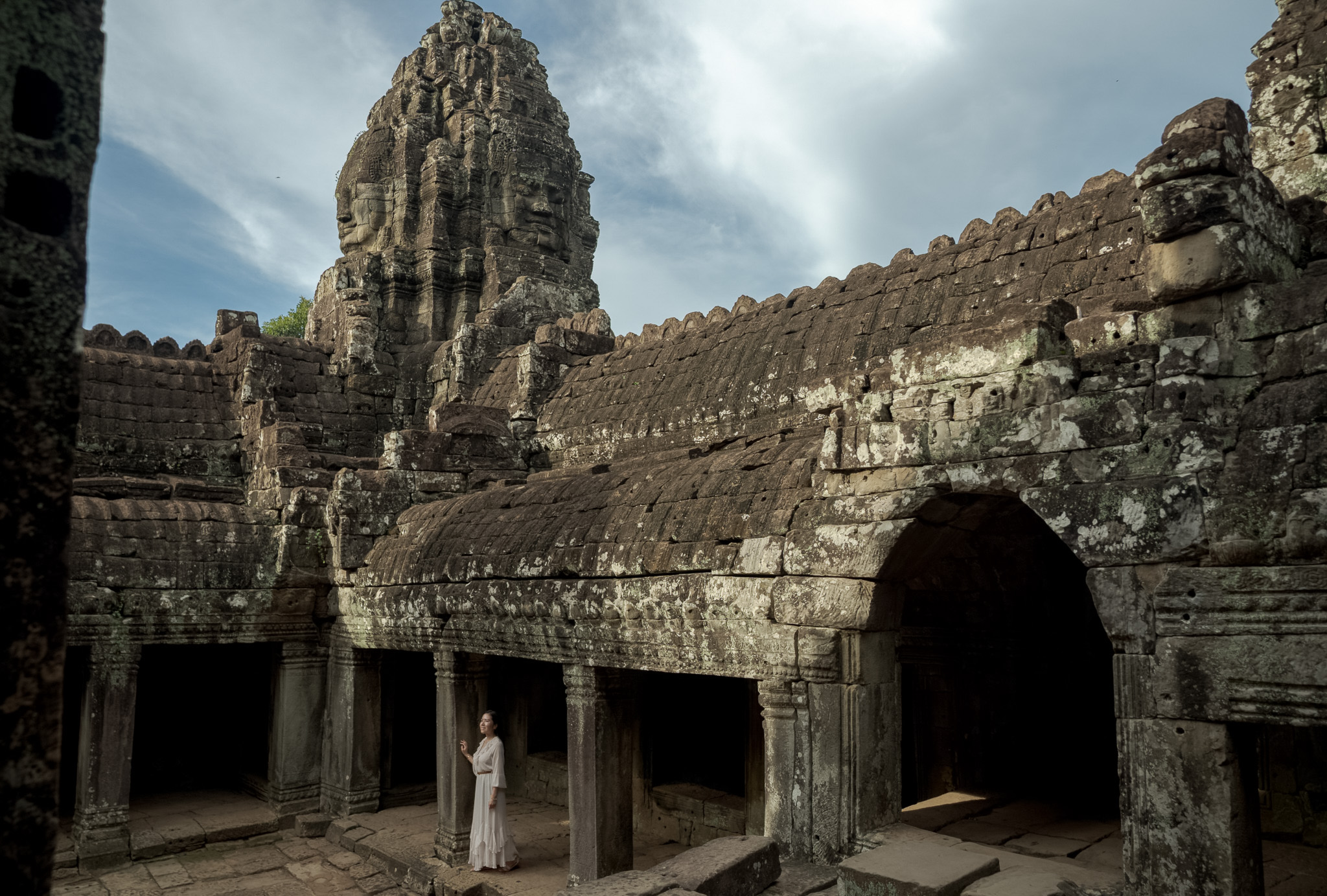
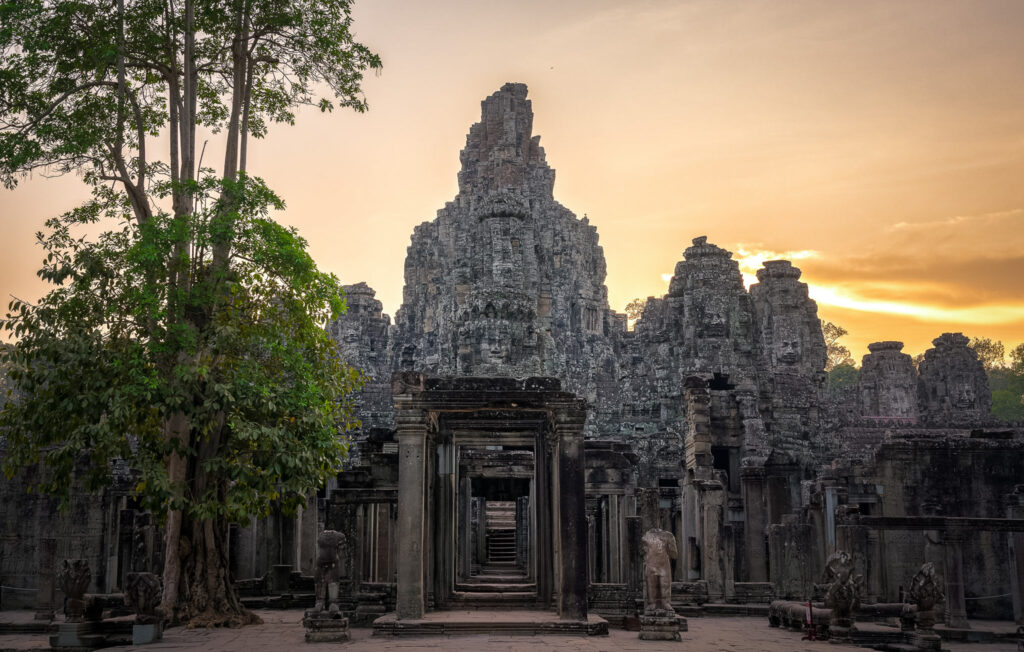
Bayon Temple towers and stone faces in Angkor Thom
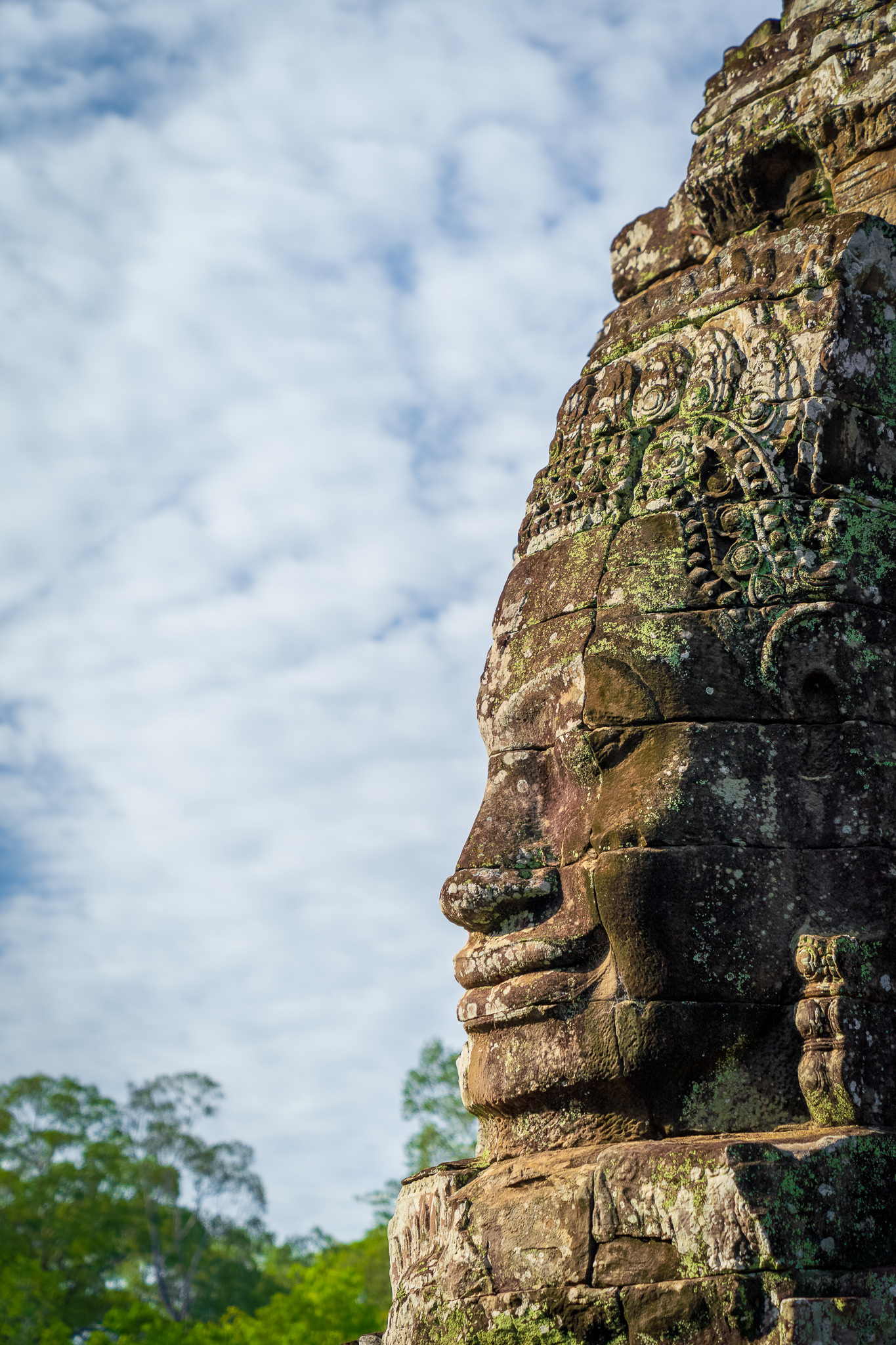
Bayon’s distinctive stone faces
Bayon sits at the exact center of Angkor Thom, and it’s instantly recognizable for the huge stone faces carved into its towers, over 200 of them looking out in every direction. Unlike the flat bas-relief galleries at Angkor Wat, Bayon is built as a dense cluster of towers, so you’re constantly walking between faces at close range rather than viewing them from a distance. It has a completely different feel to Angkor Wat, more compact, more vertical, and in some ways more atmospheric once you’re inside it.
Timing here matters just as much as it does at Ta Prohm. Most visitors head to Angkor Wat first for sunrise, which means Bayon can be remarkably quiet in the early morning. Even if the inner temple hasn’t opened yet when you arrive, the outer views are still worth it, and you may find yourself looking at the faces with barely anyone else around. Once the Angkor Wat sunrise crowd moves on to Angkor Thom later in the morning, that changes fast, so if avoiding crowds matters to you, Bayon is one of the best arguments for skipping the Angkor Wat sunrise altogether and heading here instead.
Photographically, Bayon rewards patience. The faces look different depending on the angle and the light, and late afternoon golden hour brings out strong contrast across the carved stone that the flat light of midday doesn’t. Give yourself time to walk the upper terrace slowly rather than just photographing the first few faces you come across, some of the best angles are tucked into corners that most people walk straight past.
Explore our complete Bayon Temple guide, with our photography, practical visiting advice, the famous stone faces and first-hand tips from our time exploring the temple.
Ta Prohm: The Jungle Temple
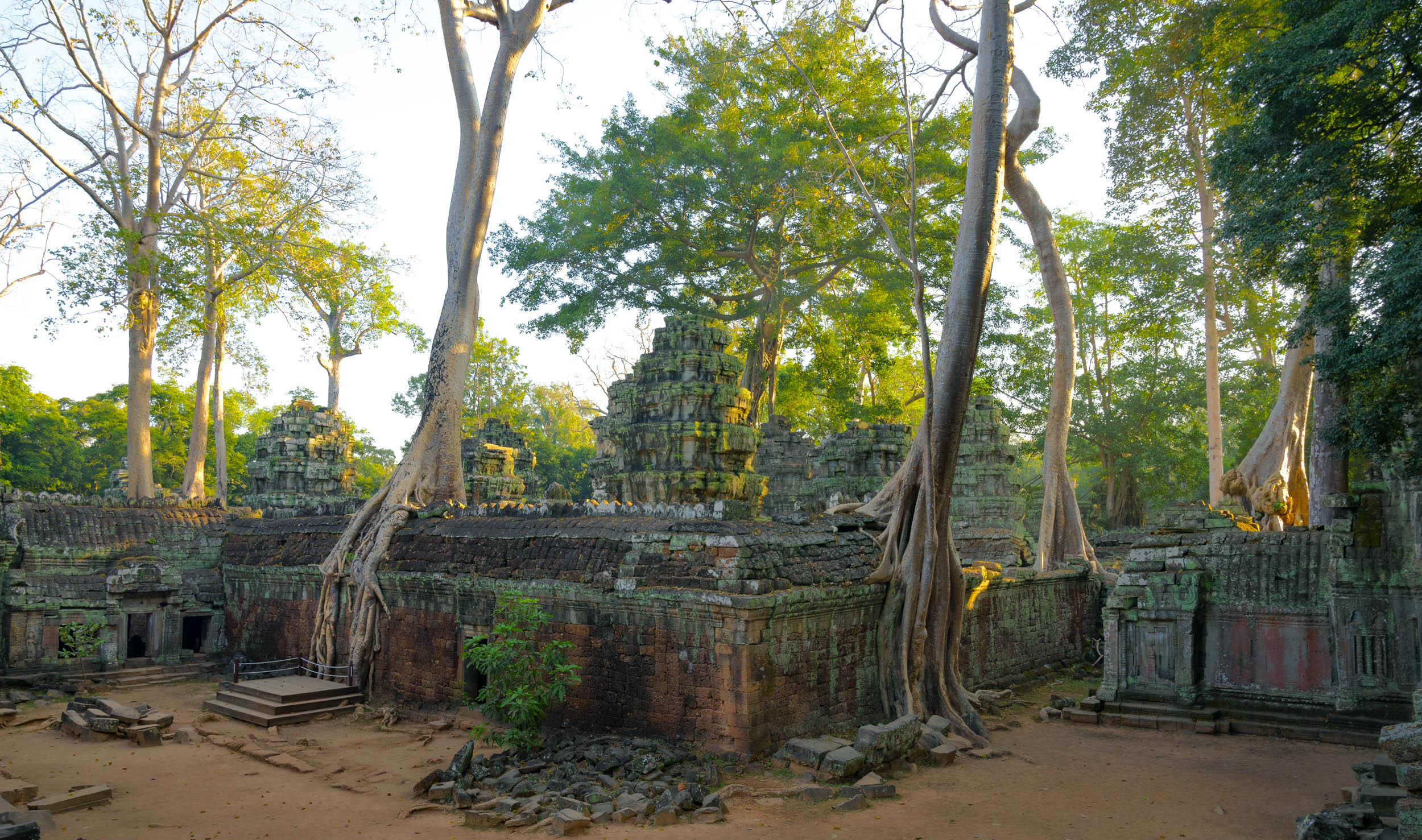
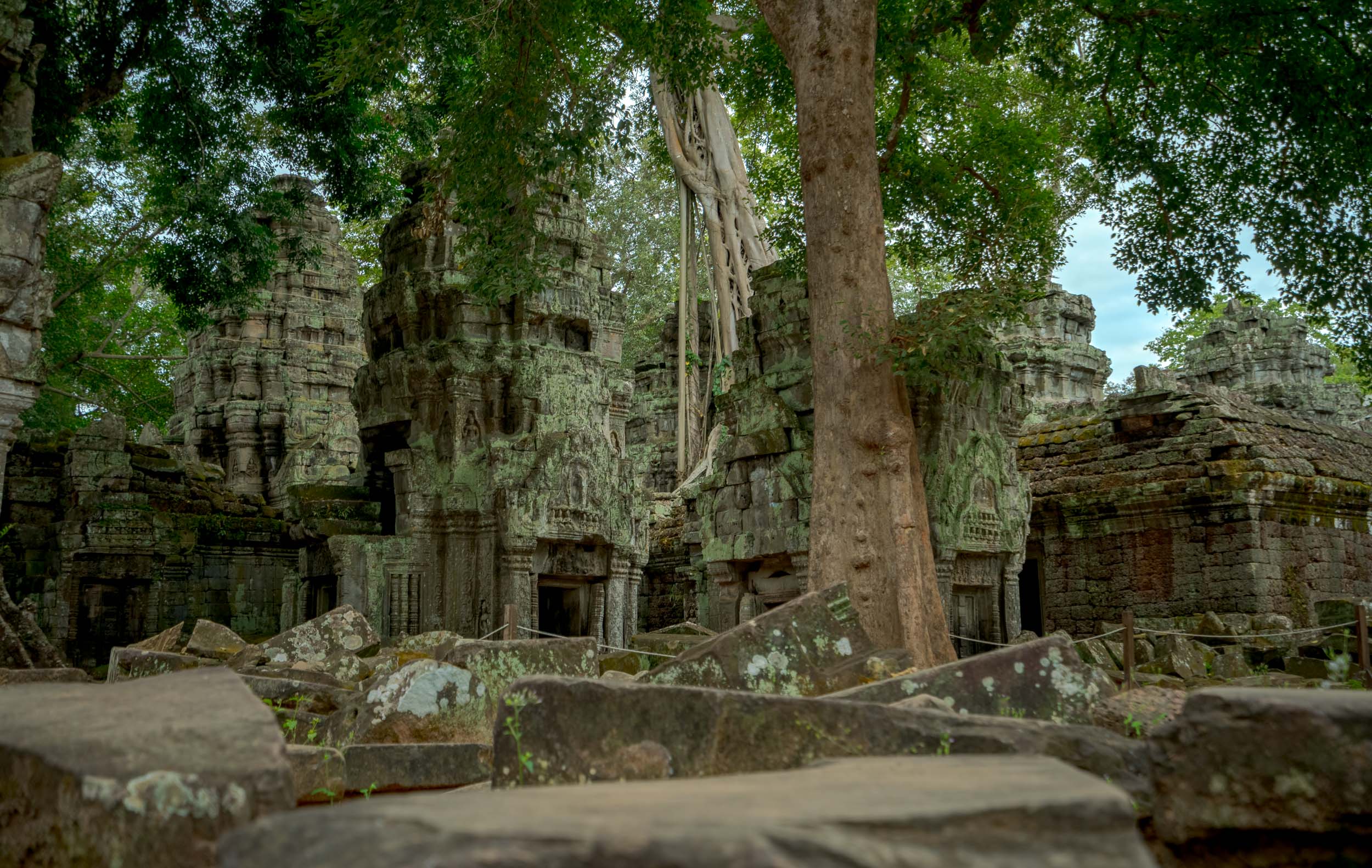
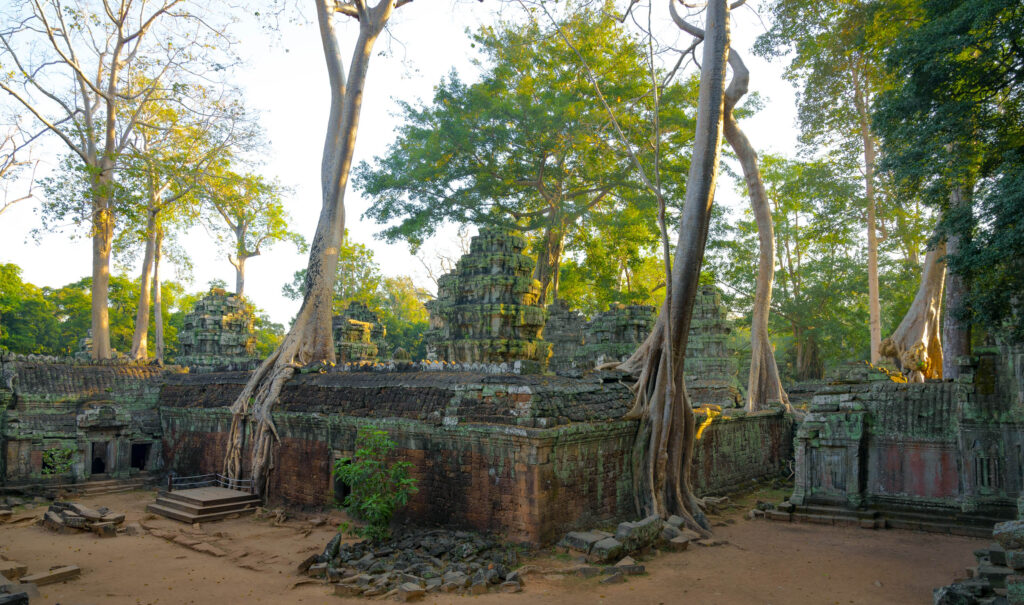
Ta Prohm, where huge trees and their roots have grown around the temple ruins, creating one of Angkor’s most distinctive landscapes.
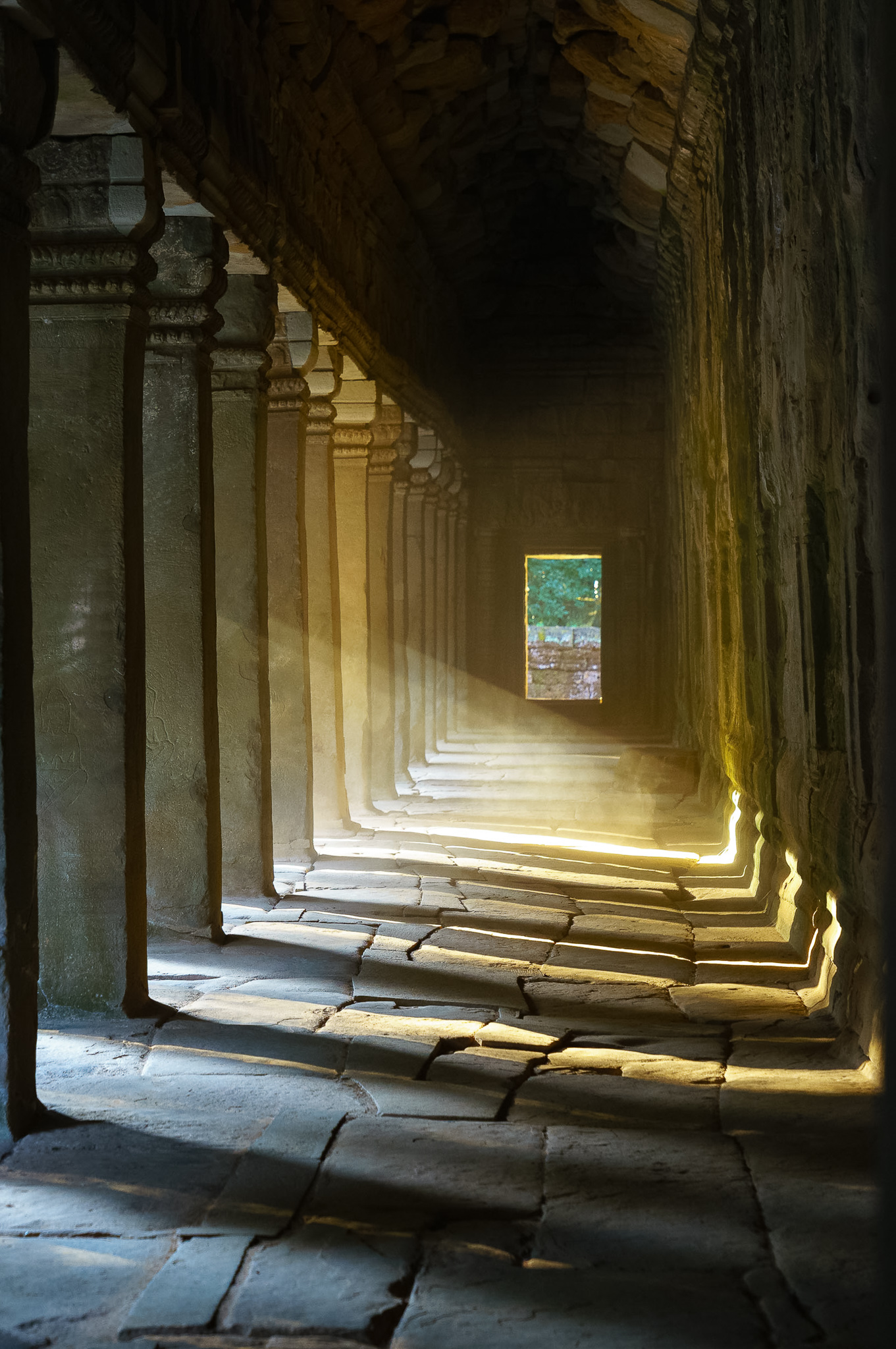
A shadowed gallery inside Ta Prohm, with sunlight filtering through the repeating stone doorways.
Ta Prohm is my favorite temple in the whole park. It’s the one where giant trees have grown straight through the stone, roots wrapping over doorways and pulling apart entire galleries, and pictures genuinely don’t prepare you for how it feels standing in front of it.
The trick is timing. Almost everyone heads straight to Angkor Wat for sunrise, which means Ta Prohm can sit almost empty in those same early hours. If you get there early, before the tour groups finish up at Angkor Wat and Bayon and start working their way over, you can find yourself walking through entire sections of the temple with barely anyone else around. It’s a completely different experience from arriving mid-morning, when the same corridors are filled with people lining up for photos at the main root formations.
Built in the late 12th century and left largely unrestored, Ta Prohm is more of a maze than Angkor Wat’s structured layout, with narrow passages and collapsed chambers, so following the marked path through is the easiest way to see it properly without doubling back on yourself. The most photographed spot is the tree over the southern gallery wall near the eastern entrance, but honestly, some of the quieter corners further into the temple are just as impressive and far less crowded.
If Ta Prohm is high on your list, it’s worth building your morning around it rather than treating it as the last stop on the way out.
Explore our complete Ta Prohm guide, with our photography, history, favourite parts of the temple and first-hand tips from years of visiting across different seasons.
The Small Circuit doesn't mean visiting every temple
One thing that can be confusing when planning an Angkor trip is that following the Small Circuit does not necessarily mean stopping at every temple along it.
There are many archaeological sites on the route, but trying to explore all of them properly in a single day would make for a very long and tiring visit. Most standard tours therefore concentrate on the major highlights, with additional stops depending on the visitor’s interests, available time and energy.
The “big three” — Angkor Wat, Bayon and Ta Prohm — dominate most Small Circuit itineraries. For a first visit, that makes sense. Each is substantially different: Angkor Wat provides the monumental scale and famous towers; Bayon is known for its enormous stone faces and its position at the centre of Angkor Thom; and Ta Prohm offers the atmospheric combination of temple ruins, jungle and enormous tree roots that many visitors associate with Angkor.
Between these major sites are several monuments that are easy to add if you have the time. Baphuon and the terraces are natural additions while exploring Angkor Thom, while temples such as Ta Keo, Ta Nei, Thommanon and Chau Say Tevoda can be included selectively rather than treating every stop as compulsory.
This is why two people can both say they completed the Small Circuit while having visited quite different combinations of temples.
What to Expect
The Small Circuit contains the highest concentration of Angkor’s famous sights, which also makes it the busiest temple route in the archaeological park. Crowd levels vary enormously throughout the day, and the major temples can feel completely different depending on when you arrive.
Many organised tours follow broadly similar schedules, particularly after sunrise, so there can be periods when large numbers of visitors move between the same temples at roughly the same time. Between around 9:00 AM and 2:00 PM, the main Small Circuit temples are generally at their busiest.
If seeing the temples with fewer people around matters to you, the order in which you visit them can be almost as important as how early you start. Most visitors starting before dawn head directly to Angkor Wat for sunrise. As a result, while thousands of people can be gathered around Angkor Wat, some of the other temples on the Small Circuit can be remarkably quiet.
Most of these temples officially open early in the morning, and in practice you can sometimes enter a little before the stated opening time. Heading directly to Angkor Thom or one of the eastern temples instead of Angkor Wat can give you a short window when you may have major sites almost entirely to yourself.
Pro tip: Bayon is particularly worth considering early in the morning. Even if the inner temple is not yet open when you arrive, you can still get excellent views from outside. With most early visitors still at Angkor Wat for sunrise, the area around Bayon can be exceptionally quiet — sometimes you may have the view almost entirely to yourself.
Once the Angkor Wat sunrise crowds begin moving on to Angkor Thom and the rest of the Small Circuit, this changes quickly. If sunrise at Angkor Wat isn’t essential to you, using those first hours elsewhere is one of the best opportunities to experience the major temples without the usual crowds.
2. The Angkor Wat Grand Circuit (~26 km Loop)
Best For: 3-day ticket holders, photography enthusiasts, and travelers looking for wider spaces with fewer tour groups.
Full circuit: Angkor Wat → South Gate → Angkor Thom (Bayon, Baphuon, Terrace of the Elephants, Terrace of the Leper King, Suor Prat / Twelve Towers) → Victory Gate → Chau Say Tevoda → Thommanon → Ta Keo → Ta Nei → Ta Prohm → Banteay Kdei.
Why don't tour drivers take you to every single stop on the full circuit?
While the full circuit list shows every minor temple along the road, the reality is that temple fatigue and heat exhaustion hit fast.
After spending hours climbing steep stone steps, walking through massive complexes, and dealing with intense tropical humidity, most visitors are completely exhausted after seeing the main big three (Angkor Wat, Bayon, and Ta Prohm). Drivers streamline the route to focus on the absolute best highlights so you don’t burn out before midday.
If you do want to visit the smaller stops like Ta Nei, Chau Say Tevoda, or Banteay Kdei, simply ask your driver in advance – just be prepared for extra walking!
What to Expect
Lower Crowd Density: Because giant tour coaches rarely cover the entire outer loop in a single morning, you’ll find far more room to walk and explore quietly.
Ideal Afternoon Timing: The long covered corridors of Preah Khan and the shaded boardwalk across the lake to Neak Pean offer great natural canopy cover when the afternoon sun is at its hottest.
Preak kahn, nek puon, krol ko, ta som, east mebon, preah rup.
Summary Comparison: Which Circuit Should You Choose?
Feature
The Small Circuit
The Grand Circuit
Total Loop Distance
~17 km
~26 km
Average Time Needed
5 – 7 hours
5 – 6 hours
Main Highlights
Angkor Wat, Bayon & Ta Prohm
Preah Khan, Neak Pean & Ta Som
Crowd Levels
High (Peak tour group density)
Moderate to Low
Pacing
High-energy, iconic sights
Relaxed, atmospheric, spread out
Do You Need a Guide at Angkor Wat?
A driver gets you to the temples. A guide explains what you’re looking at once you’re there. It’s worth understanding the difference, because many visitors book a tuk-tuk or car for the day and assume that covers everything, then spend Angkor Wat walking past hundreds of metres of carved sandstone without knowing what any of it depicts.
Licensed temple guides have been trained and tested on Angkor’s history, mythology and individual temples. That’s different from having a driver who also offers to “guide” you. Some drivers know the temples extremely well, but if understanding the history is important to you, we recommend booking a proper licensed guide.
An English-speaking guide booked directly generally costs around $40–50 for a day, although prices can be higher for other languages or guides with specialist knowledge. If you book through a tour company, expect to pay a little more. You’re not only paying for the guide’s time, but also for the operator to select a good guide, organise the itinerary, coordinate the day and be there to sort things out if plans change.
You can also find guides offering their services at the Angkor Wat entrance, although you have no way of knowing much about the individual guide beforehand. We filmed a short example of this happening as we walked into Angkor Wat.
Quality also varies considerably between guides. A licence tells you that someone is qualified, but it doesn’t necessarily tell you whether they’re a great storyteller or genuinely passionate about the temples. At Connect Cambodia, we work with guides we know and trust, chosen for their knowledge, personality and feedback from previous guests.
Where a Guide Makes the Biggest Difference
Angkor Wat itself has an enormous amount that is easy to miss. Its outer galleries are covered in bas-reliefs depicting specific stories from Hindu mythology, including the famous Churning of the Ocean of Milk. Without someone explaining what you’re seeing, it’s very easy to walk straight past them on the way to the central towers.
Sandstone bas-relief carving of figures at Angkor Wat, Cambodia
The same applies elsewhere. At Bayon, a guide can explain the enormous stone faces and the remarkable scenes of everyday Khmer life carved into the galleries. At Banteay Srei, much of the appeal is in the extraordinary detail and symbolism of its carvings.
Bayon temple stone face in the distance
Ta Prohm is another temple where we think having a guide is particularly useful. It’s surprisingly maze-like, with narrow passages, collapsed sections and several routes through the complex. A good guide doesn’t just explain its history. They know how to take you through the temple efficiently, show you the most interesting corners and help you avoid spending twenty minutes trying to work out how to get back to where you started.
Ta Prohm is like a maze
Is a Guide Worth It at Angkor Wat?
If you’re travelling solo or as a couple, mainly want the classic views, photography and experience of exploring the temples, a good driver and a little preparation can be perfectly sufficient.
If you’re visiting with family, want to understand the history and mythology behind what you’re seeing, or this is likely to be your only visit to Angkor, we think a private guide is one of the better places to spend some of your budget.
There’s also a big difference between a private guide and a group tour. A guide leading twenty people has to move at the group’s pace and can’t tailor the experience to your interests. With a private guide, you can spend longer on the things that interest you, skip what doesn’t, ask questions as you go and adjust the route throughout the day.
Our recommendation: if your budget allows it, book a private guide for your main Angkor day. If you prefer exploring independently, don’t feel that you need one for every temple. A knowledgeable driver combined with the information in this guide can still give you an excellent Angkor experience.
Angkor Wat Photography: Essential Spots, Timing & Gear
Photographing the temples of Angkor ranges from dramatic sunrise silhouettes to intricate stone carvings hidden inside shaded galleries. Because the park spans hundreds of square kilometers under intense tropical light, a few practical adjustments will dramatically improve your shots.
The Best Times for Light
Dawn & Sunrise (5:30 AM – 7:00 AM): The classic sunrise shot faces east toward Angkor Wat’s main towers, casting the complex in silhouette against the dawn sky.
Late Afternoon Golden Hour (4:00 PM – 5:30 PM): Warm, low-angle light directly illuminates the western facades of Angkor Wat and the iconic face-towers at Bayon, creating rich contrast across the stone bas-reliefs.
Midday Harsh Light (11:00 AM – 2:00 PM): Avoid open-air landscapes under the harsh overhead sun. Use these hours to shoot inside covered corridors like Ta Prohm or Preah Khan, where tree canopies filter the light through ancient stone doorways.
Crucial Park Rules & Camera Etiquette
Strict No-Drone Policy: Drones are strictly prohibited across the entire Angkor Archaeological Park without specialized government permits. Park rangers actively enforce this.
Tripods & Monopods: Lightweight tripods are permitted for sunrise at the main reflection ponds, but they can be cumbersome and difficult to use inside narrow interior corridors.
Gear Protection: High humidity and sudden tropical downpours are common. Keep silica gel packets in your camera bag and carry a compact rain sleeve.
Monks & Locals: Always ask permission before taking close-up portraits of monks or local residents.
monks at angkor wat temple at sunrise in golden morning light
Can I take pictures of monks?
Always ask permission before taking close-up portraits of Buddhist monks. Maintain a respectful distance, avoid physical contact (women should strictly avoid touching monks or their robes), and step back if they are in prayer or meditation. If you have a guide with you, you should ask your guide to ask them politely.
Looking for more photography tips?
For advanced gear recommendations and deep-dive lighting breakdowns, see the specialized temple photography guides by Siem Reap Photographer.
Professional Temple Photoshoots & Dress Rentals
If you want to be in the frame, whether for couples’ portraits, pre-wedding sessions, or traditional Cambodian silk attire, hiring a local Angkor Wat photographer means you can focus on the experience rather than managing camera settings and logistics.
Traditional Khmer Costume Styling: Local shops near the park offer rental packages featuring authentic silk garments, traditional jewelry, hair styling, and makeup fitting before heading to the temples.
Navigating Crowds for Portraits: Professional photographers who shoot in the park daily know the exact quiet outer galleries, reflection pond viewpoints, and lesser-known library arches at Angkor Wat that remain clear of tour groups.
Best Timing for Sessions: Booking an early 6:00 AM or 6:30 AM slot immediately following sunrise provides soft directional light, comfortable temperatures, and empty stone pathways.
Couple on a Photoshoot at the northern library of Angkor Wat
On-Site Freelance Photographers: What to Expect
Local photographer taking photos on the main causeway at Angkor Wat. Watch our short video showing a typical on-the-spot photoshoot.
As you enter Angkor Wat or walk along the causeway, local freelance photographers will likely approach offering on-the-spot photoshoots, often pitched as “$1 per photo.”
How It Works: They walk with you through 3–4 classic spots, direct you into fast, recognizable poses, and display the shots on their camera screen for you to select which ones you want.
The Reality:
Unedited JPEGs: You receive raw, unedited camera files directly transferred to your phone via a Wi-Fi card adapter or cable.
Cookie-Cutter Poses: Because they handle dozens of tourists daily, the poses and angles are standardized and fast-paced rather than tailored to your style.
Hidden Cost Squeeze: While pitched at “$1 a photo,” taking 20–30 quick shots can add up quickly without professional post-processing or color grading.
Local freelance photographer at Angkor Wat
The Verdict: If you just want a quick, fun souvenir shot without carrying a tripod, it’s a cheap and accessible option. However, if you want a dedicated photographer and a photoshoot planned in advance, see our Angkor Wat Photography & Photoshoots page for options, pricing and practical information.
Tourist admiring Apsara dancer carvings captured by a professional Angkor Wat photographer
Comparing Angkor Wat Photography Options?
Photography at Angkor Wat ranges from $1 on-the-spot photos to pre-booked professional photoshoots. Our guide compares the different price and service levels, what you get for your money, and which option might suit your visit.
A photoshoot portrait capturing traditional Cambodian dress inside the historic stone pillar galleries of Angkor Wat.
Planning a Traditional Dress Session?
If you want to capture timeless portraits wearing authentic Khmer silk attire at the temples, see traditional costume styling and booking details at Angkor Wat Photographer
Renting Traditional Khmer Outfits: What to Know
Renting traditional silk garments, jewelry, and accessories for an Angkor Wat photoshoot is a fantastic way to immerse yourself in Cambodian culture. However, trying to arrange this independently on the street comes with several unexpected headaches for international travelers:
Language Barriers & Unclear Pricing: Most local dress shops near the park or around town cater exclusively to domestic visitors. Staff rarely speak fluent English, making it hard to communicate preferences, and pricing is seldom posted clearly—leading to surprise costs or awkward negotiations.
Inconsistent Quality & Hygiene: Without a trusted recommendation, you can’t verify if garments are thoroughly cleaned between rentals, or if the jewelry and accessories provided are in good condition.
Unpredictable Shop Hours: Many small local businesses operate on flexible, informal schedules. Owners routinely close up shop without warning to attend family events, errands, or local holidays—meaning a shop you planned to visit at 6:00 AM might simply be locked shut.
Sizing & Selection Issues: Independent walk-ins often find limited inventory in international sizes, leaving you with few options that fit comfortably for a long day in the heat.
A Hassle-Free Solution:
Rather than gambling on random roadside shops in the morning dark, a great solution is to book through a specialized photoshoot service like Angkor Wat Photographer. They partner with clean, professional fitting studios to handle costume rentals, authentic Khmer silk styling, and seamless logistics directly to the temples.
Family wearing traditional Khmer clothing near the Southern Library at Angkor Wat, Cambodia
Traditional Clothes Rental Shop Near Angkor Wat, Siem Reap
Planning a Traditional Dress Session?
If you want to capture timeless portraits wearing authentic Khmer silk attire at the temples, see traditional costume styling and booking details at Angkor Wat Photographer
A couple exploring the quiet outer galleries of Angkor Wat, styled in authentic Khmer silk garments and gold jewelry.
Early morning and late afternoon generally provide the most attractive light, but the best time depends on the temple and the particular side or feature you want to photograph.
Cambodia’s location near the equator also means the sun rises and sets almost vertically, so the soft golden light doesn’t linger the way it does at higher latitudes. Where a European sunrise might give you an hour of good light, in Siem Reap you often have twenty to thirty minutes before the sun climbs and the light turns harsh.
Some temples benefit from low morning light, while others photograph better later in the day when the sun reaches their most interesting façades, corridors and carvings. Forest-covered temples can behave differently again, with changing patches of light creating opportunities throughout the day.
In a normal visitors timeframe it’s difficult to visit every temple early, so it is worth planning the order of your day around the direction and quality of the light.
Photographer holding a camera up to capture moss-covered devata carvings at Ta Nei temple in Siem Reap
Avoiding Crowds
Crowds are one of the biggest challenges when photographing Angkor, particularly at Angkor Wat, Bayon and Ta Prohm.
Timing helps, but arriving early is not always enough. Tour groups tend to move through the temples in predictable patterns, and sometimes waiting a few minutes, using a quieter entrance or approaching a temple in a different order can produce a better photographs and a better experience overall.
I also recommend allowing more time than a normal sightseeing itinerary. Having the freedom to wait for a group to pass or for somebody to leave your composition is often more useful than trying to rush between as many temples as possible.
Photographer taking a framed photo of a monk walking through a stone doorway at Ta Prohm temple
Planning a Photography Route
photography-focused day should be planned differently from a conventional temple tour.
Instead of following the most efficient geographical route, consider where the sun will be, which locations become crowded at particular times, and how long you are likely to spend working at each temple.
For photographers, it can often be better to visit fewer temples and explore them properly. Spending extra time walking around a temple, returning to a composition when the light changes, or waiting for a quiet moment usually produces better results than trying to photograph every major site in a single day.
Devata carving at Ta Nei Temple
Avoiding Crowds: Routing your day using quiet back entrances, secondary gateways, and reverse-circuit timing to keep your shots free of large tour groups.
Maximizing the Light: Planning arrival times so low-angle morning and afternoon light hits the facades of Bayon, Ta Prohm, and Angkor Wat at the ideal composition angles.
Setting Your Own Pace: Spending extra time working a single angle, frame, or interior gallery without being rushed by a fixed group schedule.
Private Angkor Photography Tours
For photographers who want more help on the ground, a private photography-focused Angkor tour can be planned around photography rather than a fixed sightseeing schedule.
The route can take into account the type of images you want to create, the position of the sun, expected crowd patterns and the amount of time you want to spend at each location.
This is particularly useful if you have limited time in Siem Reap and want to concentrate on the strongest photography opportunities.
Photographer captures a monk at Bakong temple
Located outside the primary park loop, Bakong is the largest temple in the Roluos Group and is fully included in your standard Angkor Pass. Built in the 9th century, its massive five-tiered sandstone pyramid offers incredible scale and geometric symmetry for photography without the massive crowds seen at central Angkor.
Photographing Angkor Independently
You certainly don’t need a photography tour to photograph Angkor successfully. With some advance planning, independent photographers can build their own route around the temples and spend as much time as they want at each location.
For a deeper dive, the Siem Reap Photographer Guide to Photography at Angkor covers locations, timing and other practical considerations for planning your own shoot
Photographing the temples of Angkor to a high standard requires some planning. Light changes quickly, crowds can transform a scene within minutes, and the direction each temple faces has a major effect on when it photographs best.
A standard sightseeing itinerary is not always a good photography itinerary. If photography is one of the main reasons for your visit, planning your route around light, timing and crowd patterns can make a considerable difference.
Almost everyone visits Angkor to see the famous Angkor Wat sunrise, and as a result the crowds gather there, then follow the same well-worn route on to Angkor Thom, Bayon, Ta Prohm and the lesser-known temples along the way. With a bit of local knowledge and a clear idea of what pictures you want to come home with, you can avoid the crowds and catch the best light.
Photographer capturing a monk in front of Bayon temple
Angkor Wat Frequently Asked Questions
How much does it cost to visit Angkor Wat?
You need an Angkor Pass to visit Angkor Wat and the other temples within Angkor Archaeological Park. One-day, three-day and seven-day passes are available. If you are only visiting the main temples, a one-day pass may be enough, while a three-day pass is a good choice if you want to explore Angkor at a more relaxed pace.
Angkor Wat opens earlier than most of the other temples at Angkor, allowing visitors to enter before sunrise. Opening times can change, so check the current information before your visit, particularly if you are planning an early start.
What time should I arrive at Angkor Wat for sunrise?
Aim to arrive at the entrance well before sunrise. This gives you enough time to walk through the entrance and choose your position before the sky begins to brighten. The busiest reflection-pool positions fill first, although there are several quieter places around Angkor Wat where you can watch and photograph sunrise.
How long do you need to visit Angkor Wat?
Allow around two to three hours to explore Angkor Wat properly, although you can easily spend longer if you are interested in its architecture, bas-reliefs or photography. If you are visiting for sunrise, your total time at the temple will usually be longer.
What is the best time of year to visit Angkor Wat?
Angkor Wat can be visited throughout the year. November to February generally brings cooler and drier weather, but it is also the busiest period. The green season brings higher humidity and occasional heavy rain, but the landscape becomes lush and the temples can be considerably quieter.
Can you visit Angkor Wat without a guide?
Yes. You do not need a guide to visit Angkor Wat, and independent visitors can explore the temple and archaeological park themselves. However, a licensed guide can add considerable context to the carvings, architecture, history and religious symbolism that are otherwise easy to walk past without understanding.
What should I wear to Angkor Wat?
Wear comfortable, lightweight clothing suitable for Cambodia’s heat, but remember that Angkor Wat remains an active religious site. Shoulders and knees should be covered when entering important sacred areas, particularly the upper Bakan sanctuary. Comfortable shoes are also strongly recommended because you will do a lot of walking.
Can you buy Angkor Wat tickets at the entrance?
There are ticket machines at Angkor Parvis beside Angkor Wat, while standard Angkor Passes can also be purchased from the main Angkor ticket office or online. The conditions attached to different ticket options can vary, so check the current ticket information before deciding where to buy.
Is one day enough for Angkor Wat?
One day is enough to see Angkor Wat and several of the major temples, particularly if you follow the Small Circuit. However, it will be a fairly full day. If you want to explore more slowly, photograph the temples at different times of day or visit temples farther from the main circuit, a three-day Angkor Pass gives you much more flexibility.
Is Angkor Wat wheelchair accessible?
Parts of Angkor Wat can be visited by wheelchair, but the temple is not fully accessible. There are uneven surfaces, steps and elevated sections, and the upper Bakan sanctuary requires climbing a very steep staircase. With suitable transport and assistance, however, visitors with limited mobility can still experience significant parts of Angkor Wat and several other temples within the archaeological park.
Accessible toilets and wheelchair ramps are available at several locations around Angkor Archaeological Park, although facilities and ease of access vary by location.
See our Angkor Wat wheelchair and accessibility guide for detailed information on accessible routes, toilets, ramps, difficult areas and planning your visit.
Can you take photos at Angkor Wat?
Yes. Personal photography is allowed throughout most of Angkor Wat, and the temple is one of Cambodia’s best-known photography locations. Be respectful around monks, ceremonies and worshippers, and follow any restrictions displayed within particular areas of the temple.
What is the difference between the Small Circuit and Grand Circuit?
The Small Circuit covers many of Angkor’s most famous temples, including Angkor Wat, Angkor Thom, Bayon and Ta Prohm, making it the usual choice for a first day. The Grand Circuit travels farther through the archaeological park and includes additional temples such as Preah Khan, Neak Pean, Ta Som, East Mebon and Pre Rup. If you have several days at Angkor, the two circuits work very well together.
Can children visit Angkor Wat?
Yes. Children can visit Angkor Wat and most areas of the temple complex. However, children under 12 are not permitted to climb to the Bakan, the upper level of Angkor Wat. Families should also be prepared for heat, uneven surfaces and a considerable amount of walking.
Are there toilets at Angkor Wat?
Yes. There are public toilets within the Angkor Wat complex, near the pagoda, although they are a bit of a walk from the main temple. There are also toilets at various locations around Angkor Archaeological Park. Most now have some level of accessible facilities, although accessibility varies by location.
Continue exploring Angkor
Angkor is much more than just Angkor Wat. Our Angkor temple guides are based on repeated visits and first hand experience, with practical advice on when to go, what to look for and which temples are worth including in your itinerary. Explore more of our guides below, or visit our complete Angkor Wat guide to start planning your time at Angkor.
Bayon is one of Angkor’s most remarkable temples, famous for its enormous stone faces and maze of carved galleries. We recommend visiting early, when the temple is quieter and the soft morning light brings the faces to life.
Ta Prohm is famous for its enormous trees growing through the ruins, but there is much more to explore beyond the best-known viewpoints. We recommend visiting early, when its corridors and courtyards are quieter and the temple is at its most atmospheric.
Visit Angkor Thom South Gate, the monumental entrance to the ancient city. Learn what to look for, when to visit, how to avoid the busiest times, and where to find the best views and photographs.
Baphuon is one of Angkor Thom’s most impressive temple mountains, with a long raised causeway, steep upper terraces and an enormous reclining Buddha. We recommend allowing time to climb and explore its remarkable architecture and restoration story.
We recommend Banteay Kdei for its atmospheric corridors, detailed carvings and quieter feel compared with nearby Ta Prohm. Visit early and you can often explore some of its most beautiful sections with very few other people around.
One of our favourite smaller temples at Angkor, Ta Nei is peaceful, atmospheric and still receives relatively few visitors. We recommend it for travellers who want to step beyond the standard temple circuit.
More Coming Soon!
Watch this space for more useful information about the Angkor Archaeological Park.